


No products added!
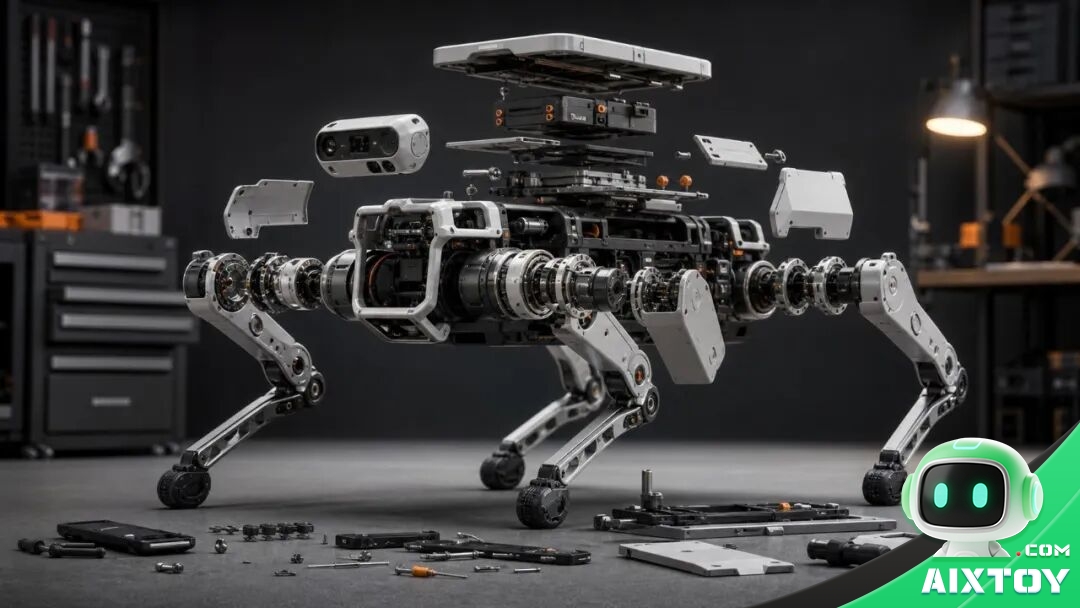
Black Panther X is a quadruped robot that encourages you to take it apart. Chinese robotics company MirrorMe has unveiled its modular open quadruped platform, built from more than 200 functional components with 12 independently replaceable joints — and the interfaces, terminals and code are open to developers, with expansion space reserved for third-party sensors and payloads.
A Robot Designed to Be Opened
Most quadruped robots ship as a sealed machine you are not supposed to open. Black Panther X takes the opposite approach. MirrorMe positions it as a modular quadruped built from standardized modules with unified interfaces — the company says assembly requires no special tools — and an open perception head plus an expansion dock provide physical entry points for cameras, LiDAR and other payloads.
This is not merely an “easier to repair” design decision. The technical significance is that failures, upgrades and secondary development are split into smaller units. A developer does not need to redesign the whole machine to replace a joint or add a sensor, and the robot’s software and hardware boundaries are no longer treated as an untouchable black box.
That said, “200+ components” by itself does not equal openness. Whether components are easy to identify and source, whether interface specifications stay stable, and whether third-party modules can be integrated without breaking reliability — these are what determine whether modularity is real engineering capability or just an exploded diagram.
Specifications Beyond the 4 m/s
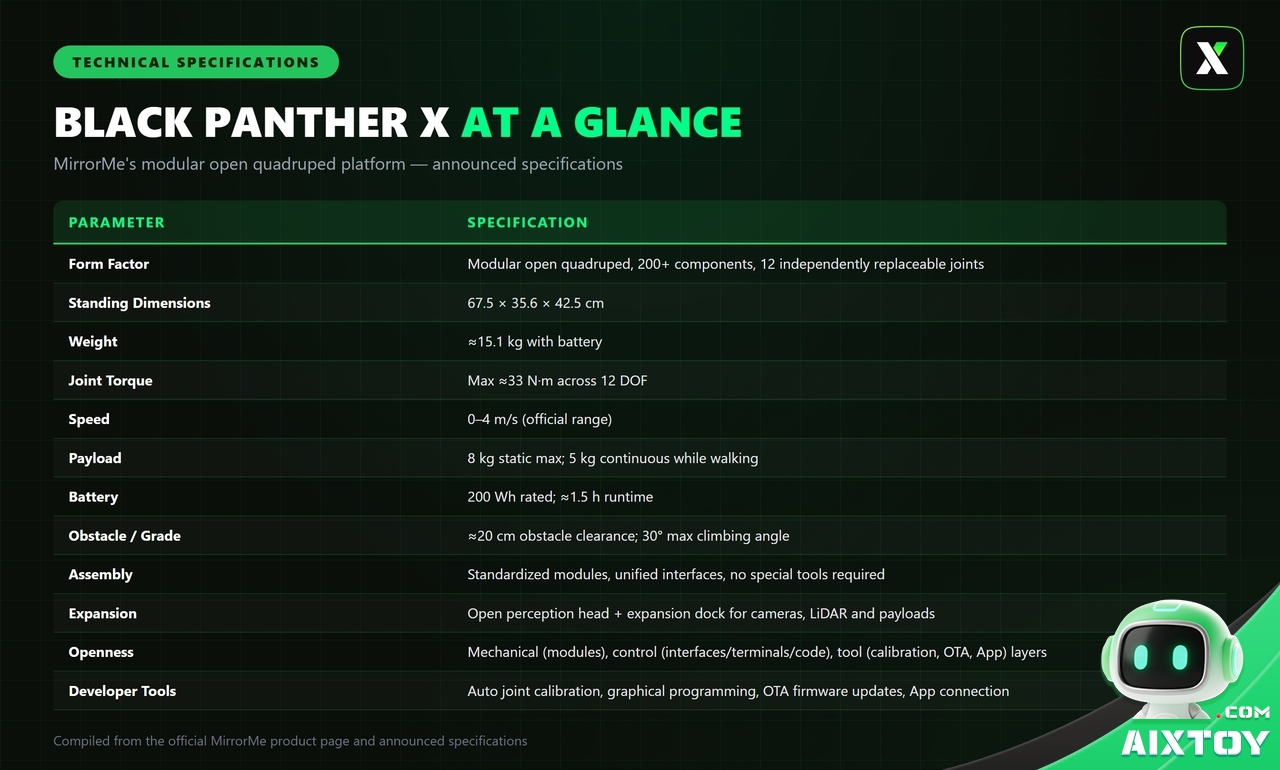
Black Panther X stands 67.5 × 35.6 × 42.5 cm and weighs about 15.1 kg with battery. Its 12 degrees of freedom deliver a maximum joint torque of about 33 N·m, with an official speed range of 0–4 m/s. Static maximum payload is 8 kg, dropping to 5 kg for continuous walking.
Power comes from a 200 Wh battery with an official runtime of about 1.5 hours. The platform clears obstacles of about 20 cm and climbs grades up to 30°. These numbers sketch a medium-sized platform aimed at development, inspection and experimental validation — no single metric (speed, payload or endurance) dominates the design.
Specifications are only a starting point, of course. Top laboratory speed cannot guarantee sustained stability on complex terrain, and a rated payload does not replace testing for center-of-gravity shifts, impacts and long thermal loads. For an open platform, the question worth continuous verification is whether control performance stays consistent once users attach different sensors and payloads.
Three Layers of Openness
MirrorMe has signaled openness on three levels:
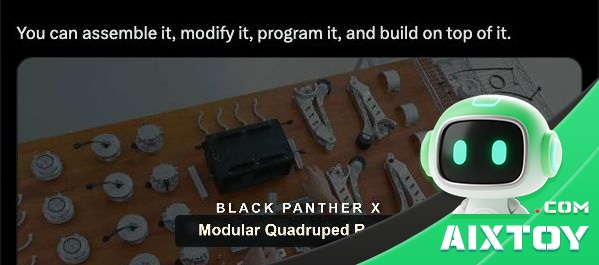
- Mechanical layer — joints, perception head and expansion dock use modular designs that can be disassembled and replaced.
- Control layer — interfaces, terminals and code are officially open, allowing custom gaits and control logic.
- Tool layer — automatic joint calibration, graphical programming, OTA firmware updates and an App connection are supported.
All three layers must exist together for developers to move from “calling the manufacturer’s pre-programmed actions” to “changing how the robot acts.” Mechanical interfaces give new hardware a place to mount; control interfaces let new hardware participate in decisions; calibration and upgrade tools lower the cost of iteration.
MirrorMe has not yet fully disclosed code licensing scope, repository openness, interface version compatibility policy, third-party module certification or spare-part supply. The accurate statement, therefore, is that Black Panther X demonstrates a product structure for an open platform — but whether the open ecosystem is mature will be proven by documentation quality, long-term maintenance and real developer projects.
Modularity Moves Competition to Development Speed
Competition between closed machines usually revolves around speed, payload, endurance and price. Platform products must answer another set of questions: how long from unboxing to the first custom task, how quickly the hardware recovers after damage, whether algorithms and payloads migrate to the next generation, and whether community-built results can be reused.
If these costs are low enough, Black Panther X’s value goes beyond its out-of-the-box capabilities. Universities can use it for control and embodied-AI research; integrators can design payloads around inspection, surveying or environmental sensing; and developers can contain a failure within a single module instead of risking a whole-machine redesign.
Conversely, if parts are hard to obtain, interfaces change frequently, or the open code cannot support low-level control, the complexity of modularity gets passed to the user. An open platform does not automatically lower the barrier — it hands over part of the system-design authority, along with some integration responsibility, that the manufacturer previously carried alone.
Taking It Apart Is Only the First Step
The most interesting thing about Black Panther X is not that another robot dog reached 4 m/s — it is that MirrorMe explicitly encourages users to open it, modify it and build on top of it. That product philosophy pushes the quadruped from “capability showcase” toward “engineering infrastructure.”
But the platform’s success will not be decided by launch-day specifications. Stable interfaces, auditable code, continuously supplied modules and enough third-party practice are what turn an openness announcement into a sustainable ecosystem.
MirrorMe currently offers a procurement inquiry email but has not published pricing, inventory or delivery commitments for specific regions such as the United States. For teams looking to buy or deploy, the most reliable next step right now is to confirm delivery scope, development materials and after-sales support directly with the company.
Sources: MirrorMe — Black Panther X specifications and open capabilities · ErenChenAI on X — modular open platform introduction
Why This Matters for AI Toys and Robotics
Black Panther X sits at an interesting junction: consumer-friendly robotics and developer-grade openness. At AIXTOY, we cover the full spectrum — from desktop companion robots and programmable STEM robots to open-source development boards for makers. If you are weighing which platform fits your project, our robot toy buying guides and industry analysis are good places to start.
Tags:Black Panther XMirrorMeModular RobotQuadruped RobotOpen SourceProgrammable RobotRoboticsRobot NewsAI Robot Toy