


No products added!
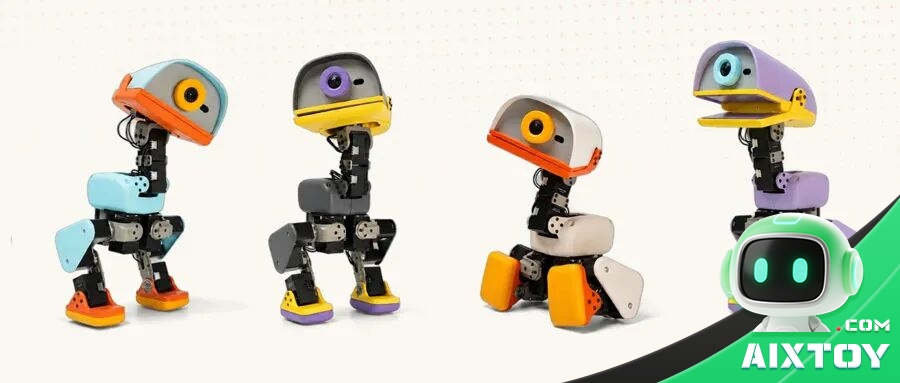
Hugging Face has opened pre-orders for Microduck, a duck-shaped open-source robot priced at $399 (about ¥2,681). Open-source, trainable, able to kick a ball and roller-skate out of the box — the company is betting this tiny companion can democratize physical AI.
Welcome to the Era of Affordable Open-Source Robots
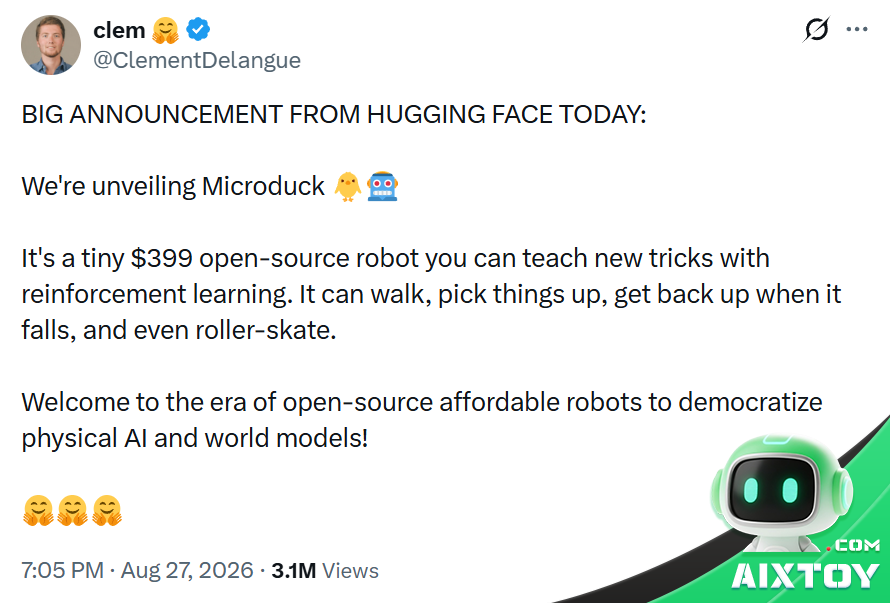
On August 27, Hugging Face unveiled Microduck, its second robot. “Welcome to the era of open-source and affordable robots,” wrote co-founder and CEO Clem Delangue on X, “to democratize physical intelligence and world models for everyone.” The company’s first robot, the desktop humanoid Reachy Mini — developed after Hugging Face acquired French startup Pollen Robotics last year — has reportedly sold around 10,000 units to date.
A Duck That Stands, Walks, Kicks and Roller-Skates
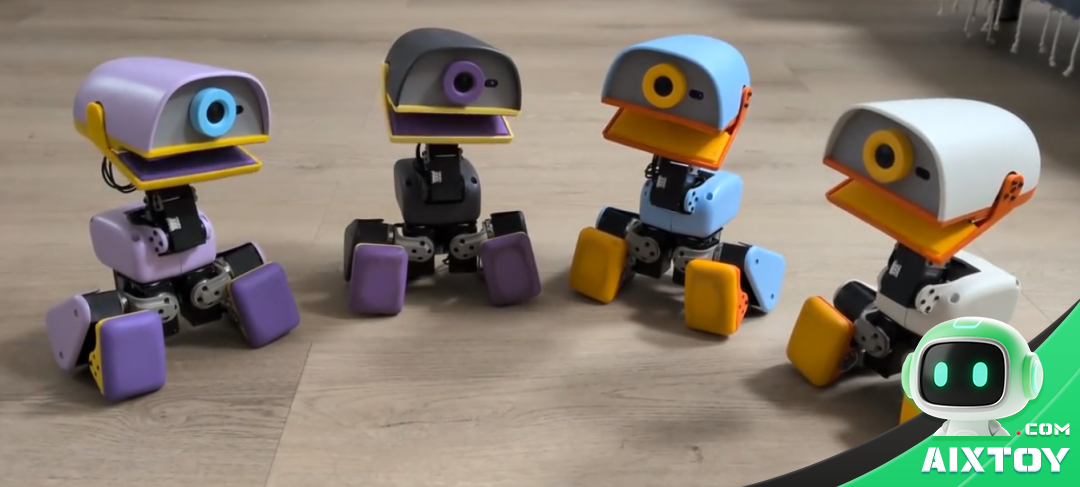
Microduck comes in four colorways and is shaped like a duck with two legs — and it can switch to a wheeled form. Its articulated beak opens and closes to pick up lightweight objects, and a single front camera gives it one eye (there is no stereo vision).
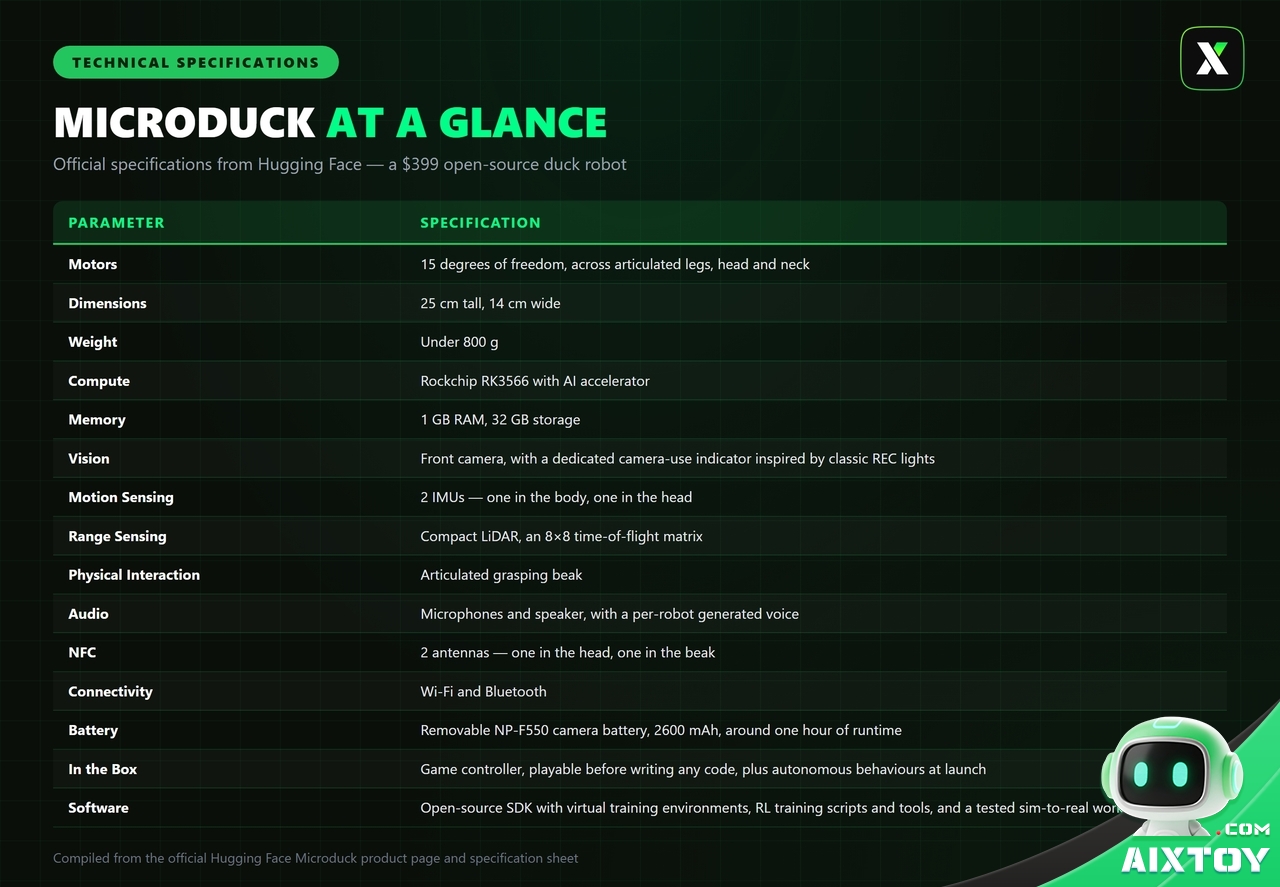
The robot stands about 25 cm tall, weighs about 770 g, and packs 15 degrees of freedom across its legs, head and neck. According to official videos, Microduck can stand up on its own, walk, kick a ball and roller-skate. Several units can even “sing” together in a coordinated group.



Inside the Small Body
Under the hood, Microduck carries a Rockchip RK3566 chip with 1 GB RAM and 32 GB storage, a front camera, and two IMUs (one in the body, one in the head) for motion sensing. Audio is handled by integrated microphones and a speaker, with each robot able to generate its own voice. Two NFC antennas (head and beak) plus Wi-Fi and Bluetooth handle connectivity. Power comes from a removable 2,600 mAh NP-F550 camera battery, good for roughly one hour of runtime depending on use.
Software: Play First, Code Later
Microduck ships with autonomous behaviors enabled out of the box — you can control it with the included game controller before writing any code. For makers, Hugging Face provides an open-source SDK with virtual training environments, reinforcement-learning (RL) training scripts and developer tools, plus a tested sim-to-real workflow. Both beginners and experienced engineers can teach Microduck new tricks, and custom behavior logic can be written in Python or JavaScript.
“We are opening up a whole new category of consumer robot: natively AI-driven, fun, and educational at the same time,” said co-founder Thomas Wolf. “Every level of user, from zero-experience beginners to advanced developers, can find the right way to interact with it.”
Sales Momentum and What’s Next
Wolf told Bloomberg that since pre-orders opened, Microduck has attracted heavy demand — selling roughly one unit every 4 seconds, with sales already around $500,000. The company’s target is to sell more than 20,000 units, with the first batch expected to ship before Christmas. Manufacturing is handled in China by Seeed Studio, a Shenzhen-based open-source hardware company.
In related news, multiple outlets have reported that NVIDIA is in talks to acquire Hugging Face for nearly $13 billion.
Why This Matters for AI Toys
Microduck is a useful marker for where consumer robotics is heading. At $399, it is not a toy for everyone, but it is dramatically cheaper than previous research-grade robots, and it is genuinely open: the SDK, training scripts and sim-to-real pipeline are all part of the product. For families and educators, that means a real dual-purpose device — a playful companion that doubles as a learning tool for reinforcement learning and embodied AI.
At AIXTOY, we curate AI toys and smart companions with genuine first-party sourcing and quality checks on every product before it ships. Whether you are looking for a desktop companion robot, a programmable STEM robot or an open-source development board to start your own robot project, our buying guides and industry analysis can help you choose the right hardware for your goals.
Tags:Hugging FaceMicroduckOpen SourceDesktop RobotProgrammable RobotSTEM RobotEducational RobotRobot News