



No products added!
A few days ago, we wrote about Open Duck Mini — a 3D-printed open-source robot that convinced many readers AI was finally getting a body you could touch. That article generated an unexpected response from a reader who sent in clips of their own project: a Chinese open-source desktop robot called Xiao Wai (小歪).
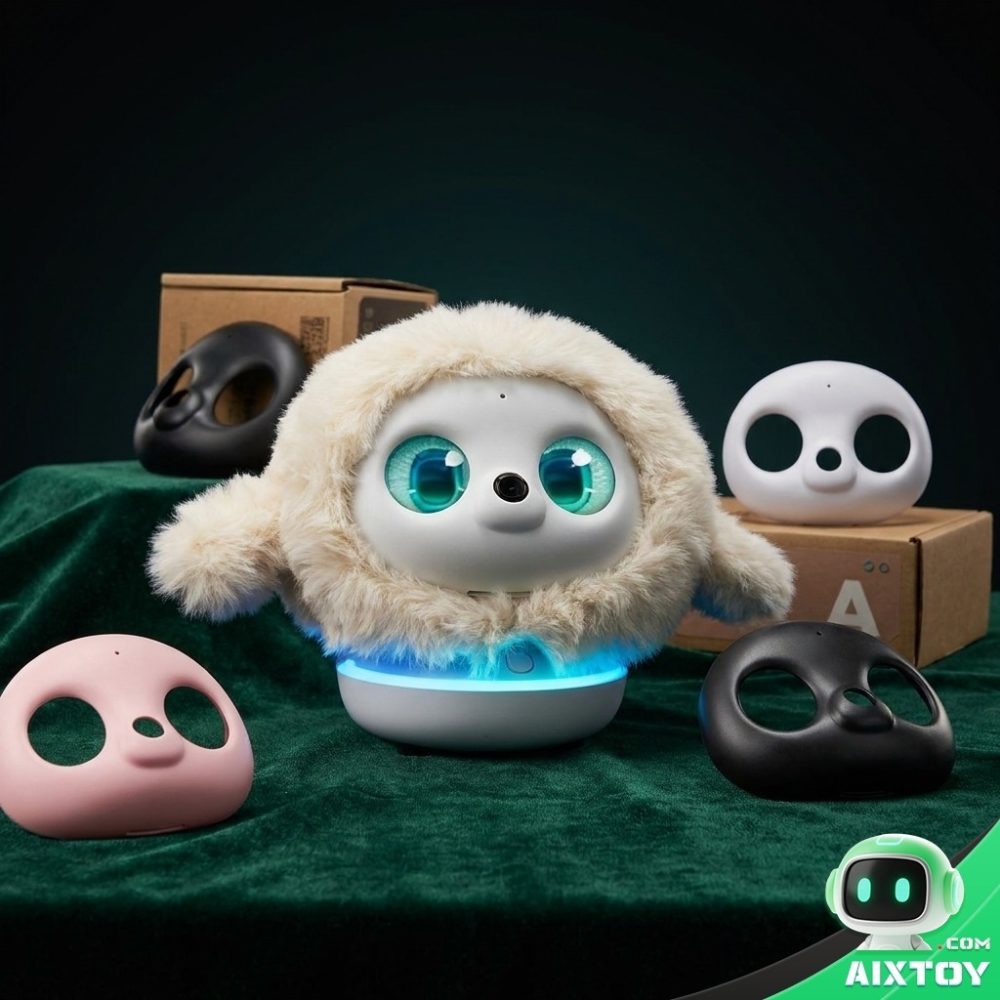
The video did not show a quadruped robot dog or a walking humanoid. It was a small white device standing on a desk — expressive eyes on an OLED display, a camera at the base, a mouth that moved in sync with its speech. But one detail stopped the scroll: it looked back at you. No wake word. No name to call. You glance at it, and it is already facing you, ready to listen.
What Xiao Wai Is — And What It Is Not
Xiao Wai and Open Duck Mini are not the same category of project. Open Duck Mini tackles locomotion: walking, 3D printing, and sim2real reinforcement learning. It answers “how do we get an open-source robot to walk?”
Xiao Wai does not walk. It solves a different, more everyday problem: how does a desktop device know you are looking at it, and how does it respond naturally — without a wake word?
The project team highlighted two capabilities already working reliably:
- Gaze awareness: A bottom-mounted camera captures face position and gaze direction. Turn your head, the robot turns to follow. Stare at it, and it recognizes you are about to speak — no verbal handshake required.
- Real-time lip sync: When the robot speaks, the mouth animation tracks phoneme changes. The mouth widens on an “ah” sound, narrows on an “oo” — creating a surprisingly convincing illusion of speech.
Imagine a small device on your desk that makes eye contact and moves its mouth when it talks to you. That is Xiao Wai.
Inside the OpenDeskBot Repository
A deep dive through the GitHub organization reveals a clean three-layer architecture, all publicly available:
Hardware and Firmware
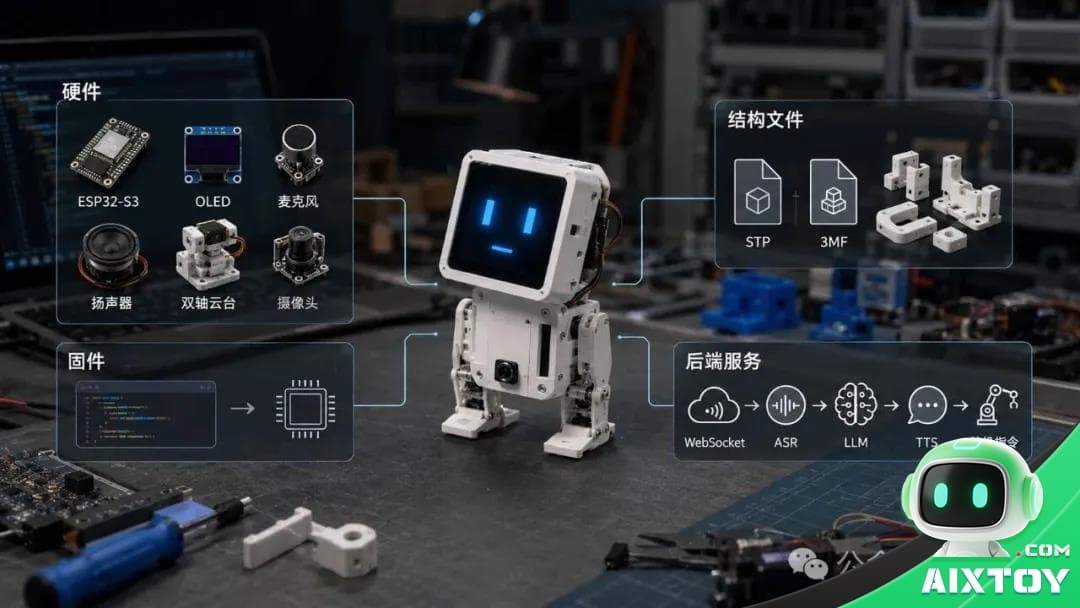
The open-deskbot-hardware repository is built around the ESP32-S3 microcontroller, handling OLED expression rendering, microphone input, speaker output, and dual-axis gimbal control. The camera module is optional and handles the visual uplink. The main controller and camera module are implemented as two independent PlatformIO projects within the same repository, licensed under GPLv3.
Mechanical Files
The mechanical directory includes product images, STP files, and 3MF printable files — enough for prototyping and adaptation, though not yet at the level of complete industrial design documentation.
Backend Service
The open-deskbot-service repository (MIT license) handles the AI pipeline: audio uploaded via WebSocket → Voice Activity Detection → Automatic Speech Recognition → Large Language Model → Text-to-Speech, then PCM audio, screen animation commands, and servo instructions are sent back through a custom protocol. An optional /camera endpoint provides face detection with a debug preview.
Crucially, voice and vision processing run on a self-hosted server — no vendor-locked cloud. The LLM layer does require an API key (Alibaba Cloud DashScope, OpenAI, etc.), keeping hardware BOM low while preserving pipeline control.
The Design Insight That Matters
There is no shortage of devices that can talk. Every smart speaker on the market does that. What makes Xiao Wai interesting is the elimination of the ritual.
Virtually every voice assistant today demands a spoken invocation: “Hey Siri,” “Alexa,” “Xiao Ai.” This is technically mature and experientially mechanical. Human beings do not chant each other’s names to begin conversations. They make eye contact. The other person knows.
Xiao Wai reimagines this entirely. Gaze becomes the signal. You look at it. It turns to face you. The conversation opens without a verbal handshake. That single design choice shifts the interaction model from command-and-response toward presence and attention — toward something that feels less like operating a machine and more like being with another being.
Desktop robots will not become natural companions by running larger models alone. They will become natural when the interaction entry point feels human. The wake word is a software solution to a hardware-era problem. Gaze awareness is a hardware solution to a human expectation.
What This Project Signals
When we wrote about Open Duck Mini, the most common reaction was “incredible, but too far away.” English documentation, overseas communities, $400 BOM estimates, sim2real pipelines — real barriers for many builders.
Xiao Wai demonstrates the other side: small Chinese teams and individual makers are also pulling AI out of screens and into physical objects. It proves itself not through a product launch but by putting hardware schematics, firmware, and backend code on GitHub. Two projects, two directions: Open Duck Mini shows a robot that walks. Xiao Wai shows a robot that watches you back.
Calibrating Expectations
Xiao Wai is an early-stage open-source project, not a consumer product. Complete hardware BOMs, wiring diagrams, and step-by-step assembly guides are not yet available. The “approximately 300 RMB” figure cited by the project team is a rough estimate covering the ESP32, M90S servo, small display, and core components — not a verified, buildable BOM.
To replicate Xiao Wai today, you will need ESP32 and PlatformIO development experience, the ability to self-host the backend service, and an LLM API key. This is for builders who want to learn, experiment, and contribute — not someone expecting a three-hour kit with polished documentation. Early-stage open-source hardware should be evaluated by the clarity of its direction and the completeness of what has been shared, not the polish of a shipping product.
A Different Kind of Path
Large corporations will keep building robots. Overseas communities will keep producing polished open-source projects. But a closer, more accessible path is emerging: small Chinese teams placing small, specific things on desks — devices that might look rough, whose documentation might be incomplete, but that make one thing increasingly concrete: AI does not have to stay trapped in a chat window. It can have eyes, a mouth, and a body that sits beside you.
AI leaving the screen will probably not arrive first as an expensive humanoid. It will probably arrive as a small device at the edge of your desk — one that looks at you, moves its mouth when it speaks, and does not need you to chant its name.
OpenDeskBot Resources:
- Organization: github.com/orgs/OpenDeskBot
- Hardware: open-deskbot-hardware
- Backend Service: open-deskbot-service
- Mechanical Files: mechanical directory
Explore open-source robots, desktop companions, and AI hardware at AIXTOY Shop.
Tags:AI Robot ToyAIXTOYDesktop AIDesktop RobotESP32-S3Gaze AwarenessOpen Source RobotOpenDeskBotXiao Wai