


No products added!
If an AI companion wants to earn a permanent place in your life, maybe it should first become something your desk already needs.
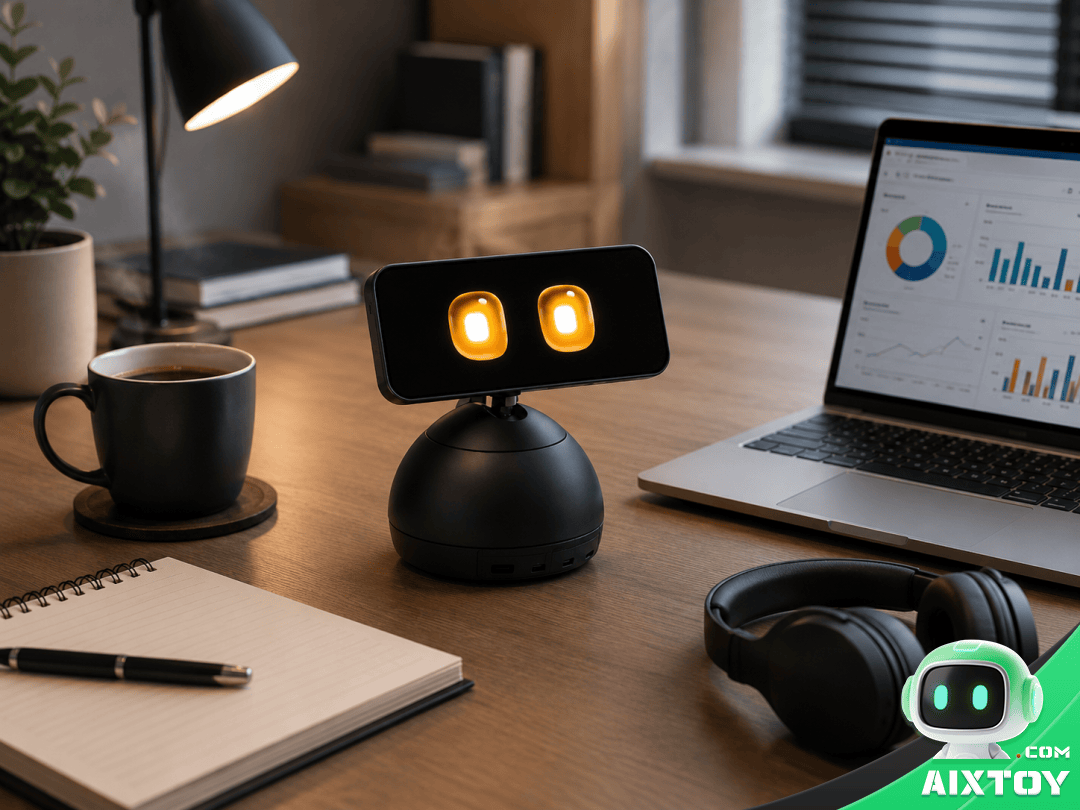
For years, AI toy and companion hardware startups have been chasing the same question: Can we make a robot that feels like a pet? But KEYi Tech’s Loona Deskmate — launched on Kickstarter and showcased at CES 2026 — poses a different, arguably more grounded question: Can an AI companion become something you’d put on your desk anyway?
That shift in framing changes everything.
What Is Loona Deskmate?
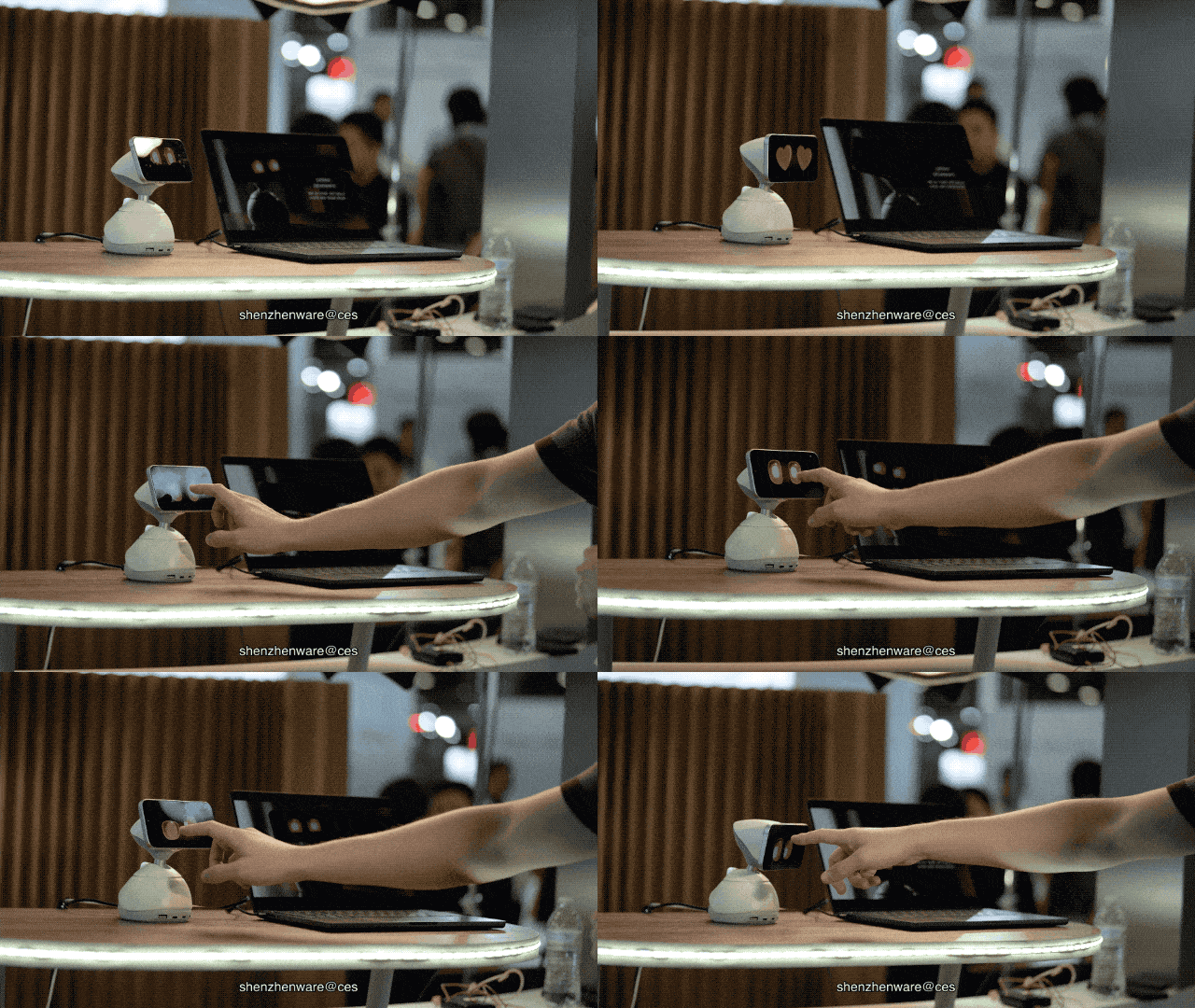
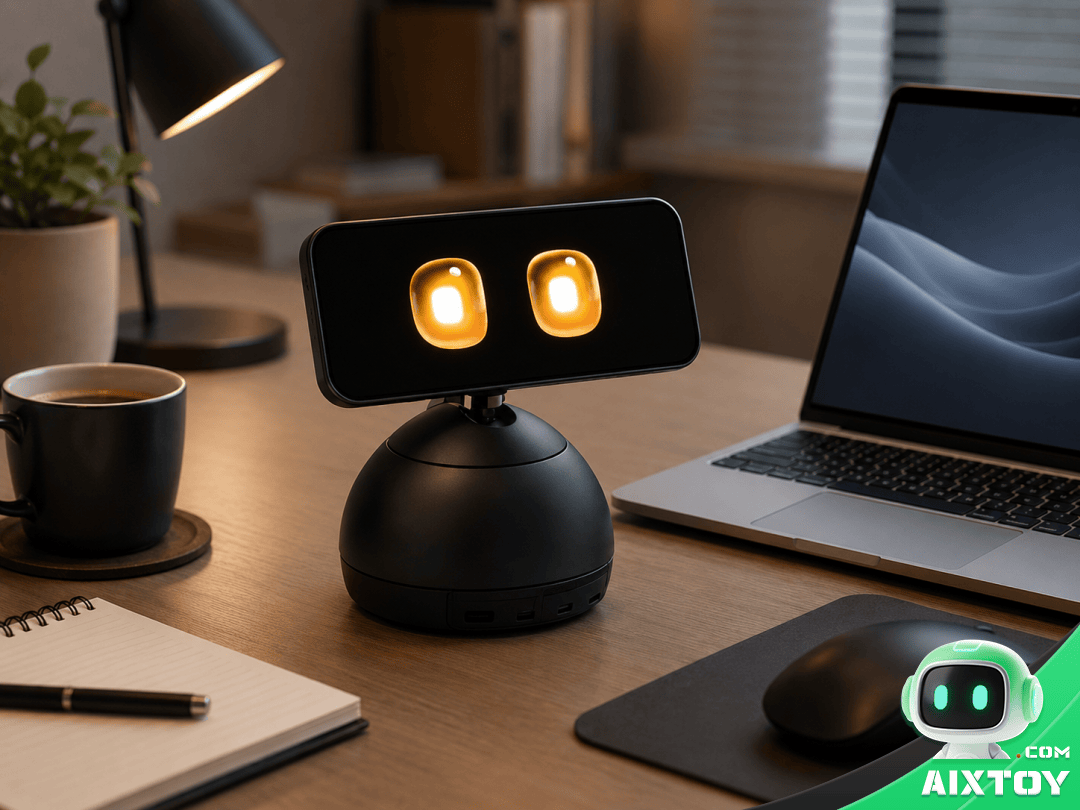
Loona Deskmate is a desktop AI companion from KEYi Tech, positioned as a screen-aware AI co-worker. Unlike standalone desktop robots that try to pack compute, display, cameras, speakers, and battery into one monolithic device, Loona Deskmate takes a radically different approach: let the iPhone be the brain and face, and let the base handle motion, charging, and physical presence.
The base unit provides 3-axis motion, voice and vision interaction capabilities, and an integrated 165W GaN charging hub with multiple USB-C and USB-A ports. The iPhone (12 or newer) snaps in as the display and compute core, running the AI interaction layer.
As CNX Software noted in their teardown analysis, the product is less a standalone robot and more a “desktop AI character dock” — the phone supplies intelligence and expression, while the base provides physical agency and a reason to stay on your desk.
The Smartest Choice: Parasitic Hardware
If you only look at the surface, Loona Deskmate looks like just another cute desktop robot. But its real innovation is architectural: it parasitizes a mature device ecosystem instead of competing with it.
Most AI toy hardware faces a brutal reality: to be smart enough to matter, you need a screen, camera, microphone, processor, battery, wireless module, and content platform. Every capability you add inflates cost, power draw, thermal budget, and maintenance complexity.
Loona Deskmate splits this problem in two. Your iPhone already has the screen, camera, microphone, compute, app ecosystem, and mobile OS. The base just needs to embody and personify what’s already there. Hackster described it plainly: it’s essentially a desktop charging dock that turns your iPhone into an AI assistant with a face and personality.
For the broader AI toy industry, this is a valuable blueprint. Not every AI companion needs to be a ground-up hardware project. The future likely holds more “parasitic peripherals” that borrow the intelligence of phones, tablets, earbuds, car systems, and smart speakers, adding value through form factor, motion, expression, and character.
The Office Desk: AI Companionship’s New Battleground
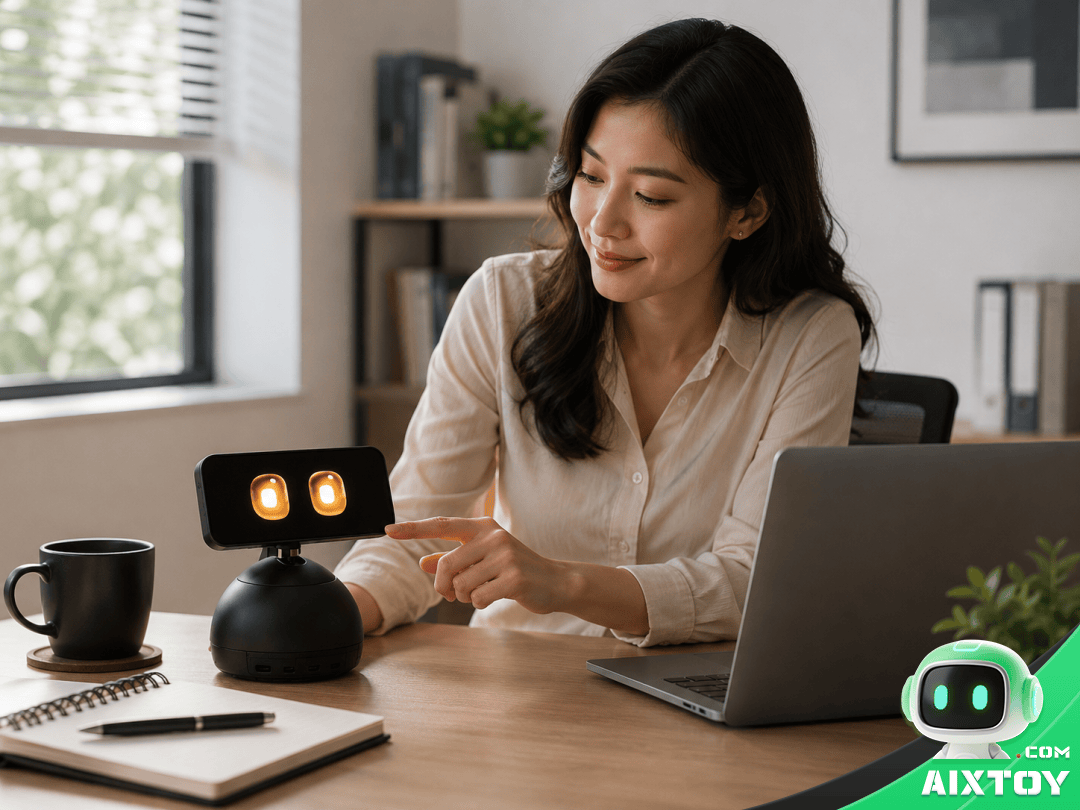
Historically, AI toys have lived in nurseries, living rooms, and bedside tables — spaces explicitly designed for play and comfort. But Loona Deskmate places the product on the office desk, and that choice is strategically significant.
The desk is not a traditional toy territory, but it is where adults spend the longest contiguous stretches of their waking hours. Your computer, phone, coffee, keyboard, headphones, calendar, and charger are already there. A companion that naturally integrates into this environment doesn’t need users to invent new rituals — it just needs to fit.
What’s more, the emotional needs at a desk are genuine and under-served. Knowledge workers need reminders that feel human, interruptions that land softly, tools that help without feeling cold, and — during long solo work sessions — the quiet sense that someone (or something) is nearby.
The Verge, in its CES 2026 trend coverage, observed that AI is spilling out of screens and into the physical world, citing Loona DeskMate as an example of hardware that turns phones into big-eyed desk companions while offering Slack integration, meeting assistance, and other practical utilities.
In other words, the boundary of “AI toy” is expanding. It doesn’t have to be a children’s product. It can be a desk ornament, a work companion, an emotional support object, a corporate gift, or even lifestyle hardware.
“Cute” Is the Hook. “Unobtrusive” Is the Moat.
That said, products like Loona Deskmate face a delicate existential test: does it make you more productive, or does it just add noise?
Desktop AI companions can fail in two directions. One is being too toy-like: fun for a week, then forgotten. The other is being too tool-like: constantly pinging, popping up, and interrupting — ultimately becoming a source of friction rather than relief.
The real challenge isn’t capability — it’s restraint. Hackster’s coverage noted that Loona Deskmate attempts to use audio and visual cues to determine whether the user is actually interacting with it, without relying on wake words, and tries to stay quiet when the user is focused.
This is the central tension for all AI companion hardware. Companionship is not about constant engagement. A great desk companion shouldn’t just be good at talking — it should be even better at knowing when to be silent.
Five Takeaways for the AI Toy Industry
1. Find a High-Frequency Reason to Stay
If a product is merely “interesting,” users will put it away after the novelty fades. But if it’s also a charger, a desk stand, a lamp, a Bluetooth speaker, an alarm clock, a bag charm, or a car accessory — it gains a persistent reason to remain visible and accessible.
2. The Phone Is Not Your Competitor — It’s Your Platform
Many hardware startups dream of building the device that replaces the phone. For AI toys and companions, a far more realistic path is to borrow the phone. The phone supplies compute, connectivity, and the display. Your hardware supplies the body, the motion, the tactile presence, and the character.
3. Adult Scenarios Are Opening Fast
AI toys are no longer confined to children’s education. The office desk, the car interior, the nightstand, pet households, elder care, couple gifting, and anime/collector fandom are all emerging as viable entry points. Loona Deskmate’s value isn’t that it will become a mass-market blockbuster — it’s that it proves adults can own AI toys too.
4. Hardware Is Just the Beginning
A desktop AI companion that ships as a one-time hardware product will struggle to sustain engagement. It needs ongoing content: new expressions, skills, workflows, voice styles, seasonal skins, holiday interactions, and community features. Without that, even the cutest desk pet becomes a forgotten stand within weeks.
5. Distribution Channels Are Shifting
These products won’t just live in toy stores. They’ll increasingly appear on crowdfunding platforms, digital accessory channels, corporate gifting catalogs, designer toy shops, lifestyle boutiques, Apple ecosystem accessory stores, and high-demonstration-content platforms like TikTok and YouTube.
The Bottom Line
Loona Deskmate’s real contribution to the AI companion space isn’t a specific technical breakthrough — it’s a reframing of the question. Stop asking “Can I make users love me?” and start asking “What gives me the right to be on their desk every day?”
An AI robot tucked away in a drawer, no matter how intelligent, will never build a relationship. An AI object that lives naturally on the desk, the nightstand, the bag strap, or the dashboard — that’s the one with a real shot at becoming part of someone’s life.
When AI capability, designer toy aesthetics, desktop utility, and character-driven content converge, AI toys stop being “talking gadgets” and start becoming a new category of lifestyle hardware.
Explore AI companion robots and desktop toys at AIXTOY Shop.
Tags:AI Desktop CompanionAI Robot ToyAIXTOYDesktop AIDesktop RobotiPhone RobotKEYi TechLoona Deskmate