


No products added!
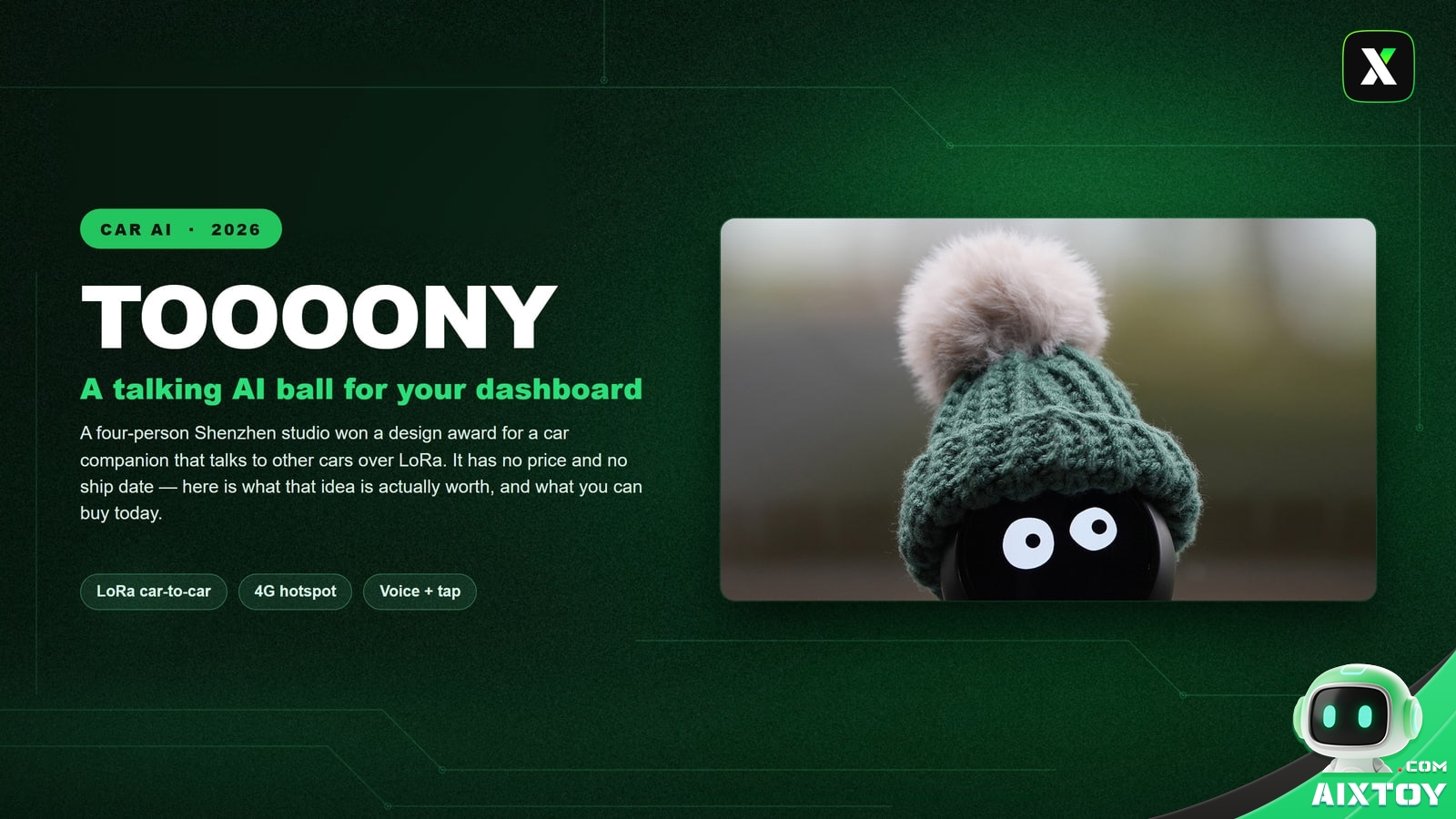
A talking ball on your dashboard
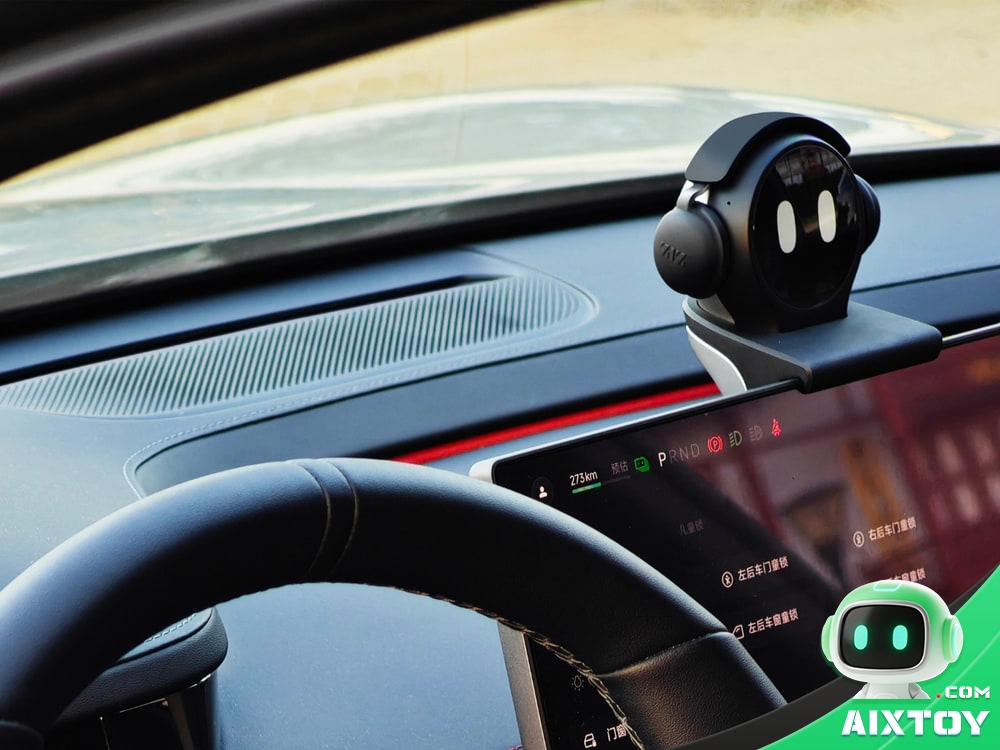
There is a small black sphere sitting on your dashboard with a pair of cartoon eyes on its face, a knitted beanie on its head, and an opinion about your lane changes. That is TOOOONY, a concept in-car AI companion from ZIZ Intelligent Manufacturing (Shenzhen) Technology Co., Ltd. — and it is one of the more interesting pieces of hardware design to come out of Shenzhen this year, because it takes an idea most carmakers treat as their own private territory and hands it to a third party.
It is also, at this moment, not something you can buy. So this article does two things: it explains what TOOOONY actually claims, and it walks through the car AI companions that are shipping — including the ones we sell — so you can tell the difference between a design award and a product you can put in your car this week.
What TOOOONY actually is
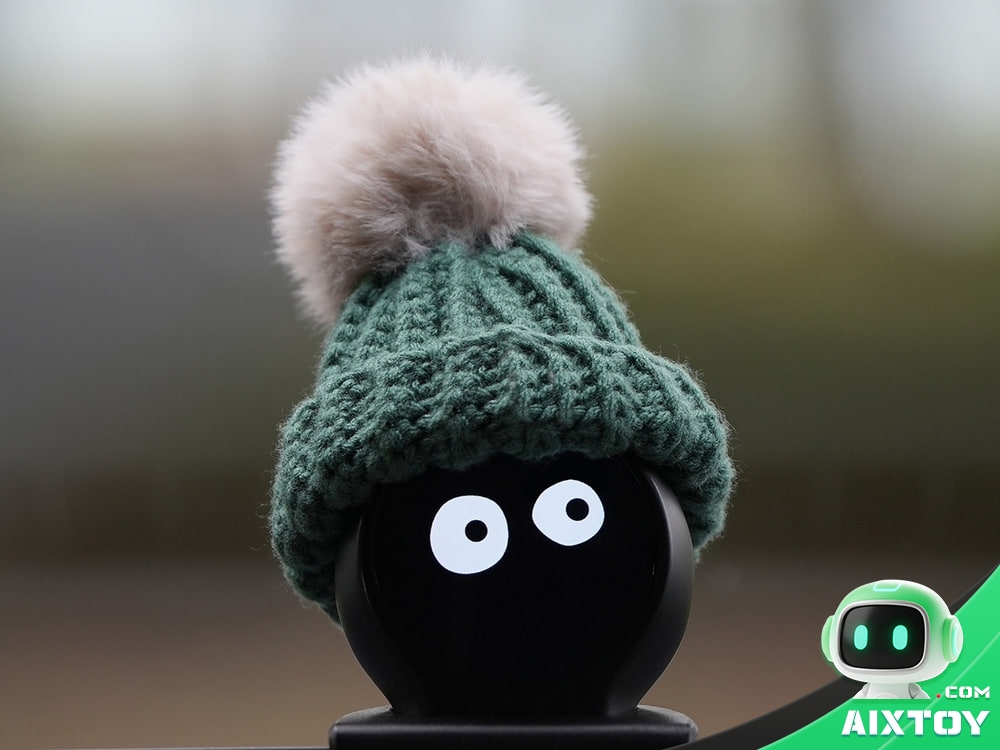
TOOOONY is a palm-sized sphere. Its face is a circular display that renders animated eyes and expressions, and its body carries a ring of structure near the top — described as headphone-hanger-like — that lets you clip on hats and accessories. The version that circulates most widely online is a green knitted beanie with a pom-pom, which tells you a lot about the intended emotional register: this is designed to read as a pet, not as an appliance.
Underneath the character work, the feature list is short and specific:
- An anthropomorphic AI dialogue system. Not a fixed command grammar — it is meant to hold a conversation, and it responds to voice as well as touch.
- “Tap to interact.” A physical, tactile input path, so you can poke it rather than talk to it.
- A circular screen as both face and information hub. Customisable watch faces, vehicle stats, weather, navigation cues — the screen changes register depending on what the car is doing.
- Built-in lighting and sound. The device uses light and audio to signal state, so it can communicate without your eyes leaving the road for long.
- LoRa near-field encrypted communication.
- 4G with whole-vehicle hotspot capability.
The company describes it as the world’s first cross-brand, non-contact travel social device. That is a marketing sentence, and it is worth unpacking in a moment — but it is also the only genuinely novel idea in the product.
The award, and who is behind it
TOOOONY is the work of a four-person design team — Junjia Yang, Yang Shen, Yanan Liu and Ruilin Niu — at ZIZ Intelligent Manufacturing in Shenzhen. The project took Gold in the Automotive & Transport / Accessories for Cars & Personal Vehicles category at the 2025 International Design Awards, whose entry description matches the feature list above almost word for word: an intelligent in-vehicle assistant with a circular screen, an anthropomorphic AI dialogue system, voice, touch and tap-to-interact input, built-in lighting, sound and expressions, LoRa near-field encrypted communication, and 4G hotspot capability.
That is a real credential. A professional-category design award is not a marketing badge — it means a jury of working designers looked at the object and the interaction model and ranked it against other entries. It is worth noting what the award does not cover, though: industrial design awards judge design, not manufacturability, unit economics or supply chain. Nothing in the award record tells you the device can be built at a price anyone will pay.
There is no published price, no announced production date and no retail channel. Trend Hunter catalogues it as a conceptual product. The most honest status label is: designed, awarded, not yet shipping.
The one feature nobody else is shipping: LoRa between cars
Most of TOOOONY’s feature list has been done before. Animated face on a circular screen? Done. Voice conversation? Done. A 4G hotspot in the cabin? Commodity — you can buy a plug-in router for the price of a dinner.
The LoRa piece is different. LoRa is a low-power, long-range radio designed for small, encrypted packets, and using it for car-to-car communication instead of Bluetooth or Wi-Fi is a genuinely sensible engineering choice: Bluetooth pairing is a nuisance and a security surface, and Wi-Fi is short-range and power-hungry. LoRa lets two devices acknowledge each other at road distance, encrypted, without either driver adding the other on anything.
The stated use cases are light: a greeting between drivers, a shared traffic note, an acknowledgement between two strangers at a light. The framing — “cross-brand” — is the interesting part. Every carmaker’s companion device lives inside that carmaker’s ecosystem, and every carmaker’s social feature requires both parties to own the same brand. A third-party device with its own radio sidesteps that entirely. It works between a Tesla and a Toyota.
The catch is the oldest one in networking: a social protocol with one user is a rock. The feature has value only when the car next to you also has a TOOOONY. Until there is an installed base large enough that encountering another unit is a realistic event, buyers are paying for an AI dashboard pet and a promise. That is not a reason to dismiss the idea — it is a reason to be clear-eyed about what the first 10,000 buyers are actually buying.
Three things the concept does not answer
Price. There is none. And the price matters enormously here, because the category TOOOONY is entering has a well-established range (see below) and buyers now benchmark against it.
Production. A four-person design studio can produce an award-winning prototype. Volume manufacturing, a cellular modem certification path, a LoRa regulatory footprint per market, an app, OTA infrastructure and support are a different company-sized problem.
The 4G hotspot claim. “Stable whole-vehicle coverage” is doing a lot of work. Your phone already does this, and Chinese EV makers increasingly bundle a data plan into the car. Beating that requires either better hardware or a cheaper data plan — and neither is visible in the public material.
The category is already shipping — at three price tiers
Here is the part that matters if you are shopping rather than reading about design awards. In-car AI companions are not a future category. They are a shipping category with three distinct tiers, and the tiers do not buy the same thing at all.
| Tier | What you are buying | Typical price | Examples |
|---|---|---|---|
| Entry | Emotion and animation. Motion sensing, expression libraries, a magnet mount. Little or no real conversation. | roughly $50–60 | MANGOGO, AI Fortune God, Dasai Mochi 3 |
| Mid | Voice conversation with an actual model, plus vehicle-state reactions. The tier most buyers should compare. | roughly $90–160 | LUMI, DiMi |
| Flagship | Vehicle integration — OBD diagnostics, always-on 4G, remote-work features — or a carmaker’s own ecosystem device. | roughly $230–900 | Commander Pro, Cami o2 MAX |
Two data points from the wider market make the shape clear. On Amazon, MANGOGO-class dashboard robots list between $59 and $69, and AOTOROBO’s AI car chat robot sits at $49.99 — so the entry tier is genuinely commoditised, and there is no reason to overpay inside it. At the top end, carmaker devices are expensive and brand-locked: NIO’s NOMI retrofit runs into the thousands of RMB, Xiaomi’s Smart Dial 2 sells for ¥999 and sold out its first batch, and Geely’s Eva launched around ¥1,099.
What you can buy today
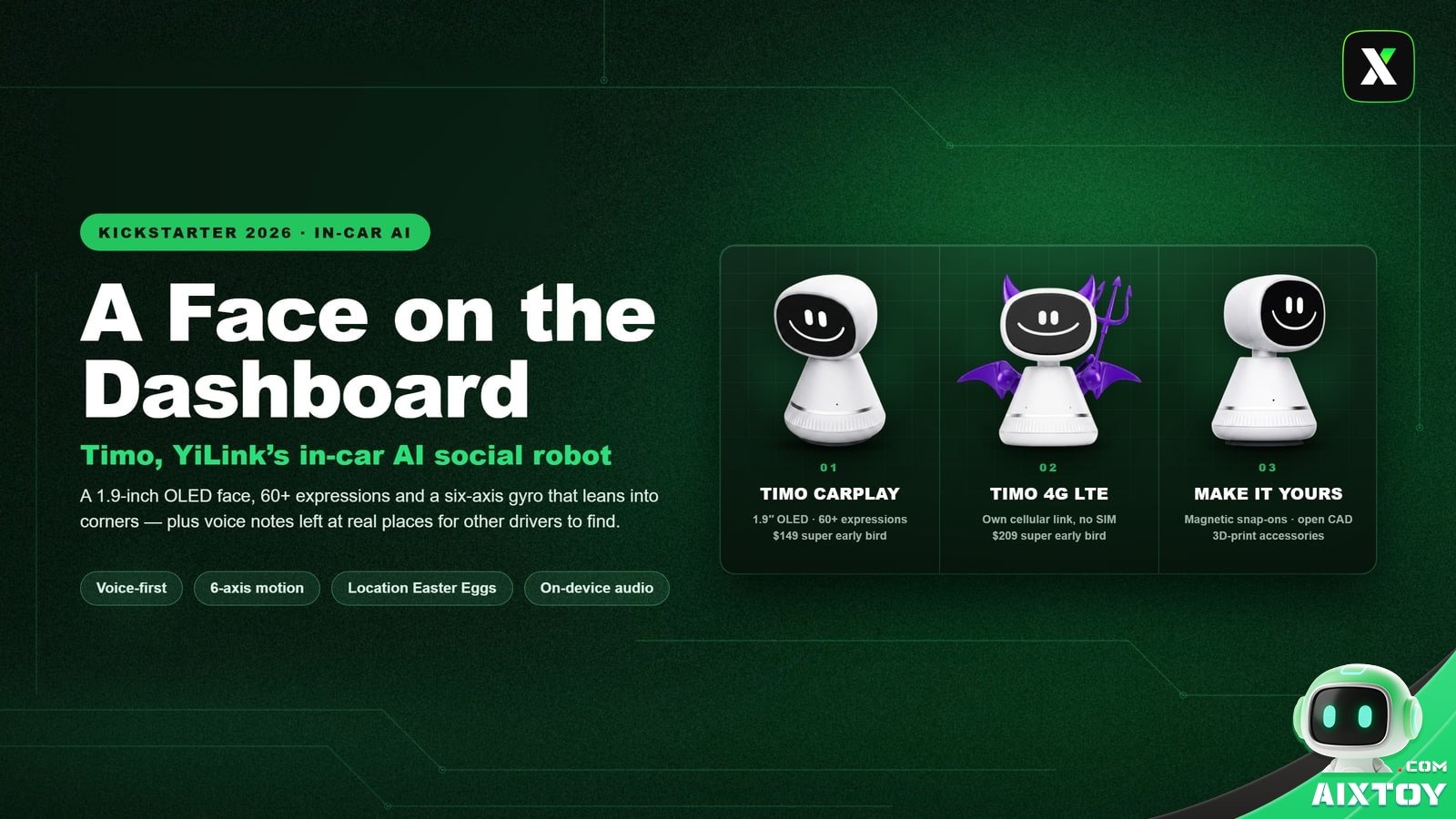
If the appeal of TOOOONY is “a character on my dashboard that reacts to the way I drive,” that experience already exists — and the entry point is cheap.
MANGOGO is the cleanest version of the entry tier we stock. It senses acceleration, braking and cornering with a gyro sensor and answers with animated expressions and sound, switches itself on and off with the ignition, and runs about ten hours on a charge. For a driver who wants the emotional payoff without the AI services bill, this is where to start.
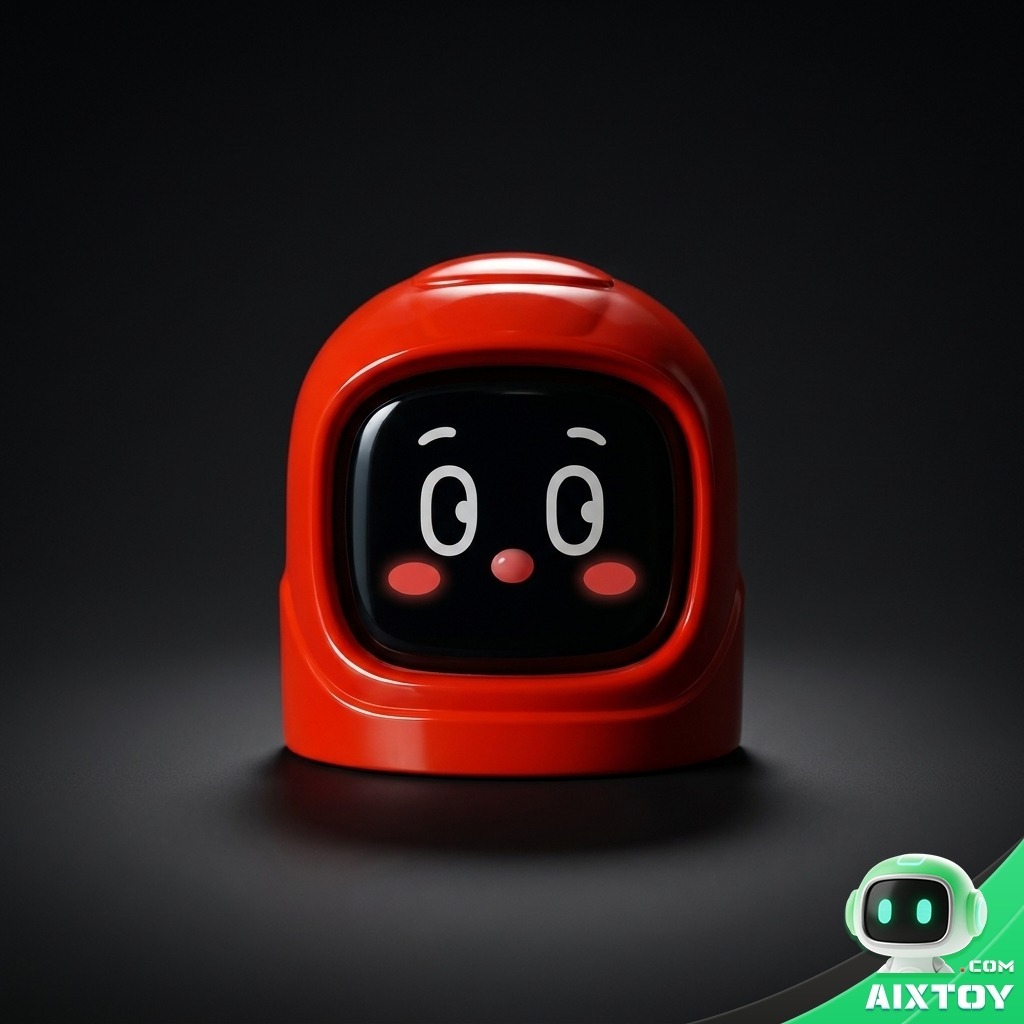
MANGOGO Car Robot — AI Companion Smart Gadget for Car Dashboard Decoration
$53.99
Gyro-sensing dashboard robot with 200+ animated expressions across two expression packs. Reacts to acceleration, braking and cornering, switches itself on and off with the ignition, and runs about 10 hours on a 900‑mAh cell.
Dasai Mochi 3 takes the same brief in a collectible direction: a tiny cube with a high-brightness OLED face, a removable helmet and a wide colour range, with gyro-triggered reactions and automatic sleep when the car is parked. It is the one in this group that reads as a design object first.
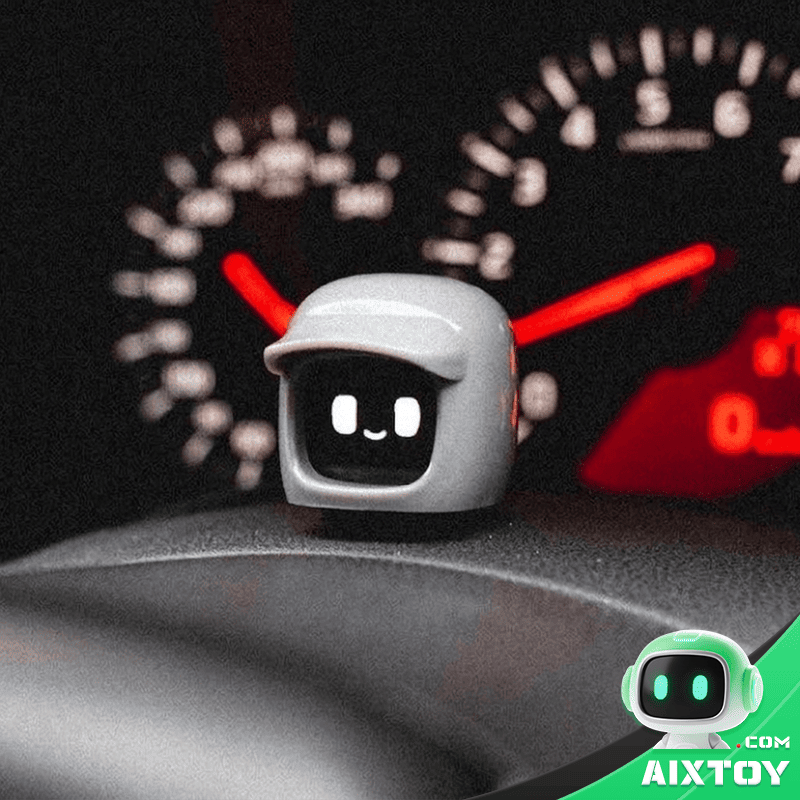
Dasai Mochi 3 Car AI Robot Companion
$52.99
A 4 cm collectible car companion with a 1,000‑nit OLED face, a removable helmet and gyro-triggered reactions. Sleeps when the car is parked and wakes on movement. The design object of the group.
The mid tier is where the experience changes character. LUMI adds physical motion — it rocks, sways and moves rather than only changing its face — so the interaction is body language as much as pixels, and it runs on an internal battery with an optional solar panel.
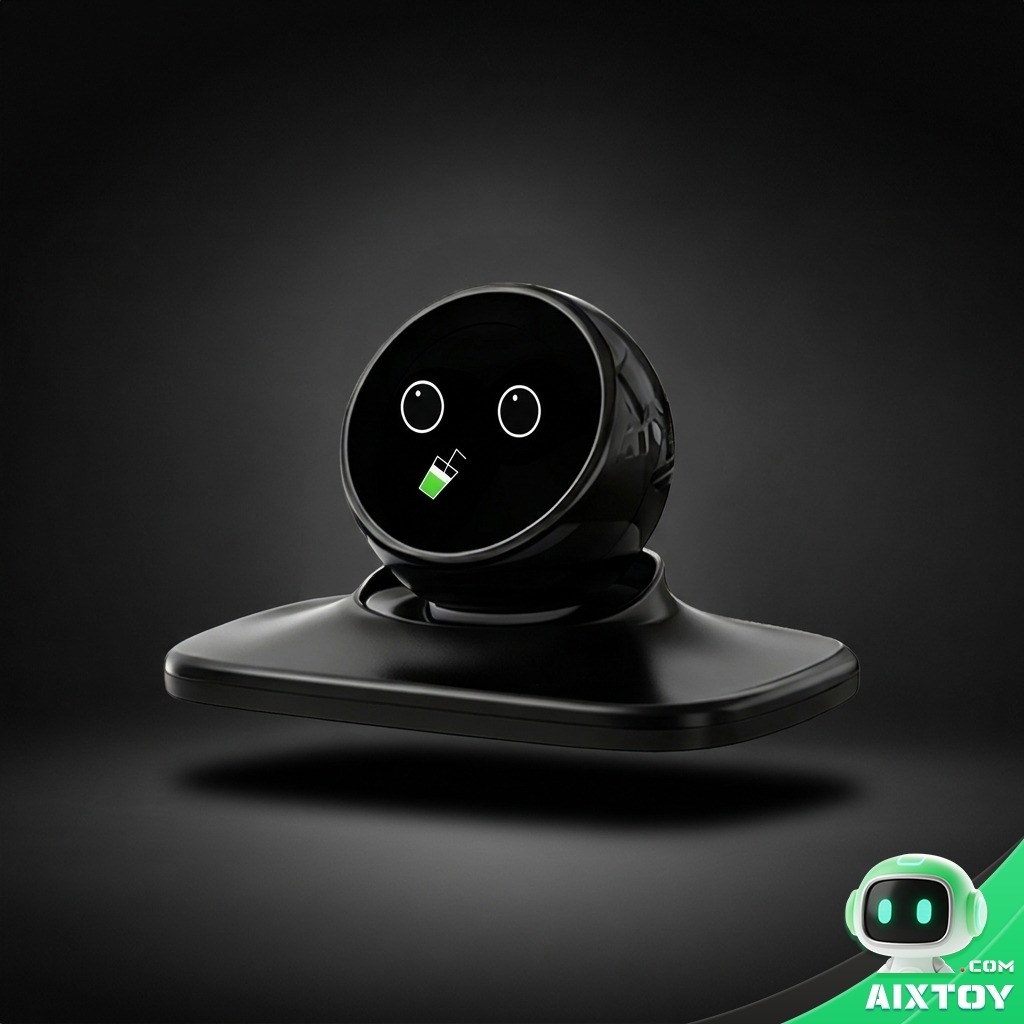
LUMI Car AI Robot — Dashboard Companion
$89.99
Adds physical movement to the formula — LUMI rocks, sways and dances as well as changing expression, pairing 100+ animations with an internal battery and an optional solar charging panel.
DiMi is the mid-tier pick if you actually want to talk to the thing. It pairs 4G and Wi‑Fi with voice interaction and emotion recognition, mounts magnetically on the dash or on a desk, and is explicitly built to react to what the vehicle is doing rather than sit inert.
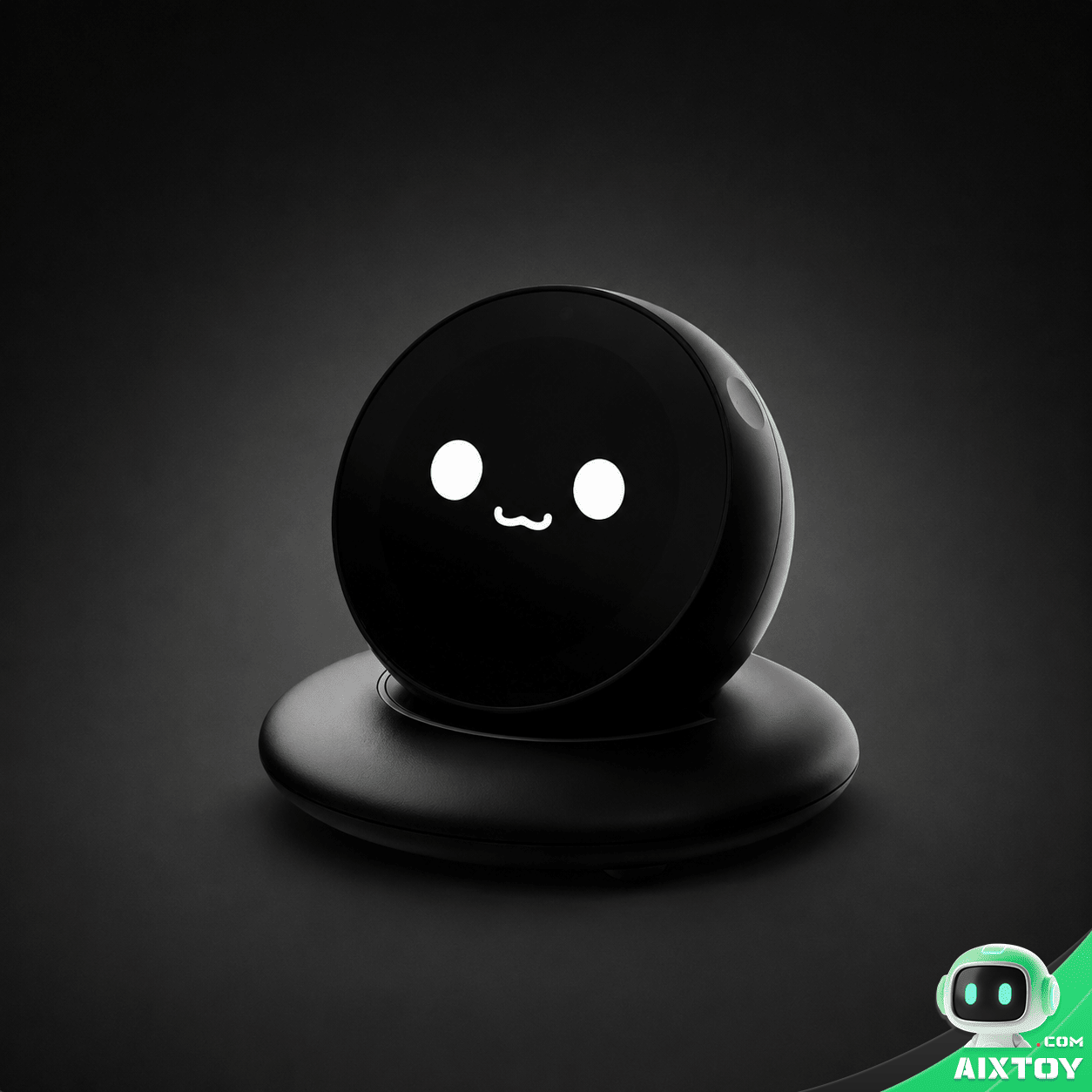
DiMi AI Smart Car Robot — 4G Wireless Dashboard Companion with Emotion Recognition
$149.99
4G plus Wi‑Fi, voice interaction and emotion recognition, with magnetic mounting for the dashboard or a desk. Built to react to what the vehicle is doing, not only to what you say.
The walled-garden problem — and why TOOOONY’s framing is the point
This is the part of the story worth taking seriously even if TOOOONY never ships.
Carmaker companion devices are excellent, and they are locked. Commander Pro is a good illustration of the trade: as a Tesla Model 3 / Model Y companion it is genuinely well integrated, reacts to the vehicle and gives the cabin a character it otherwise lacks — and it is only ever going to be useful in a Tesla Model 3 or Model Y. Buy it, and you have bought into one brand’s ecosystem for as long as you own that brand’s car.
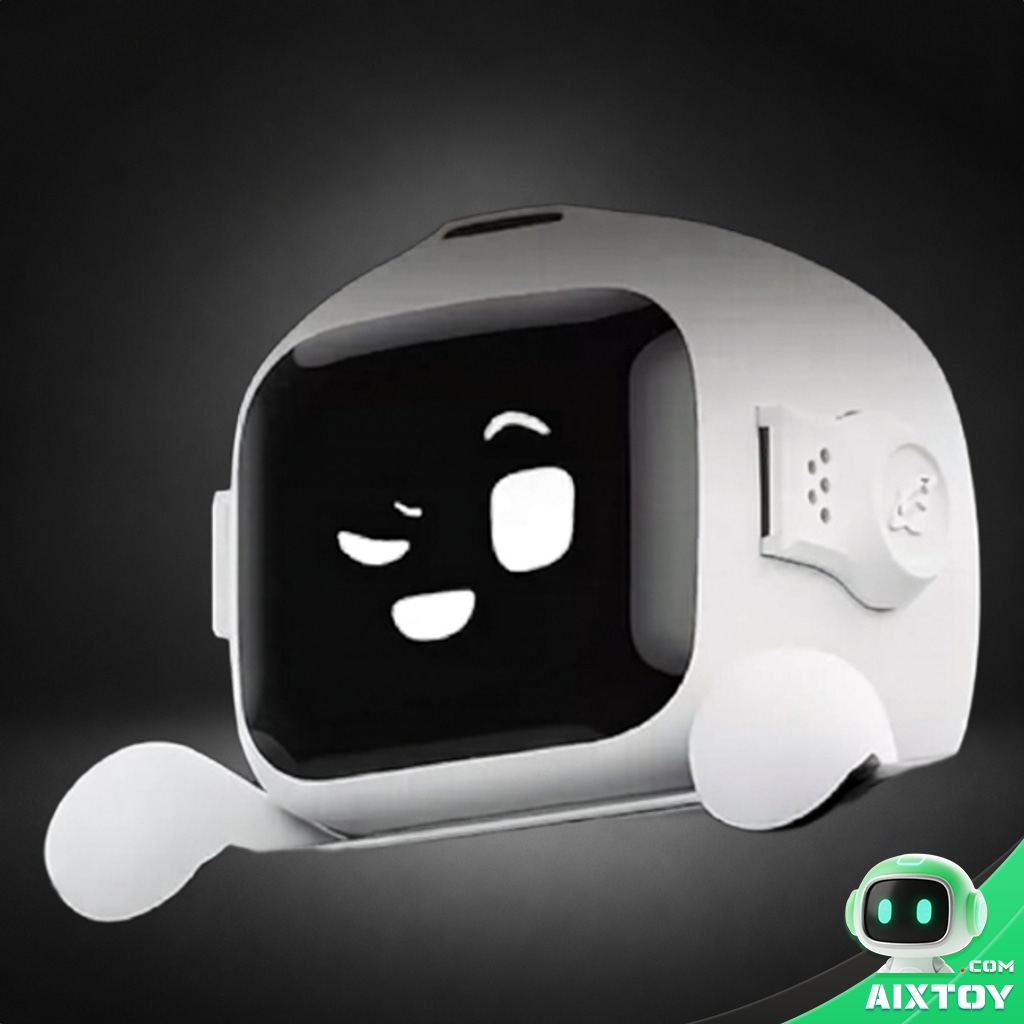
Commander Pro Car AI Companion — Smart Voice Robot for Tesla Model 3 / Model Y
$223.99
A voice-driven companion built specifically for the Tesla Model 3 and Model Y, with a character that reacts to what the vehicle is doing. Excellent inside the right car — and useless outside it.
TOOOONY’s bet is that a meaningful number of drivers want the character without the lock-in — the same instinct that makes people buy a phone mount instead of using the built-in one. A third-party device that works in any car and can talk to any other third-party device is a different product category from a carmaker accessory. Whether anyone pays for it is an open question. That it is a better idea than the current arrangement is not really in doubt.
If you want the deepest end of what ships today, that direction exists too: Cami o2 MAX is a 4G in-car robot with OBD vehicle diagnostics and a remote-work assistant built in — it monitors the car’s health and doubles as a co-pilot, which is the “car robot as a real assistant” version of the same idea.
How to judge any car robot before you buy
Ignore the marketing and run three tests. They separate a working companion from a light-up ornament faster than any spec sheet.
- Sensing. Does it have a gyroscope or accelerometer, and does the product page say what it does with it? A robot that reacts to braking, cornering and acceleration is a participant in the drive. One that cycles through animations on a timer is a screensaver. If the sensing hardware is not in the spec list, assume it is not there.
- Interaction. Is there a real language model behind the voice, or a fixed list of phrases? “AI voice interaction” without a named model or a stated processing location is usually the latter. Ask whether voice requires the phone to be connected — if it does, your phone is the computer and the robot is a speaker.
- Integration. Does it know the car exists? Reacting to vehicle state, starting and stopping with the ignition, reading diagnostics — that is integration. Sitting on the dashboard doing its own thing is decoration, which is fine as long as you are paying decoration prices for it.
A fourth question, specific to this category: does it need to be plugged in? A device with its own battery survives a parked car; a USB-only device does not. If you plan to leave it in the car, battery is not a detail.
What to watch next
- Third-party, cross-brand devices. This is the gap TOOOONY is aiming at and the one worth paying attention to. Watch for a shipping product with a real installed base — the social feature only becomes real at scale.
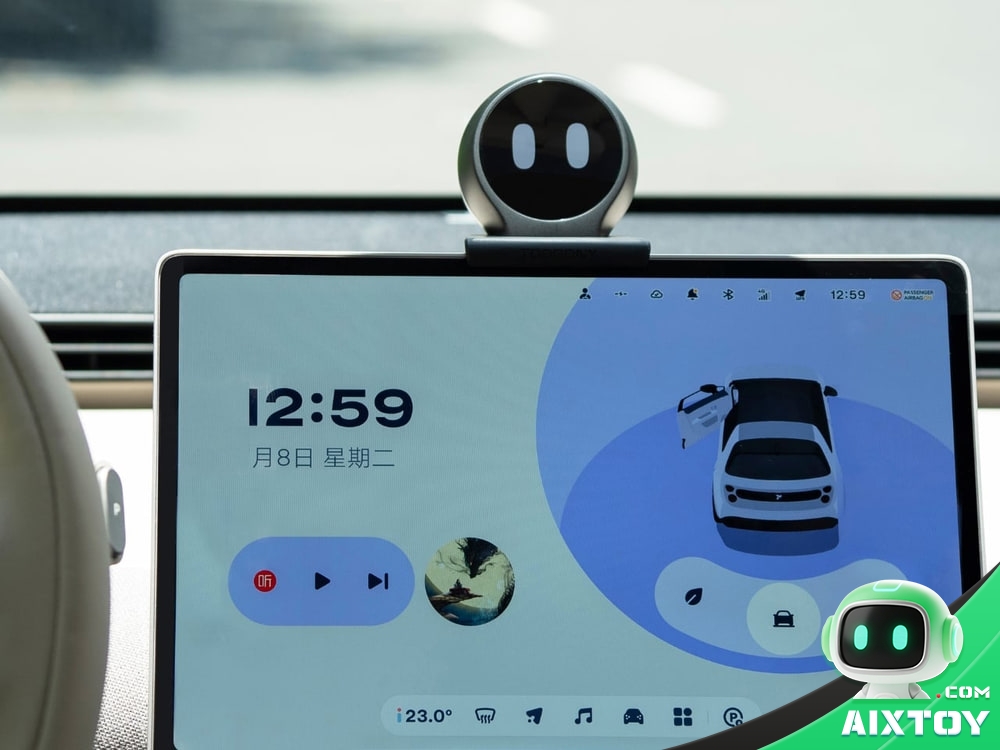
- Cars as the integration layer. Xiaomi’s Smart Dial 2 mounts above the infotainment screen, turns toward whoever is speaking, and changes expression with navigation, driver assistance and music. That is a carmaker doing the AI companion properly — inside its own ecosystem.
- Maker-grade versions. SIXSPEED’s Poki, built on an ESP32-S3 with a 1.32″ OLED and an accelerometer, crowdfunded at around €59, shows how little silicon this category actually needs. If you like the idea of a dashboard robot you can flash yourself, that corner of the market is moving.
The AIXTOY take
TOOOONY is the most interesting car AI concept of the past year because it attacks the right problem. The hardware — a screen, a speaker, some sensors, a radio — is close to commodity. The defensible idea is cross-brand social hardware, and the reason nobody has shipped one is not technical difficulty but network effects and business model: every carmaker would rather you stayed inside its app.
Our advice is unromantic, and it splits by what you actually want.
If you want a character on the dashboard that reacts to your driving, buy it now and buy it cheap. The entry tier is commoditised and the experience is real; there is no reason to wait for a concept product, and no reason to pay flagship money for expression animations.
If you want conversation, move up to the mid tier and check the model and the connectivity before you buy. That is where the difference between “talks to me” and “plays clips at me” lives.
If you want the car to be part of the product — diagnostics, always-on connectivity, real utility — go to the flagship tier, and accept that you are buying into a brand.
And if the thing you actually want is TOOOONY’s specific promise — a third-party companion that works in any car and can greet the car next to you — the honest answer is that you cannot buy it yet. You can buy the emotional half of it today. The social half is still a bet on an installed base that does not exist. Worth watching. Not yet worth waiting for.
Sources: Yanko Design, “This Cute AI Robot Just Turned Your Car into a 4G Hotspot” (December 2025); International Design Awards, TOOOONY entry (2025); Trend Hunter, “Cartoonish In-Car Connectivity Robots”; Hackster.io, “SIXSPEED’s Poki Is an Espressif ESP32-S3-Powered Companion Robot for Your Car”; Amazon product listings for MANGOGO and AOTOROBO; AIXTOY product pages for specifications and pricing.
Tags:AIXTOY AI Toy Car Companion Automotive AI Toy Smart Car Toy Connected Car Automotive IoT AI Companion Companion Robot Emotional AI AI Hardware Consumer Robotics Social Toy