


No products added!
Espressif has shaken up the embedded AI world by open-sourcing ESP-Claw — a lightweight C-language agent framework that runs directly on ESP32-series microcontrollers. This is not another cloud-dependent SDK; it is a genuine attempt to put intelligent agents inside low-power edge devices.
Why ESP-Claw Matters
The IoT industry has long struggled with a fundamental tension: edge devices need to be smart, but smart requires compute. ESP-Claw solves this by treating the ESP32 not as a mere data pipe to the cloud, but as an autonomous agent — capable of reasoning, tool-calling, and decision-making locally, with cloud fallback only when needed.
Written in C for maximum efficiency, ESP-Claw can operate on devices with as little as 4MB of flash and 512KB of SRAM — a fraction of what typical AI frameworks demand.
Technical Highlights
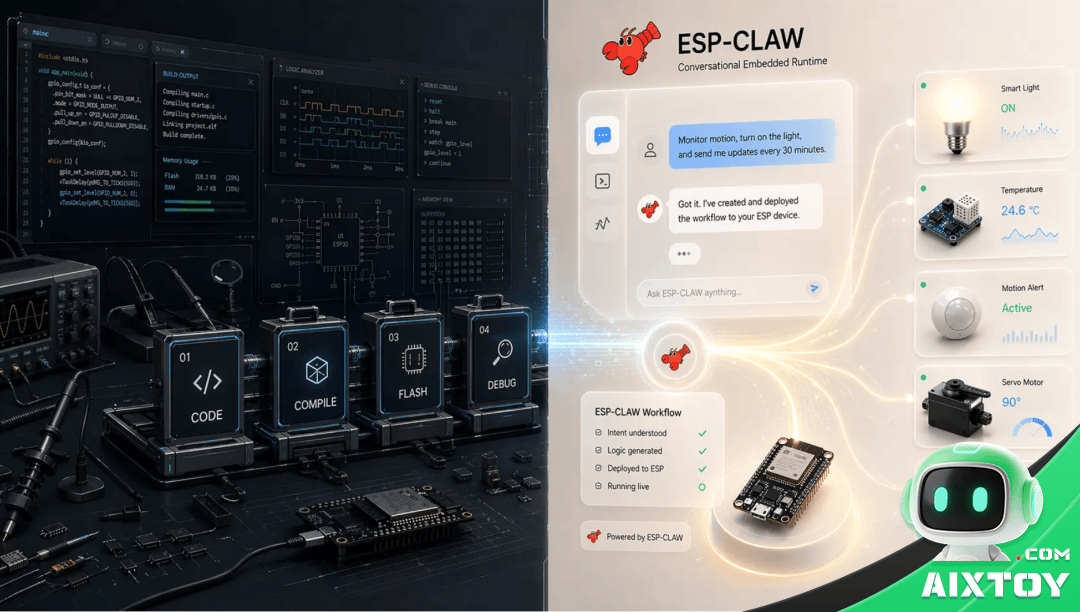
Modular Agent Design. ESP-Claw implements a clean separation between the agent core (reasoning loop), tool registry (callable functions), and communication layer (MQTT/HTTP). This means adding new capabilities — like controlling a motor, reading a sensor, or querying an API — is as simple as registering a tool function.
Tool-Calling Architecture. Inspired by OpenAI’s function-calling paradigm, ESP-Claw allows the language model (running either locally or remotely) to invoke C functions on the device. The agent decides which tool to call based on user intent, executes it, and returns the result — all in a tight event loop.
Protocol-Agnostic. The framework supports multiple communication backends: WiFi, BLE, ESP-NOW, and even Thread. This means your ESP32 agent can work in mesh networks, point-to-point connections, or traditional cloud setups.
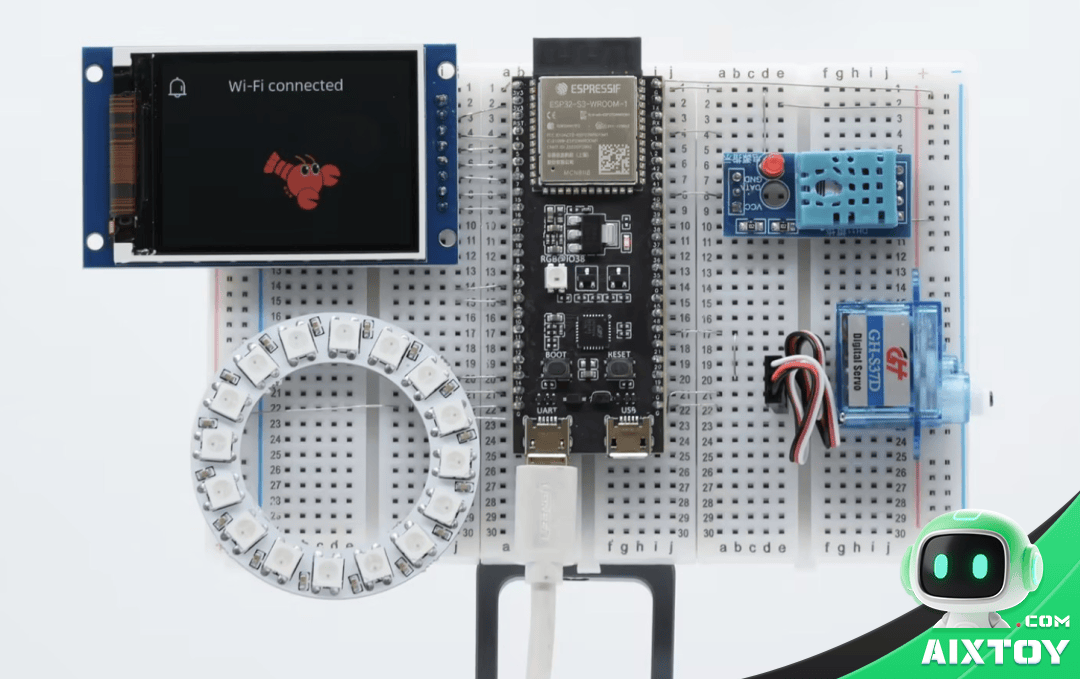
What You Can Build
The practical applications span every corner of IoT: a smart sensor that reasons about anomalies before alerting, a robot controller that interprets natural language commands in real time, an industrial monitor that decides when to trigger maintenance — all running on a microcontroller that costs under $5.
ESP-Claw represents a paradigm shift: the agent does not need to live in the cloud. It can live on the edge, in the very devices it controls. For embedded developers and AI engineers alike, this is the framework to watch.
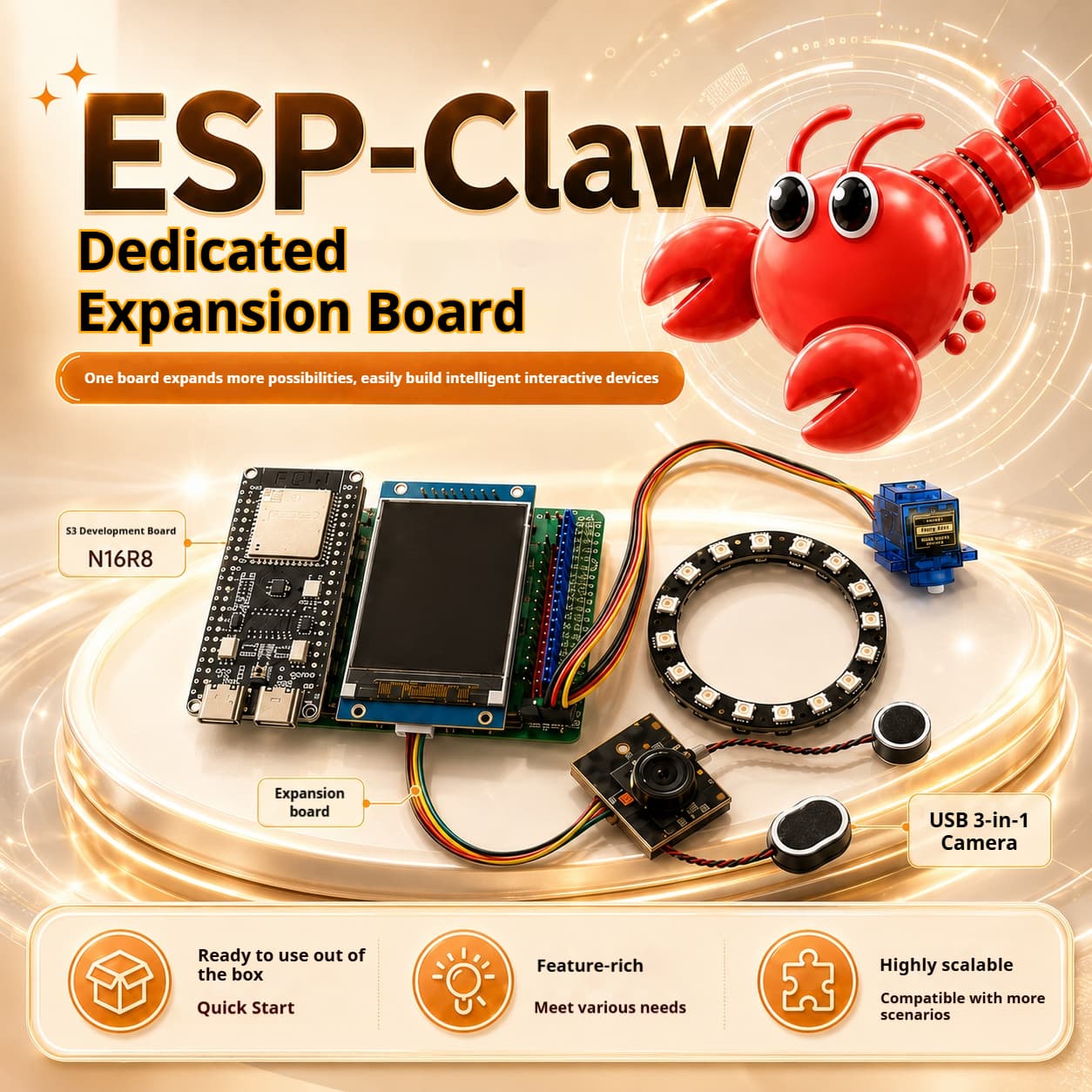
ESP-Claw Expansion Board – ESP32 Programmable I/O Module
$19.99
ESP32-powered programmable robotics I/O expansion module for DIY robot arm and smart car projects – build, code, and create with full GPIO control.
Tags:Agent FrameworkAIXTOYEdge AIEmbedded AIESP-ClawESP32EspressifIoTOpen Source