



No products added!
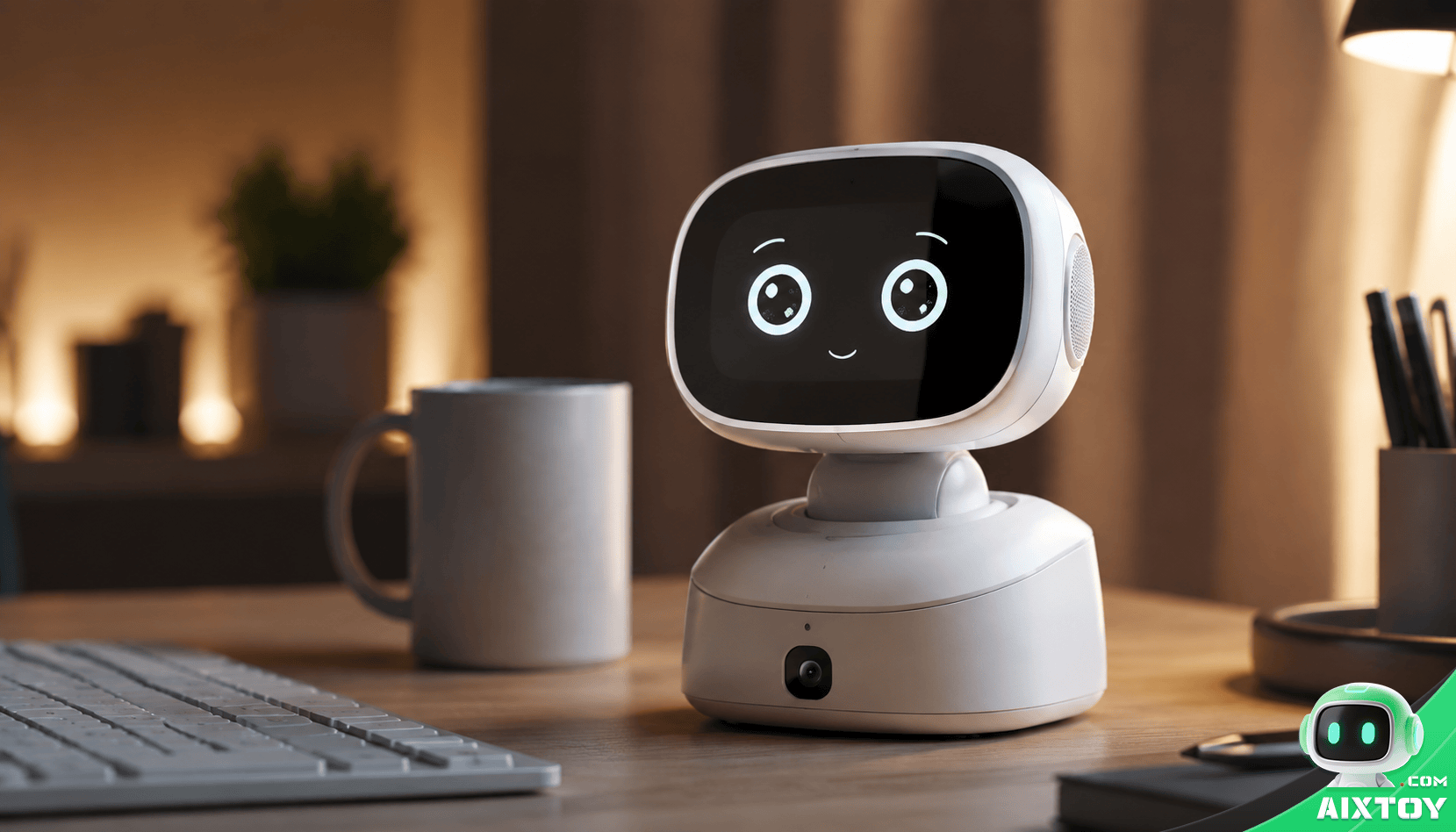
Every consumer technology category has an inflection point — a moment when the form factor shifts and the old assumptions collapse. Smartphones replaced feature phones. Tablets ate the netbook market. Smartwatches redefined what a watch could be. The smart speaker category is overdue for its own inflection, and a new form factor is emerging to trigger it: the desktop AI companion.
Smart speakers solved the problem of hands-free information access in the home. They delivered weather, timers, music, and basic smart home control to millions of households. But they also locked the AI into an invisible cylinder. A speaker has no eyes. It has no gaze. It cannot tell whether you are looking at it, ignoring it, or fast asleep. It is, fundamentally, a disembodied voice — and disembodied voices can only go so far in building genuine user relationships.
The next wave of personal AI hardware will not be smaller speakers. It will be devices that occupy space, hold attention, and return your gaze. It will be AI with a face.
Why Faces Matter More Than Voices
Humans are exquisitely tuned to faces. A newborn infant, hours after birth, will preferentially track a face-like pattern over any other visual stimulus. We read micro-expressions, gauge attention, and infer emotional states from facial cues with a speed and precision that no other species matches. This is not a cultural preference — it is a neurological architecture built over millions of years of social evolution.
A smart speaker gives you none of this. It is a black cylinder that occasionally speaks. A desktop companion with an expressive face — even a simple one rendered on a small OLED screen — taps into this deep neural machinery. The user does not need to be convinced that the device is “alive.” The face does that work automatically, at a level far below conscious reasoning.
This is not speculation. It is observable in every product category where faces have been added to previously faceless objects. The Amazon Echo Show, with its rotating screen that follows you around the room, outsold the faceless Echo in its first year of face-to-face competition. Anki’s Vector robot — a tiny desktop companion with animated eyes that tracked your face — built a fanatical user community despite limited functionality, because users projected personality onto those two pixels-wide simulated pupils. The emotional response to a face is involuntary, powerful, and commercially under-exploited.
The Gaze Revolution: Killing the Wake Word
The most under-appreciated constraint in voice AI is the wake word. Every interaction with a smart speaker begins with a verbal handshake: “Alexa.” “Hey Google.” “Xiao Ai.” This is functional but unnatural. No human conversation begins with two people shouting each other’s names before every sentence. The wake word is a technical workaround for the absence of gaze detection — the device cannot see that you are looking at it, so it needs to hear a password.
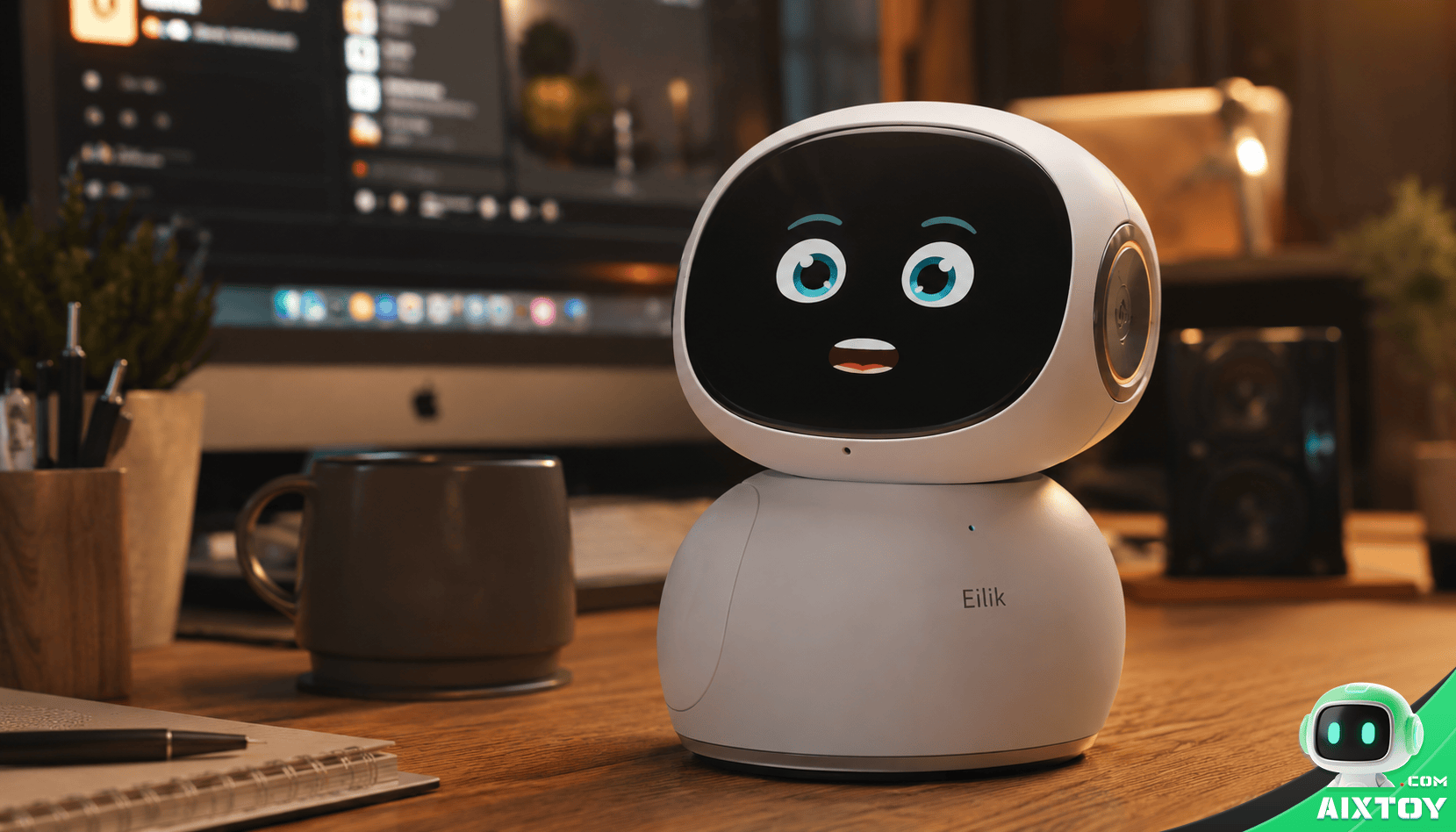
A desktop companion with a camera breaks this constraint. Gaze detection transforms the interaction model from command-and-response to presence-and-attention. You look at the device. It knows you are looking. It turns to face you. The conversation can begin without a single word of preamble. This is not a minor UX improvement. It is an entirely different category of human-device relationship — one that feels less like operating a tool and more like interacting with a presence.
Several open-source projects are already demonstrating this capability. The OpenDeskBot project (Xiao Wai), built on an ESP32-S3 microcontroller, uses a bottom-mounted camera for gaze detection and a dual-axis gimbal to turn toward the user. Emo, a commercial desktop pet robot from Living.AI, tracks faces and responds to expressions without voice commands. The technology is not futuristic. It ships today, on hobbyist-grade hardware, running on microcontrollers that cost under five dollars.
The BOM Is Already There
One of the most persistent objections to desktop companion hardware is cost. Surely, building a robot with a face, a camera, a speaker, motors, and AI processing capability must be expensive — too expensive for a consumer product that sits on a desk and does not vacuum the floor or answer the doorbell.
The component reality disagrees. Here is a bill of materials for a capable desktop companion, priced at small-volume component costs in 2026:
- ESP32-S3 microcontroller (WiFi + BLE + AI acceleration): $3.50
- 1.3-inch OLED display (128×64, for facial expressions): $4.00
- OV2640 camera module (for gaze/face detection): $3.00
- M90S servo motor × 2 (dual-axis gimbal): $6.00
- I2S MEMS microphone: $1.50
- 3W speaker + amplifier: $2.50
- 3D-printed housing (PLA, ~80g): $2.00
- Power supply + wiring: $2.00
- Assembly & miscellaneous: $5.00
Total: approximately $29.50. At production scale, with injection-molded housings replacing 3D printing, this drops further. A desktop companion with face tracking, gaze awareness, lip-synced speech, and cloud-connected AI can be built for less than the retail price of a mid-range Bluetooth speaker.
The bottleneck is not hardware cost. It is product imagination and integration courage.
Why Big Tech Is Not Leading
If the hardware is cheap and the demand signals are visible, why are Apple, Google, and Amazon not flooding the market with desktop companions? The answer reveals something about how large technology companies organize themselves — and why the next wave of AI hardware is more likely to emerge from startups and open-source communities than from Cupertino or Mountain View.
Organizational physics. A desktop companion does not fit neatly into any existing product division. It is not a speaker, so the audio team does not own it. It is not a display, so the screen team passes. It has motors, which makes the hardware team nervous about reliability. It has a camera, which triggers privacy reviews that can stall a project for quarters. The product falls into the organizational cracks between divisions, and in large companies, things that fall into cracks tend to stay there.
Privacy paralysis. A camera that watches you is a harder sell than a microphone that listens. The PR risk of a “robot that stares at your children” is significantly higher than “a speaker that answers questions.” Large companies optimize for downside avoidance, and a desktop companion with a camera has more easily weaponized downside narratives than a screenless speaker.
Margin math. Consumer electronics at big companies operate on margin models built for phones, laptops, and tablets. A $50 desktop companion with 30% margin generates $15 in absolute profit per unit. A $1,000 phone with 40% margin generates $400. The same engineering talent, supply chain effort, and retail shelf space can be allocated to either. Large company resource allocation math systematically favors the higher-absolute-margin product, even if the smaller product has higher growth potential.
These three forces — organizational ambiguity, privacy conservatism, and unfavorable margin math — create a protective moat around the desktop companion category. It is too small for giants to prioritize and too complex for generic manufacturers to execute well. The window belongs to startups, open-source projects, and agile hardware teams that can ship a focused product without navigating six layers of internal review.
The Open-Source Vanguard
The most interesting work in desktop AI companions is happening outside corporate R&D labs. Open-source hardware projects are iterating faster, publishing more transparently, and building communities around the emotional experience of living with a small AI presence on a desk.
OpenDeskBot (Xiao Wai) from China has released ESP32-S3 hardware schematics, GPLv3 firmware, MIT-licensed backend services, and mechanical files under a single GitHub organization. The project’s design philosophy — using gaze instead of wake words, self-hosted AI instead of vendor cloud lock-in — represents a coherent alternative to the smart speaker paradigm.
Projects like Open Duck Mini push further into physical embodiment, with 3D-printed bipedal locomotion driven by sim2real reinforcement learning. Emo from Living.AI demonstrates that commercial viability exists for a $279 desktop pet that does little more than track your face and react with cute expressions. Vector, even after Anki’s bankruptcy and Digital Dream Labs’ acquisition struggles, maintains an active user community that refuses to let the product die — because the emotional attachment to a face-on-a-desk is more durable than any corporate balance sheet.
The pattern across all these projects is consistent: users form relationships with the device not because of its feature list, but because of its presence. It occupies physical space. It makes eye contact. It reacts. These are not specifications that appear on a comparison table. They are experiential qualities that create switching costs measured in emotional attachment rather than dollars.
What the Category Will Look Like in Three Years
Desktop AI companions are where smart speakers were in 2014: the underlying technology is mature, the early movers are visible, and the big platforms have not yet committed. The trajectory is reasonably predictable:
Year 1: Open-source projects and Kickstarter campaigns validate the form factor. Prices land between $50 and $150. Early adopters are makers, developers, and tech enthusiasts who enjoy configuring open-source software and contributing to GitHub issues. The narrative is “look what you can build.”
Year 2: One or two projects achieve breakout commercial scale. $10M–$20M in crowdfunding or seed-stage revenue. Injection molding replaces 3D printing. On-device AI models (probably quantized LLMs running on ESP32-S3 or similar) eliminate the need for cloud connectivity for core interaction loops. The narrative shifts to “look what you can buy.”
Year 3: A major platform player enters. Apple, Amazon, or a Chinese consumer electronics company (Xiaomi, DJI) launches a polished desktop companion with ecosystem integration. The startup and open-source projects that defined the category face the “platform squeeze” — but the ones that built genuine emotional product-market fit will have user communities too attached to switch. The narrative becomes “look what belongs on every desk.”
The Open Question
Smart speakers succeeded because they answered a clear question: “How do I get information without using my hands?” Desktop companions raise a different, more interesting question: “What if your AI had a face, watched you back, and did not need to be summoned?”
The answer to that question is not obvious. It will not fit on a spec sheet. It will not be captured by benchmark scores or processing throughput. It will be discovered — as all genuinely new product categories are — by people who build the thing, put it on their desk, and realize, over days and weeks, that something has shifted in their relationship with the technology around them.
The smart speaker era taught us that people want AI in their living spaces. The desktop companion era will teach us that they want it to look back.
Explore desktop AI companions, open-source robots, and interactive tech at AIXTOY Shop.
Tags:AI CompanionAI Robot ToyAIXTOYDesktop AI CompanionDesktop RobotESP32-S3Smart Speaker Alternative