

No products added!
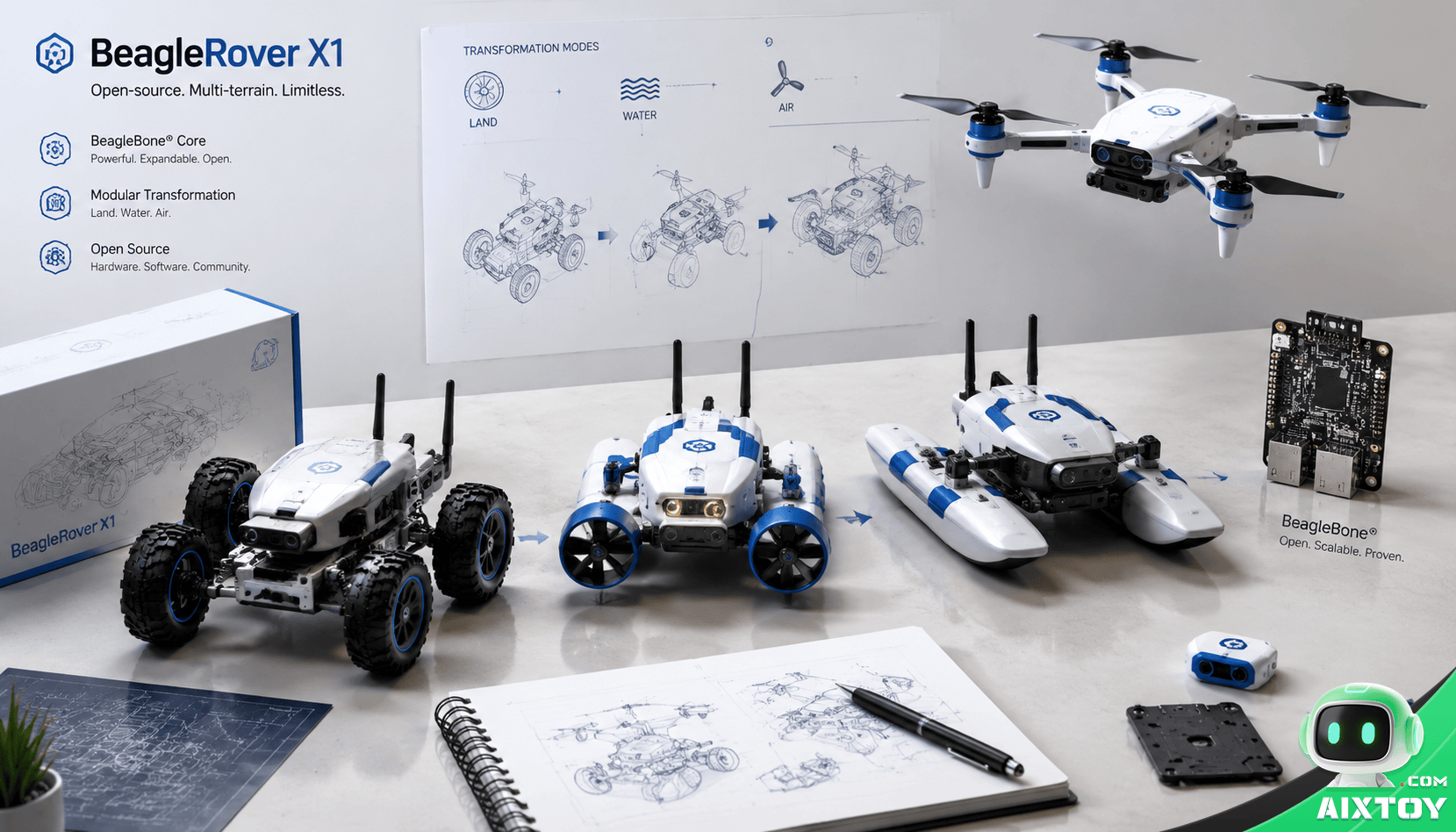
After building a basic wheeled robot, adding motor control, vision recognition, obstacle avoidance, and remote operation, many makers hit the same question: what is next? The answer is not a faster processor or a bigger chassis. It is breaking free of the wheeled form factor entirely — taking the same controller, the same code architecture, and the same development mindset into completely different physical domains.
This guide covers the three most accessible multi-form robot expansions for the maker and STEM education community: marine surface robots, underwater ROVs, and educational quadcopters — all built around a single-board computer like the BeagleBone Black. The core insight is simple: the controller does not change. The carrier, power system, sensors, and environment do.
The Universal Robotics Stack
Before diving into individual robot forms, understand the architecture that makes all of them possible. Every robot in this guide shares the same functional stack:
- Data acquisition: Sensors read the physical world — GPS coordinates, depth, attitude, distance to obstacles, water flow
- Computation: The BeagleBone Black processes sensor data and runs control algorithms — PID loops, navigation logic, safety checks
- Actuation: Motor drivers convert computed commands into physical motion — propeller thrust, servo angles, motor speeds
- Communication: Wireless or wired links provide telemetry and remote control capability
The four robot forms covered here — land, marine surface, underwater, and aerial — differ only in which specific hardware fills each layer of this stack. The code that reads a wheel encoder is structurally identical to the code that reads a propeller RPM sensor. The PID controller that keeps a car tracking a line is algorithmically identical to the PID controller that keeps a boat on a GPS waypoint. Once you internalize this, you stop seeing different robots and start seeing different configurations of the same system.
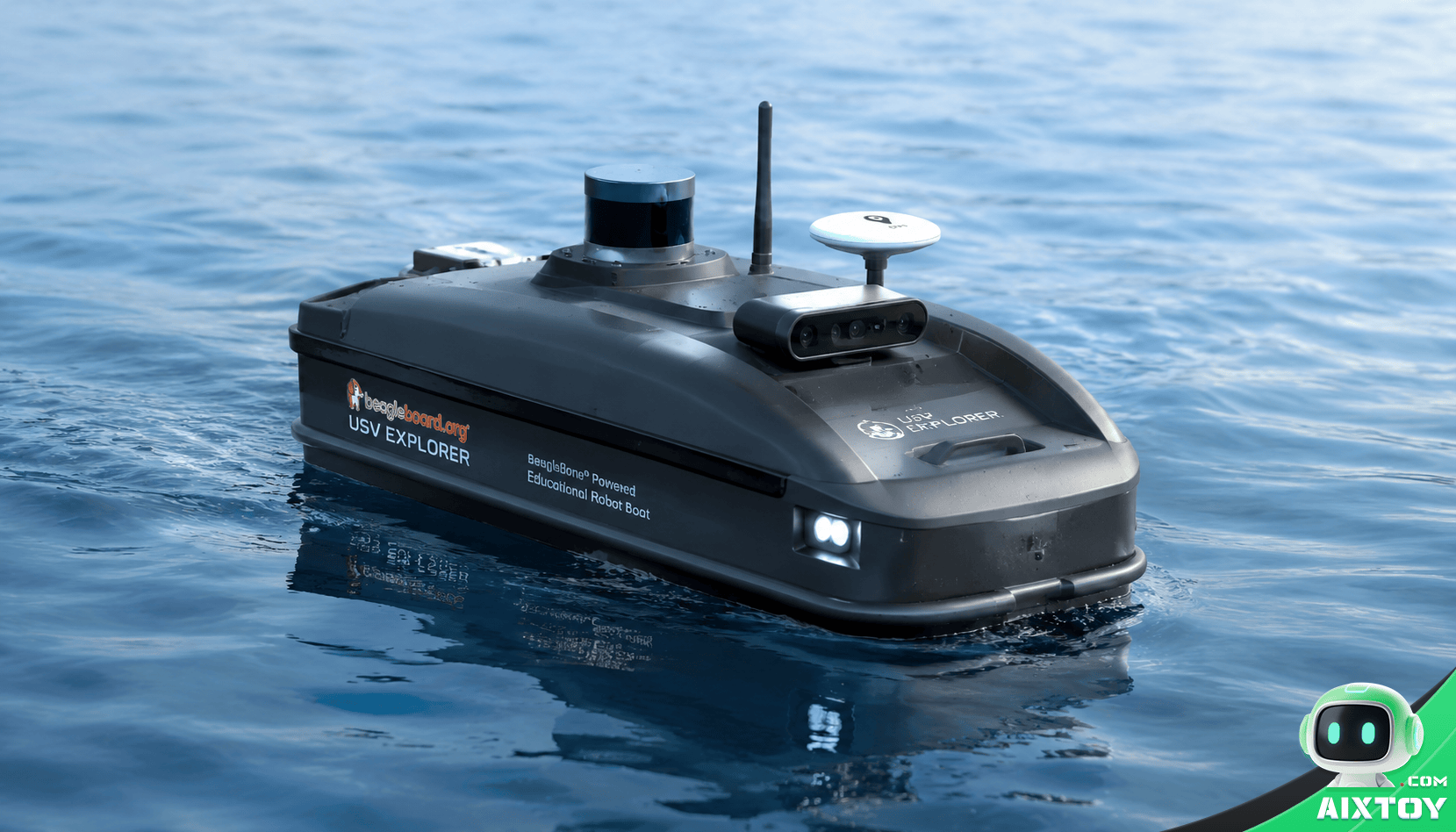
Marine Surface Robot: Autonomous Boat Building
Hardware Selection
- Hull: A simple RC boat hull provides stable buoyancy — no need for custom fabrication
- Propulsion: Dual left/right propellers replace wheels. Differential thrust steers exactly like differential wheel drive
- Control: BeagleBone Black + L298N motor driver — the same driver used for wheeled robots
- Sensors: GPS module for waypoint navigation, water flow sensor for drift compensation, waterproof ultrasonic for obstacle detection, waterproof camera for live video
- Protection: Simple waterproof enclosure around the board and circuits — silicone sealant and a transparent food container go surprisingly far
Code Adaptation
The motion control code is nearly identical to a wheeled robot. Left and right propellers use the same differential steering logic: reduce left thrust and increase right thrust to turn left, and vice versa. The only change is the GPIO pin mapping — propeller ESCs connect to different pins than wheel motor drivers, but the software abstraction layer stays the same.
GPS waypoint navigation is where marine robots come into their own. On land, GPS-guided navigation is constrained by roads, obstacles, and terrain. On open water, a robot can navigate directly to a coordinate — no path planning required. Set a target latitude and longitude, compute bearing and distance, and let a PID controller maintain the heading while the propellers maintain speed. The result is a robot that can autonomously survey a lake, patrol a coastline, or deliver a payload across a pond.
The Water Compensation Problem
Water introduces a complication that land robots never face: drift. Currents, wind, and waves push the boat off course continuously. Without compensation, GPS waypoint navigation becomes a zigzagging mess. The solution is a PID heading correction loop that compares the boat’s actual heading with the desired heading to the waypoint, and adjusts differential thrust in real time. Tuning the P, I, and D gains for water conditions takes trial and error — start with conservative values and increase proportional gain until the boat tracks straight in calm water.
Underwater ROV: Building a Simple Submersible
Underwater robots are the next step in difficulty. Waterproofing, pressure management, buoyancy control, and signal transmission all become harder when the entire robot is submerged. This section covers a shallow-water educational ROV — not a deep-sea research vessel, but a practical project that teaches the fundamentals of subsea robotics.
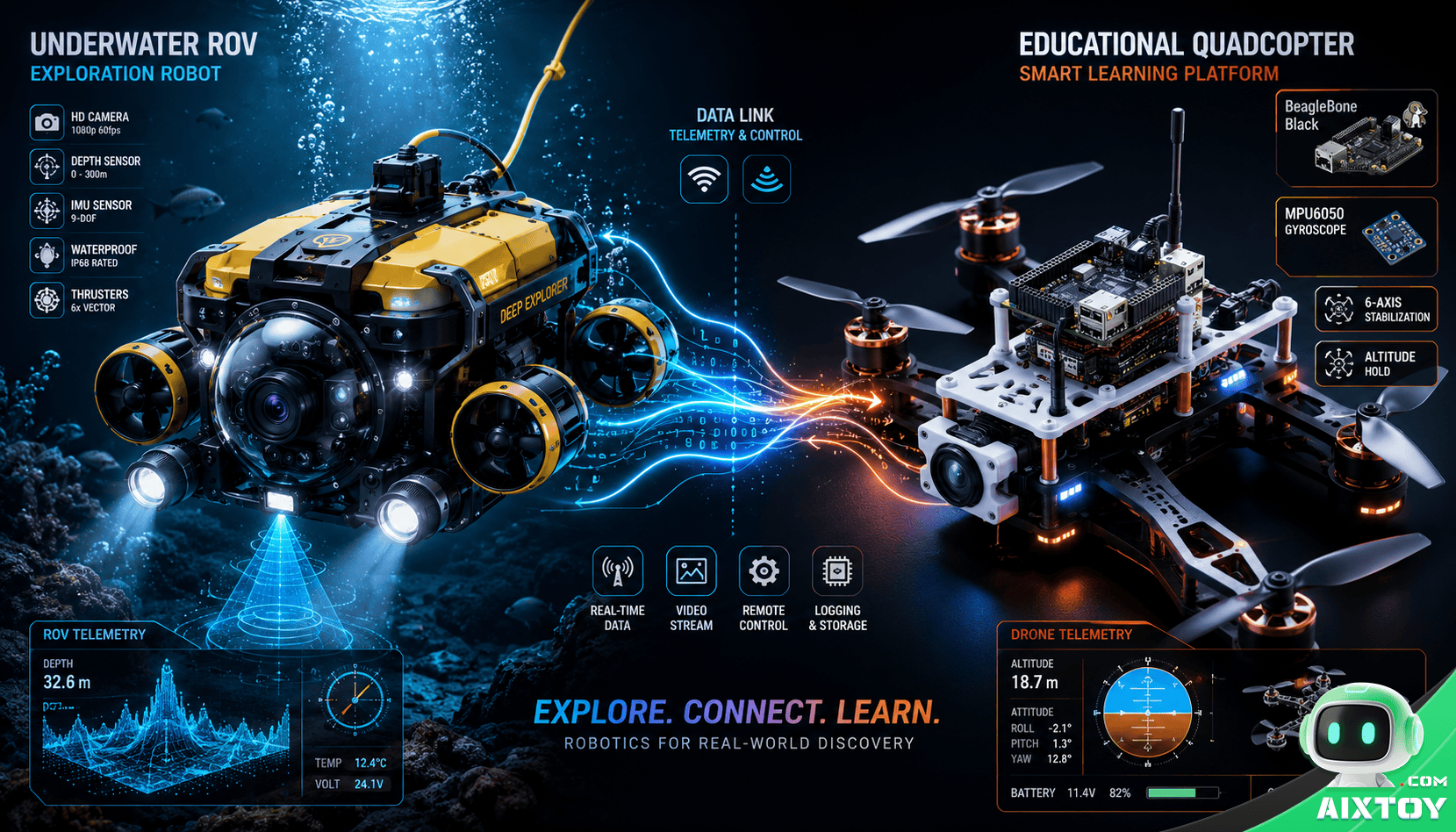
Hardware Essentials
- Pressure housing: A sealed acrylic tube or waterproof electronics enclosure holds the BeagleBone and circuitry. O-ring seals at both ends
- Thrusters: Multiple waterproof brushless thrusters — typically two for forward/backward, two for vertical (ascend/descend), and one or two for lateral movement and rotation
- Sensors: Depth/pressure sensor for maintaining depth, underwater camera with LED lighting, ultrasonic for close-range obstacle detection
- Power: Waterproof LiPo battery pack, fully insulated. All connections double-sealed with heat-shrink tubing and marine-grade adhesive
- Communication: Wired control is mandatory. Radio signals attenuate within centimeters underwater. A neutrally buoyant tether cable carries power, control signals, and video back to the surface operator
Depth Control Logic
Depth control is the defining challenge of underwater robotics. The robot must maintain a set depth despite variations in buoyancy — water temperature changes density, trapped air compresses at depth. A depth sensor provides the feedback signal. A PID controller adjusts vertical thruster output to hold the target depth. The implementation is straightforward — a single control loop reading one sensor and driving one motor axis — but the tuning requires patience. Overshoot means the robot bobs up and down. Undershoot means it sinks slowly. The right gains produce a robot that locks onto a depth and stays there like it is on rails.
Safety note: Start in shallow, clear water — a swimming pool or calm pond. Verify waterproofing at the surface before submerging. Keep the tether short enough for quick manual retrieval. Never build a deep-water ROV as your first underwater project.
Educational Quadcopter: Learning Flight Control
A BeagleBone Black is not the right controller for a racing drone or a professional aerial photography platform — those applications demand dedicated flight controllers running real-time firmware at kilohertz loop rates. But for an educational quadcopter designed to teach the fundamentals of attitude estimation, motor mixing, and PID control, it is perfectly adequate and deeply instructive.
Hardware Configuration
- Frame: 250mm–450mm quadcopter frame — large enough to mount a single-board computer, small enough to fly in a field
- Motors: Four brushless motors with matching ESCs. 1000–1400KV range for a gentle, educational flight envelope
- IMU: MPU6050 6-axis gyroscope + accelerometer for attitude estimation
- Power: LiPo battery with power management board supplying stable 5V to the BeagleBone and 12V to the ESCs
- Communication: WiFi or RC receiver for remote control commands
Core Development Tasks
Attitude estimation is the heart of flight control. The MPU6050 provides raw gyroscope and accelerometer readings. A complementary filter or a simple Kalman filter fuses these into a stable estimate of pitch, roll, and yaw. The gyroscope provides fast, short-term orientation data. The accelerometer provides slow, long-term drift correction. Together they produce an attitude estimate stable enough for manual flight.
Motor mixing translates desired attitude changes into individual motor speeds. A quadcopter in X-configuration uses a simple mixing matrix applied across four motors. The math is linear and fits in under 20 lines of code — but understanding it is the gateway to all multirotor flight control.
Safety logic is non-negotiable. Implement a low-battery auto-land sequence and a signal-loss failsafe that cuts throttle. Never fly near people, buildings, or restricted airspace.
Universal Development Patterns
After building across land, water, and air domains, certain design patterns become obvious:
Code reuse is the superpower. Motor control, sensor reading, PID loops, and communication protocols are domain-agnostic. A function that reads a wheel encoder on a land robot reads a propeller RPM sensor on a marine robot with zero changes to the logic — only the pin number changes. Structure your code as a library of reusable modules and each new robot form becomes a configuration exercise rather than a rewrite.
Environmental adaptation, not algorithm replacement. Moving from land to water does not require new control theory. It requires tuning existing PID gains for a different physical response curve. The same PID structure works; the gains are different. Learn to tune for the environment rather than seeking a new algorithm for every domain.
Safety scales with domain complexity. A land robot that malfunctions stops moving. A boat that malfunctions drifts. A drone that malfunctions falls from the sky. An ROV that malfunctions floods. Build, test, and validate incrementally — shallow water before deep, low altitude before high, short range before long.
Modular architecture pays compounding dividends. Separate motor control, sensor interfaces, and communication into independent modules. When you switch from a wheeled chassis to a boat hull, you swap the motor module — everything else stays the same. This approach turns robot development from a series of one-off projects into a growing platform.
The Real Payoff
The goal of multi-form robotics is not to build one robot that does everything — that is an engineering fantasy that leads to compromised designs. The goal is to build a universal development mindset: a single controller, a shared codebase, a consistent architecture, and the ability to switch physical domains by swapping carriers, power systems, and sensors.
Start with a wheeled robot. Then build the same robot as a boat. The code that steers the wheels steers the propellers. The PID that follows a line follows a GPS waypoint. The sensor that detects obstacles detects shorelines. Somewhere in the process of building the third or fourth form factor, the mental model clicks: you are no longer building robots — you are configuring a platform.
From that point forward, every new robot form is a weekend project.
Explore robot kits, single-board computers, sensors, and multi-terrain platforms at AIXTOY Shop.
Tags:AIXTOYBeagleBoneDIY Robot KitMarine RobotMulti-Form RobotQuadcopterRobot KitSTEM RoboticsUnderwater ROV