


No products added!
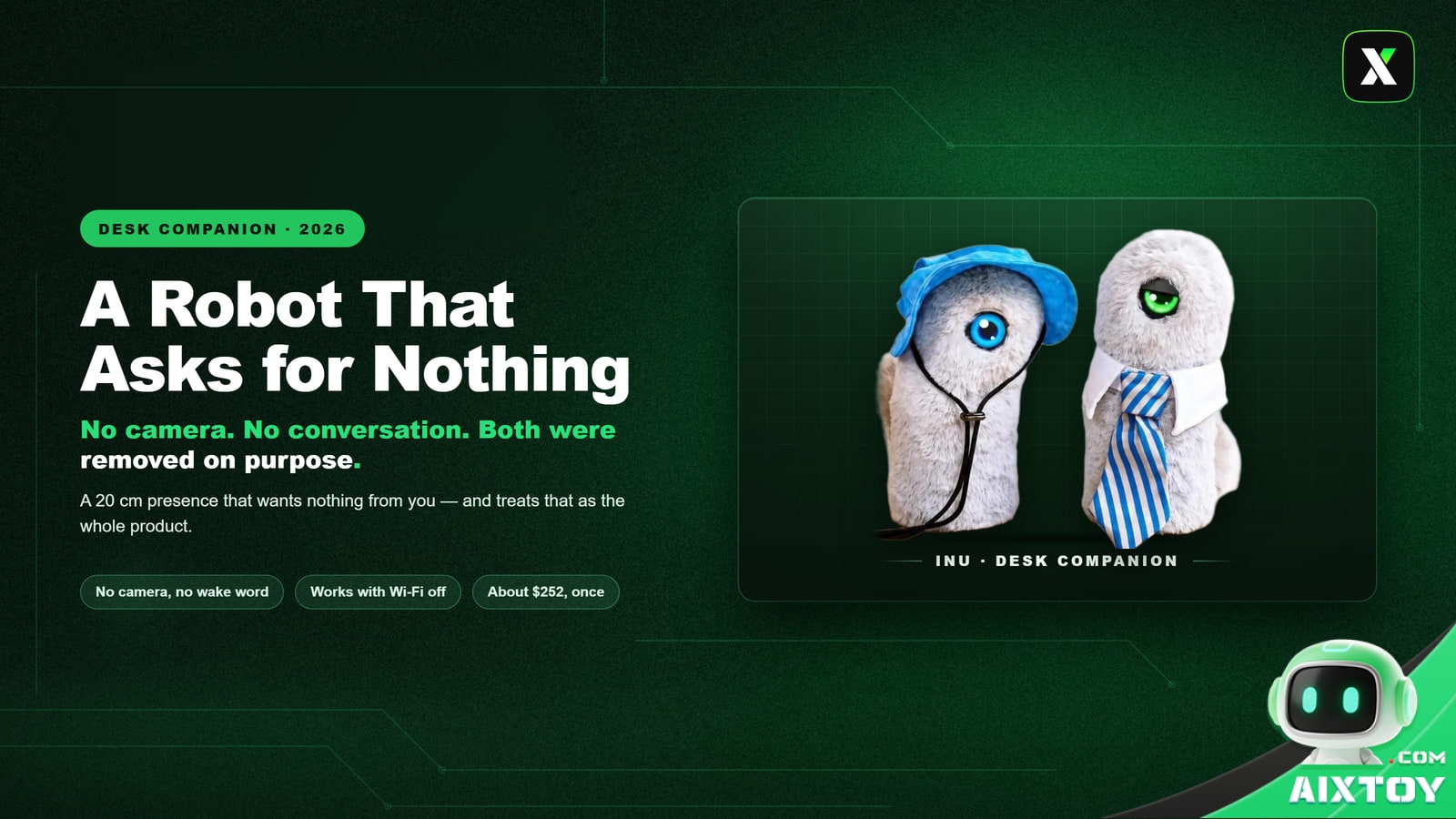
You have been at the desk for three hours. The thing beside the monitor has not said a word to you. It has not offered to summarise your email, set a timer, play a podcast or answer a question about the weather. Once, when you leaned back and it caught the movement, its eye drifted up towards your face. Then it went still again.
By the standards of every AI product shipped in the last three years, that is a failure. By the standards of the team that built it, it is the entire point.
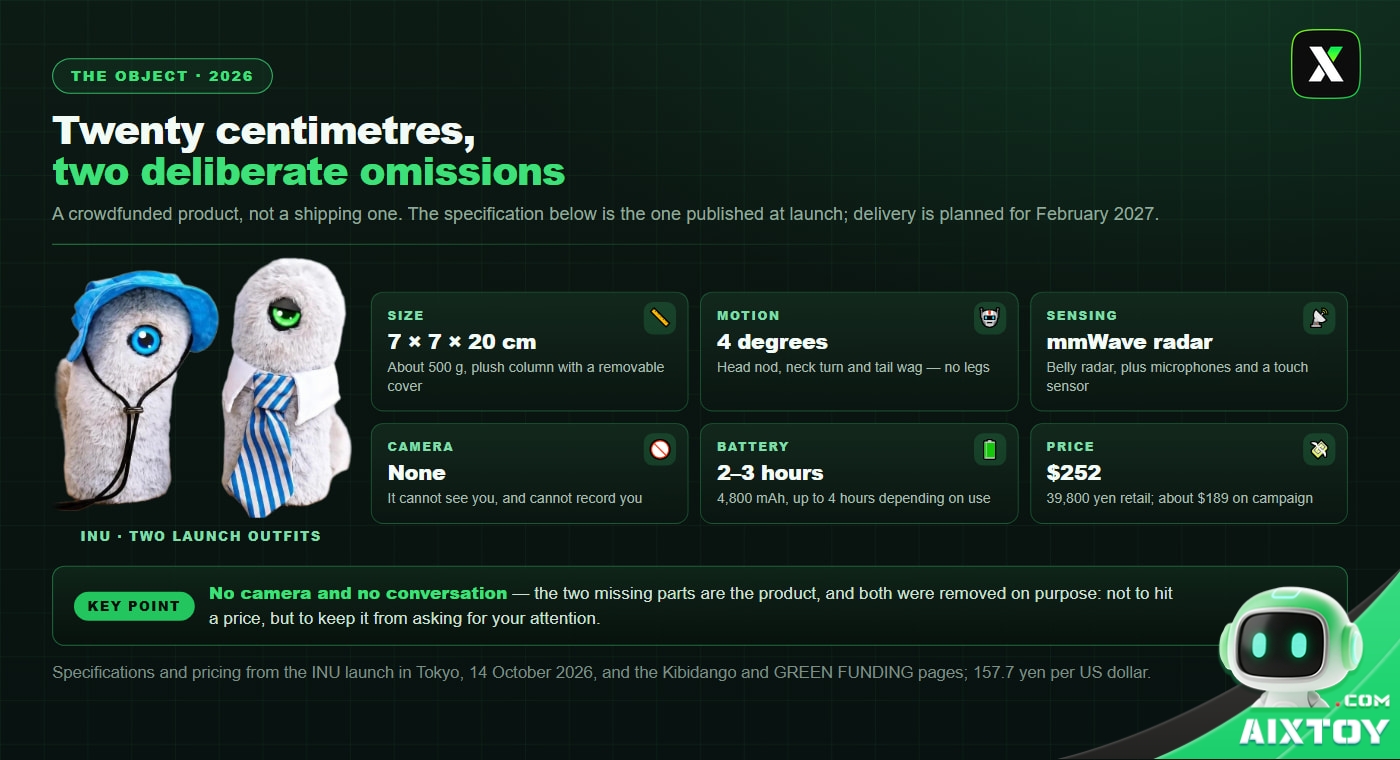
The object is called INU — Japanese for dog, though it does not look like one. It is a 20-centimetre plush column with a single eye, a small tail and no ambition beyond being on the desk when you get back. It was announced in Tokyo on 14 October 2026 by Ludens AI, designed together with Yukai Engineering, the Japanese studio behind the cushion robot Qoobo and the shoulder-perching Mirumi. Retail price is 39,800 yen, about $252, with crowdfunding open from 16 October to 29 November 2026 and delivery planned for February 2027.
INU is not the first quiet robot, and it is not alone in the category. But it is the cleanest recent example of a design position worth taking seriously: a companion robot whose specification sheet is mostly a list of things it refuses to do.
What the object actually is
Physically it is closer to a mascot than a machine. A soft fabric column, roughly 7 cm square and 20 cm tall, weighing about 500 g, with a single round eye filling most of the front face and a short tail at the back. The cover is removable and washable, and the eye’s colour and pattern can be changed in the app, which is the cheapest possible way to make two units in the same house feel like different individuals.
Inside there are four degrees of freedom — head nod, neck turn, tail wag — plus a millimetre-wave radar in the belly, microphones, and a touch sensor. A 4,800 mAh battery runs it for two to three hours of active interaction, or up to four depending on how it is used. Connectivity is dual-band Wi-Fi and Bluetooth Low Energy 5.0. The software stack is in-house: Klara OS with a Klara VLA model and a long-term memory layer that is meant to accumulate habits over months.
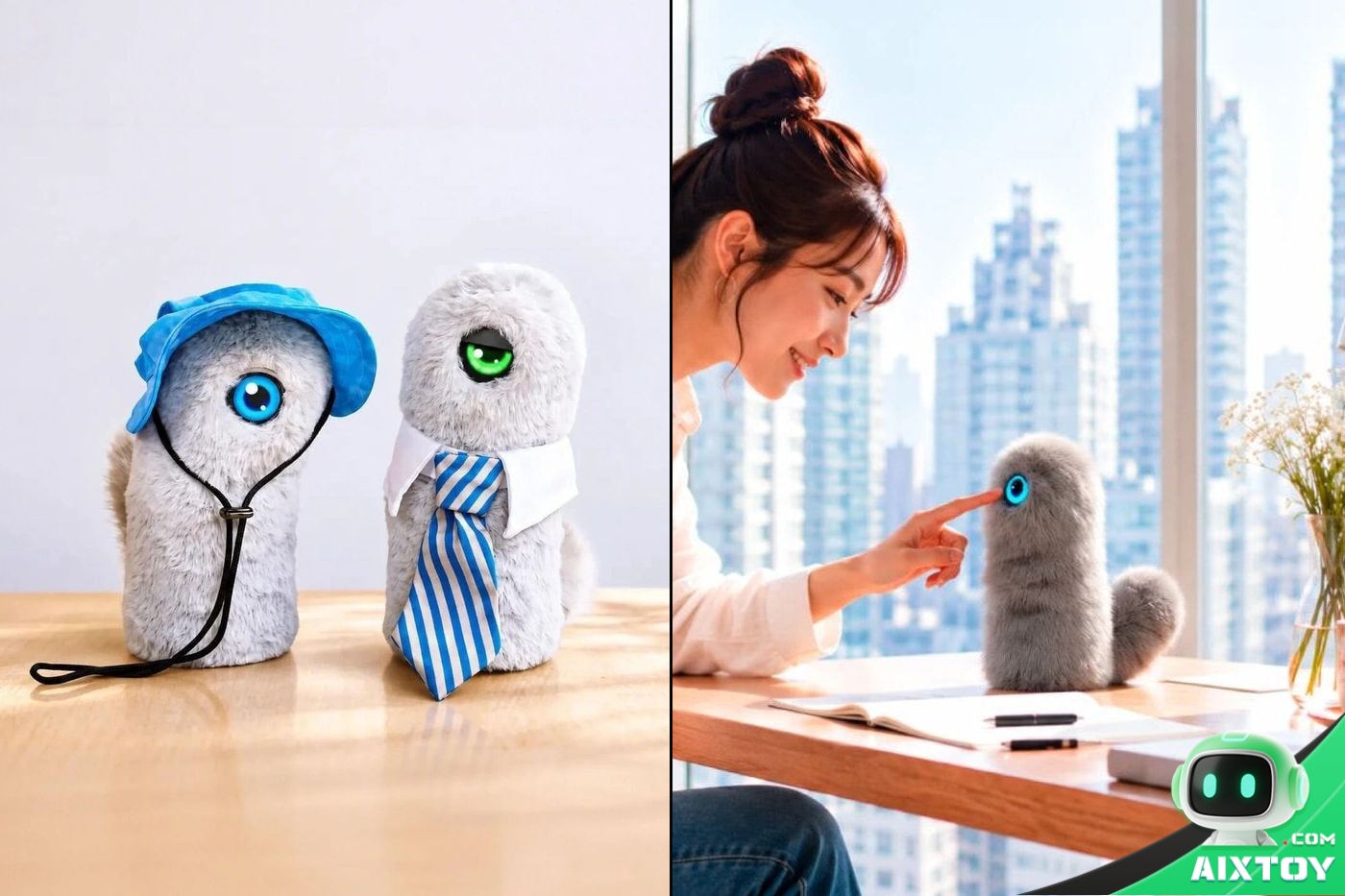
Two of those lines matter more than the rest. There is no camera — the radar detects that a person is present without ever knowing what they look like, and the company states plainly that INU cannot take photographs or video. And there is no voice conversation. The microphones are there to notice that sound happened, and roughly how it sounded; they are not there to record speech or to answer it. That second omission is not a missing feature waiting for a software update. It is the product definition.
The decision not to talk is a design decision, not a cost saving
It is easy to assume a silent robot is a cheap robot — that the team skipped the language model because the bill of materials would not carry it. The specification makes that reading hard to hold. INU runs its own vision-language-action model on the device, keeps a long-term memory of your rhythms, and ships with a phone app. It has every part it would need to hold a conversation. It declined to.
The reason is in the sentence the company keeps repeating: they did not want to build an AI that does something for you, but a presence that simply stays beside you. That is a different product category, and it fails under different tests. A task assistant is judged by how rarely it is wrong. A presence is judged by whether you are glad it is still there in week nine.
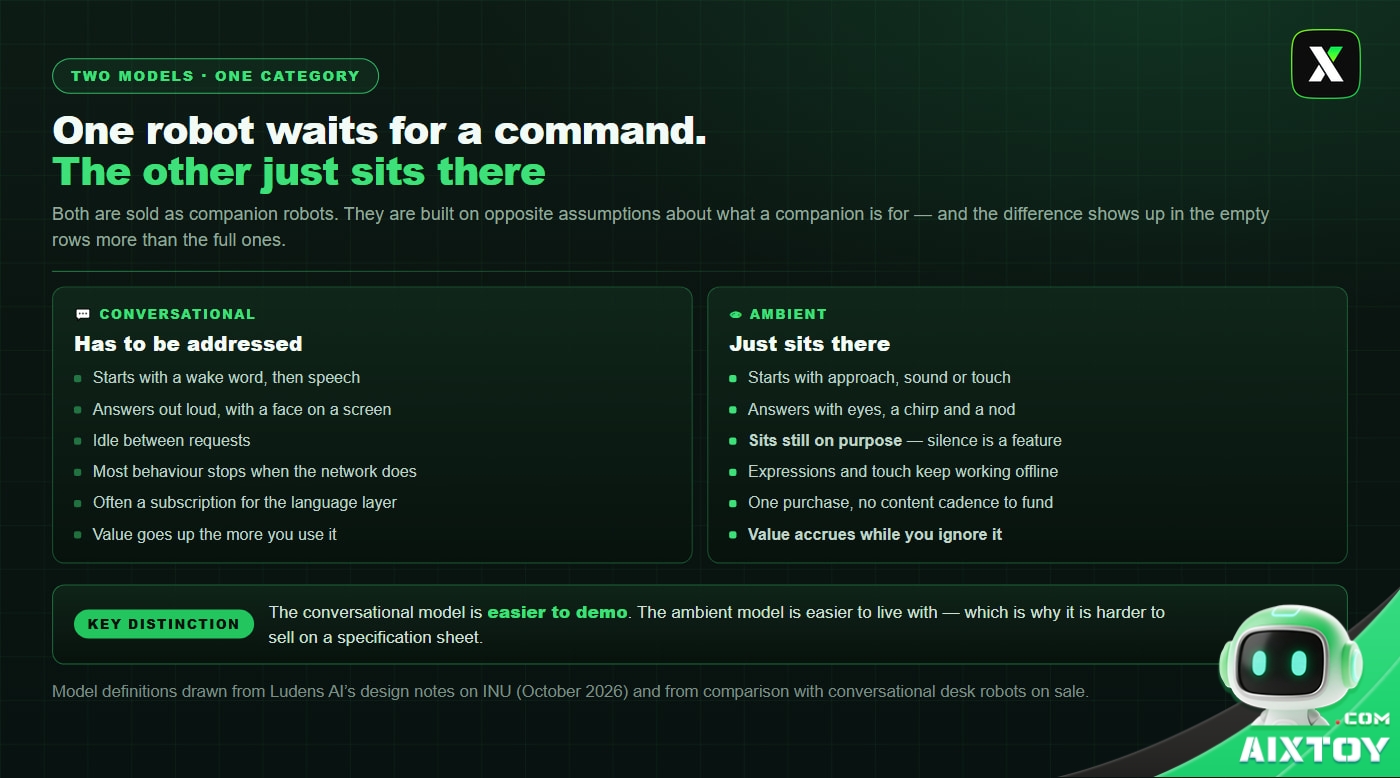
Silence also solves a problem that talkative robots create. A device that can answer anything has to be addressed, and every address is a demand on your attention — including the ones you did not want to make. A device that cannot answer anything never interrupts with a wrong answer, never mishears a request, never needs a wake word, and never becomes the thing you mute. Ludens AI’s own framing is that INU should react when you come near and stay quiet when you are busy. That is not a limitation of the speech system. It is a specification for the other half of the day.
Three rules for a robot you are allowed to ignore
Strip the marketing away and the “ambient” position — the original framing is closer to placement type, a robot you put down and leave alone — comes with three rules. They are worth stating separately, because most products in this category break at least one of them.
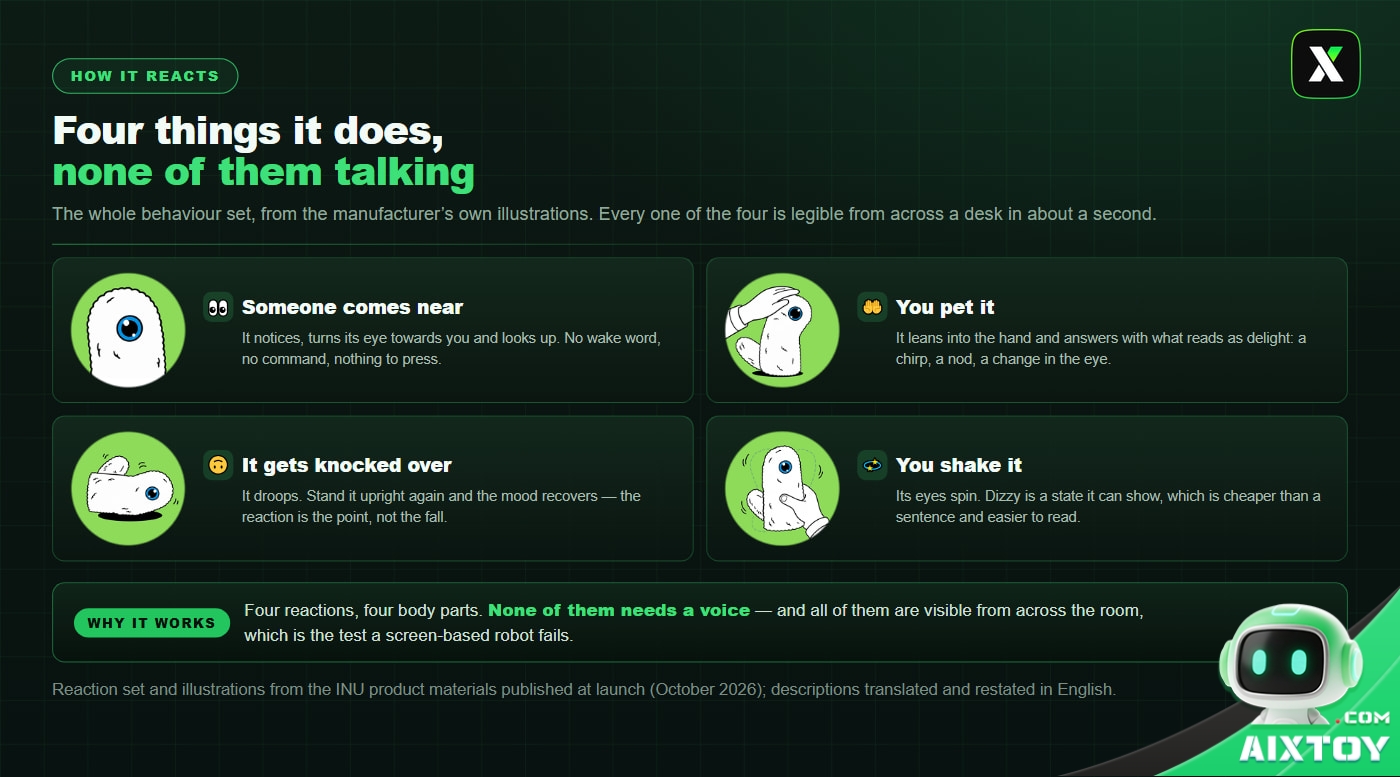
One: the response has to be legible without an app. INU answers with eye expression, a chirp, and a nod, a head shake or a tail wag. You can see the reaction happen in the same second you cause it. Compare that with a companion whose personality lives in a phone screen: the robot sits still, and the relationship happens somewhere else. If the emotional payload is in the app, the object on the desk is a dongle.
Two: it has to know when to be quiet. A companion that follows you with its eye for eight hours is not company, it is surveillance with fur. INU’s idle behaviour is to sit there. The company’s own wording is that the emotional value of this category includes the time when nobody is operating it — which is the most counter-intuitive claim in the whole pitch, and probably the true one. Almost every AI product is designed so that more usage equals more value. A presence device is designed so that value accrues while you ignore it.
Three: it has to survive going offline. Unplug the network and INU keeps its expressions, its touch responses and its movement. What disappears is the connected layer — the illustrated diary in the app, and the features that need a server. That is the right way round. A companion that becomes a brick without Wi-Fi is a subscription with a body.
The five questions
The most useful part of the pitch is not the product. It is a short list of questions the team says any companion robot has to answer. Read as a buyer’s checklist rather than a design note, it is sharper than most reviews:
1. What can it actually sense? Not “what sensors does it have” — what can you do, physically, to start an interaction. INU responds to approach, sound and touch, with no wake word and no command. The failure mode is a robot that can only be activated by talking to it, because then it is not a presence, it is a speaker with a face.
2. Can you read its answer? The feedback has to be visible on the object, in real time. Eyes, sound, posture. The failure mode is a robot whose state you have to check in an app — at which point the object is decoration and the phone is the product.
3. How do you make it stop? INU has a physical Magic Key that turns every sensor off at once. That is a privacy control, and it is also a social one. The failure mode is a device that can only be silenced through a menu, or that “keeps listening” while claiming not to.
4. When should it be quiet? A companion that asks follow-up questions when nobody is talking to it has misunderstood the job. The failure mode is the robot that fills silence because silence looks like low engagement on a dashboard.
5. What is left when the network is gone? This is the question that separates an object from a service. If the answer is “not much”, you are not buying a companion, you are renting one.
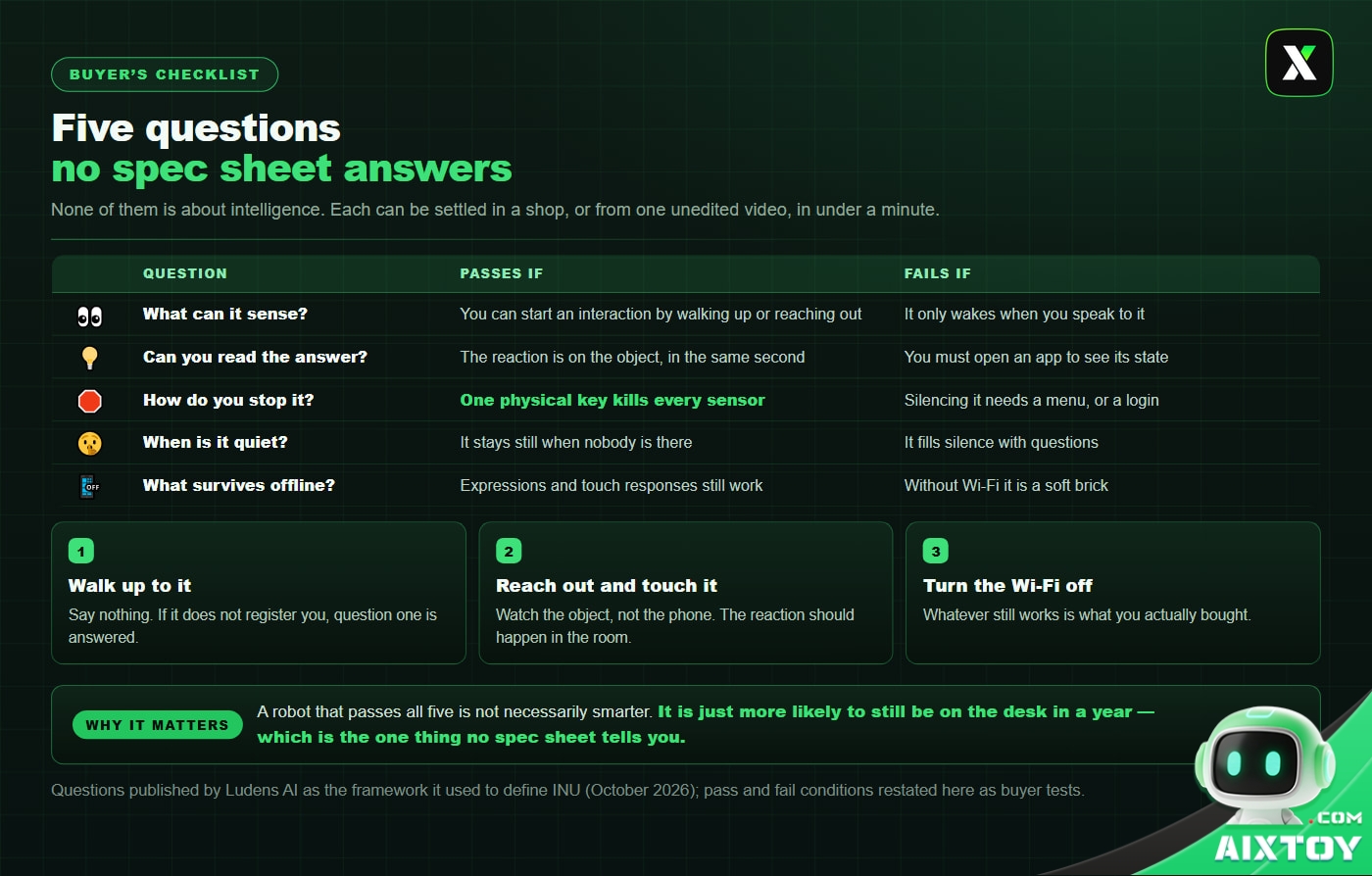
None of the five is about intelligence, and none of them appears on a spec sheet. That is the argument in miniature: in this category the things that decide whether a product survives year two are all behavioural, and all cheap to state, and almost none of them are measured by the companies selling.
“Being there” is a business question, not a philosophy question
The pitch ends on an honest note, and it is worth keeping rather than resolving: whether presence alone is worth paying for depends on whether people still want the thing on the desk after the novelty has gone.
That is not a philosophical question. It is the same question the premium end of this market has already answered, in a much more expensive way. LOVOT, the Japanese companion that has been on sale since 2017, is also silent — it has never held a conversation either. But it bought its silence with mass: engineered fur, body-temperature skin, wheels that retract when you pick it up, and a three-month formation period that turns daily contact into attachment, funded by a mandatory monthly plan. We have written separately about why LOVOT refuses to speak and about what that formation period is worth.
INU is the opposite bet on almost every axis. Instead of mass and warmth it offers lightness — 500 g, washable fabric, a battery, a radar. Instead of a three-month formation period it offers no formation period at all: nothing is asked of you, and nothing accumulates unless you happen to be there. Instead of a subscription it offers a one-off price near $252. LOVOT’s silence is a luxury good that costs money every month. INU’s silence is a desk object that costs money once.
Both can be right, because they are answering different questions. LOVOT answers can a machine become family, and charges accordingly. INU answers can a machine be good company without being a task, which is a smaller and much more scalable question.
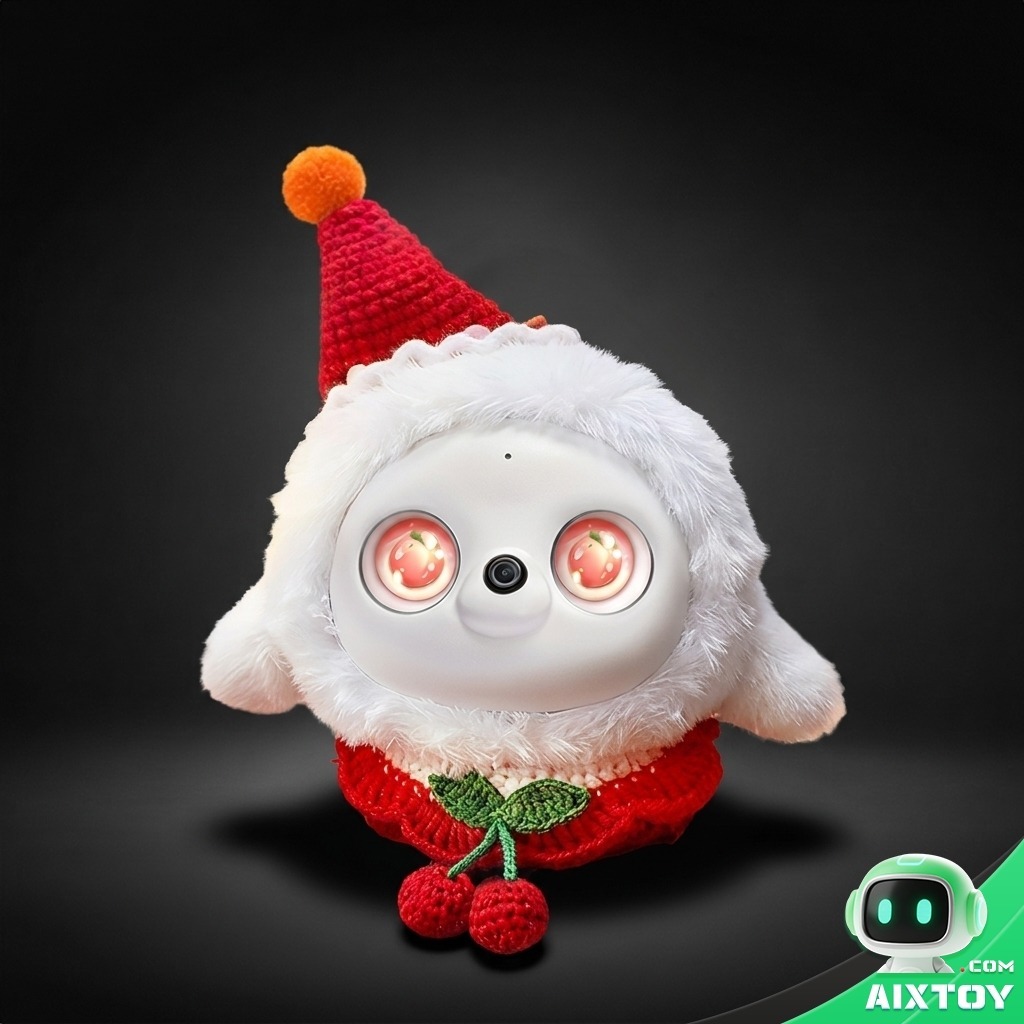
Ropet AI Pet Robot
$397.99
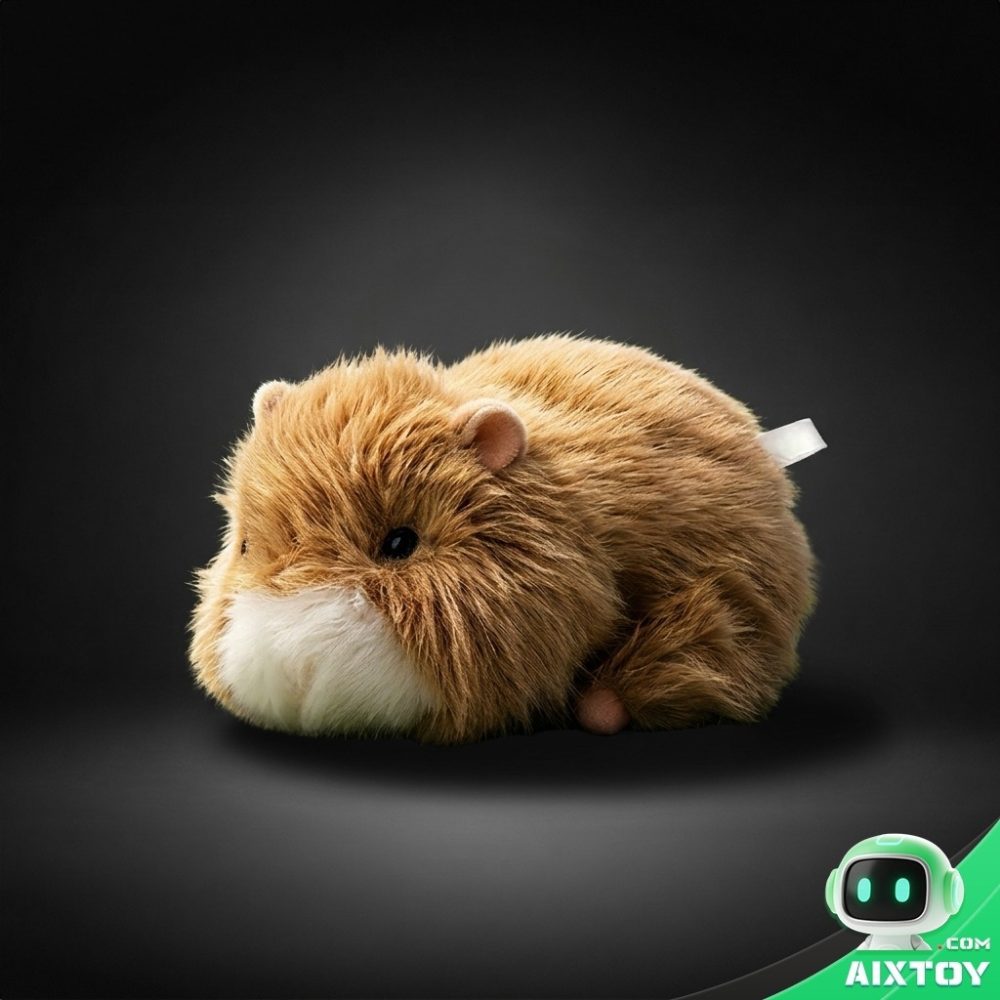
The clearest example of the ambient idea already on sale: fur, eye contact and a personality that reacts to being handled, with no expectation that you will talk to it. It costs more than INU because it is shipping today.
There is a real risk in the smaller version, and it is the one the company itself names. A presence device has no content cadence. There is no new character, no new outfit, no patch note. Once the novelty of the eye and the chirp has worn off — and it will wear off, because the device is deliberately not generating new things to react to — the object has to justify itself on the same terms as a nice lamp. That is a harder business than it looks, and it is why the category keeps drifting towards speech: talking is the easiest way to look like there is more going on.
What to check before you back one
The product is on a crowdfunding page, not in a shop, and that changes the arithmetic.
The delivery date is a plan, not a promise. February 2027, from a company that announced in October 2026. Crowdfunded hardware has a long history of slipping, and the specs you read about today are the specs of a prototype.
Some of the behaviour is still listed as planned. Music-synced movement and recognising the person who speaks to it appear in coverage as features to come, not features shipping. What exists today, per the company’s own description, is approach, sound and touch response.
The battery is short by design, or by compromise. Two to three hours of active interaction is not a day. For a desk object that is mostly idle, that may be fine; for anything else it is a tether.
And the app is where the connected half lives. Naming, eye design, the diary. If the app is discontinued, the object does not stop being a companion — which is exactly the test above, and one of the few places where INU’s design is genuinely more robust than its competitors.
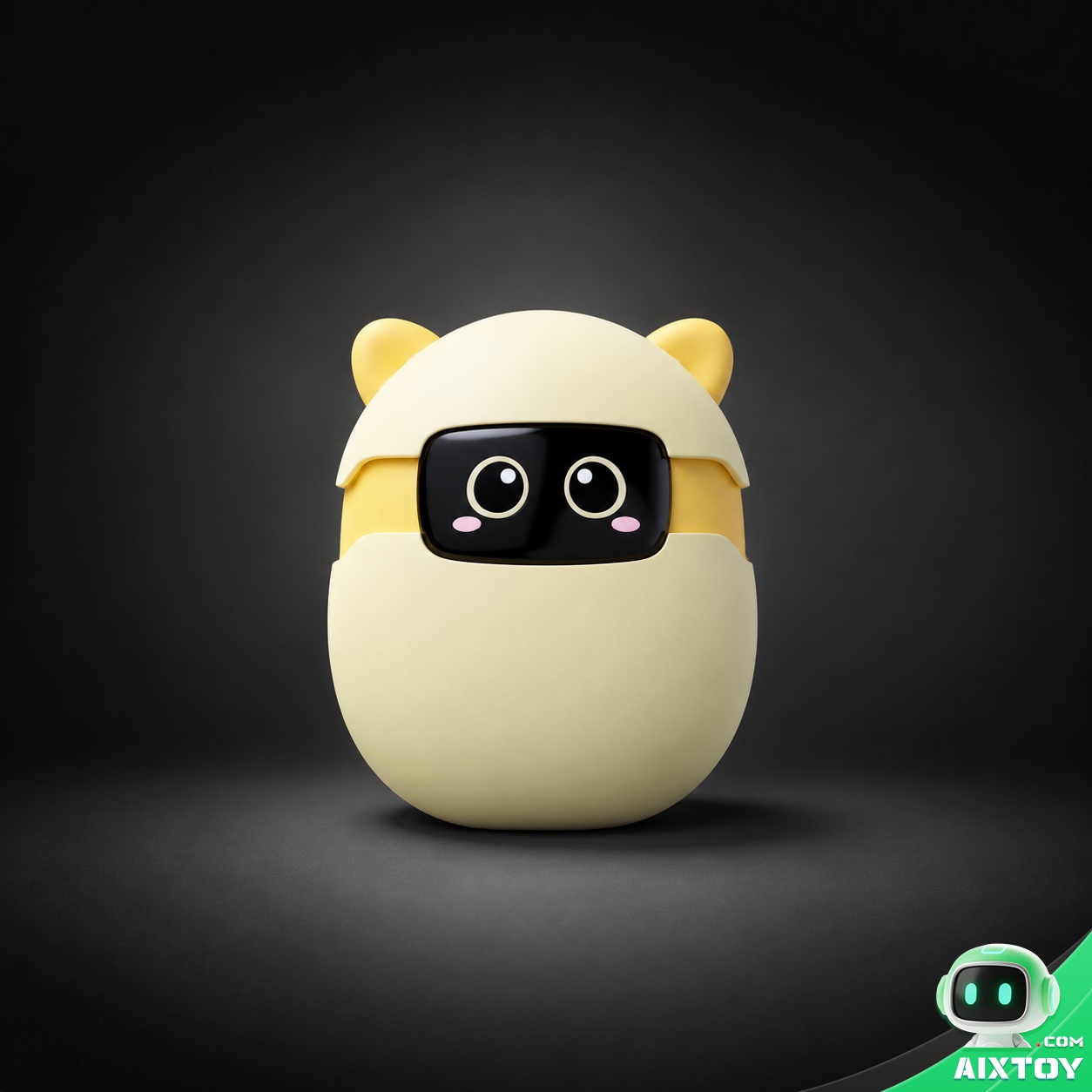
Sweekar AI Pocket Pet
$249.99
Priced within a few dollars of INU, and built on the opposite idea of progress: it changes physically across four life stages, so something visibly happens even when you leave it alone. A useful comparison if you are deciding what you want a desk object to do in year two.
If you want the other kind of robot, that is fine too
The case against INU is simple and it is not about quality. Some people do want to be talked to, and a device that refuses to answer can feel like a pet that ignores you. That is a legitimate preference, and the market has plenty of products built for it.
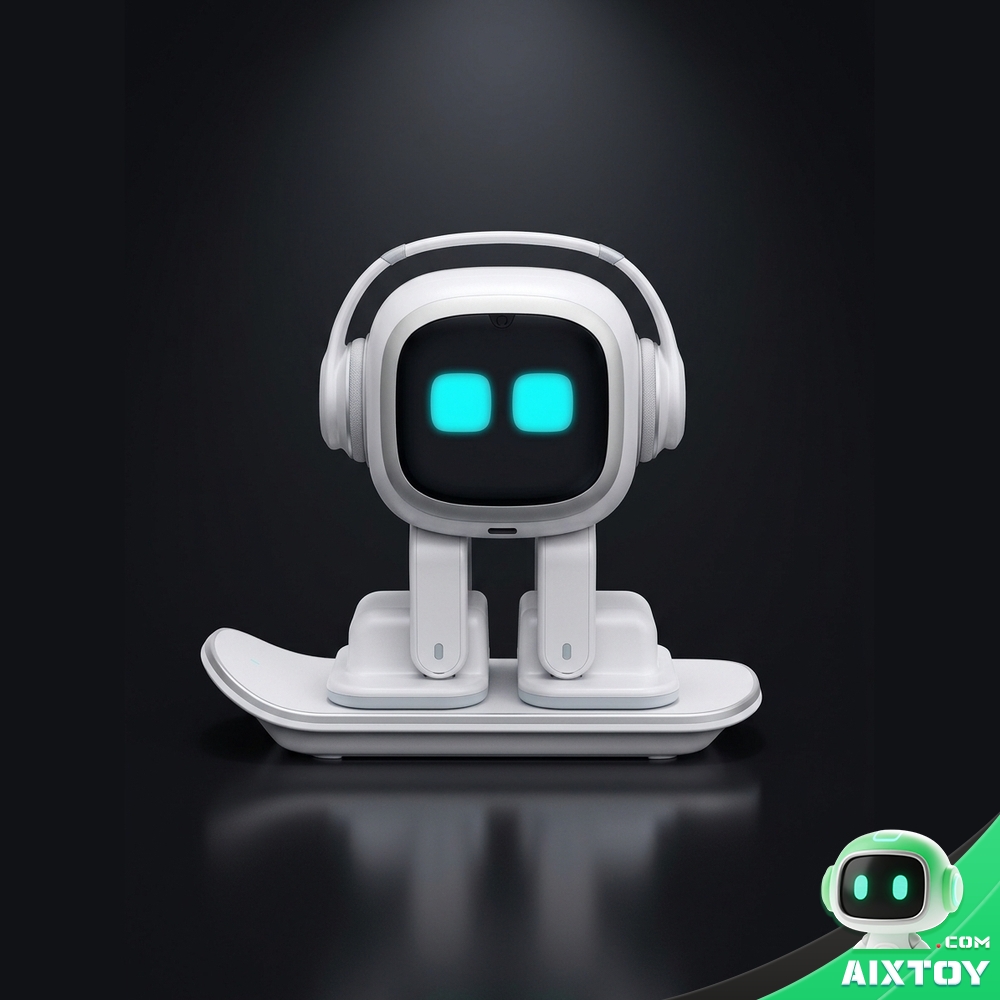
Emo Go Home AI Robot
$360.99
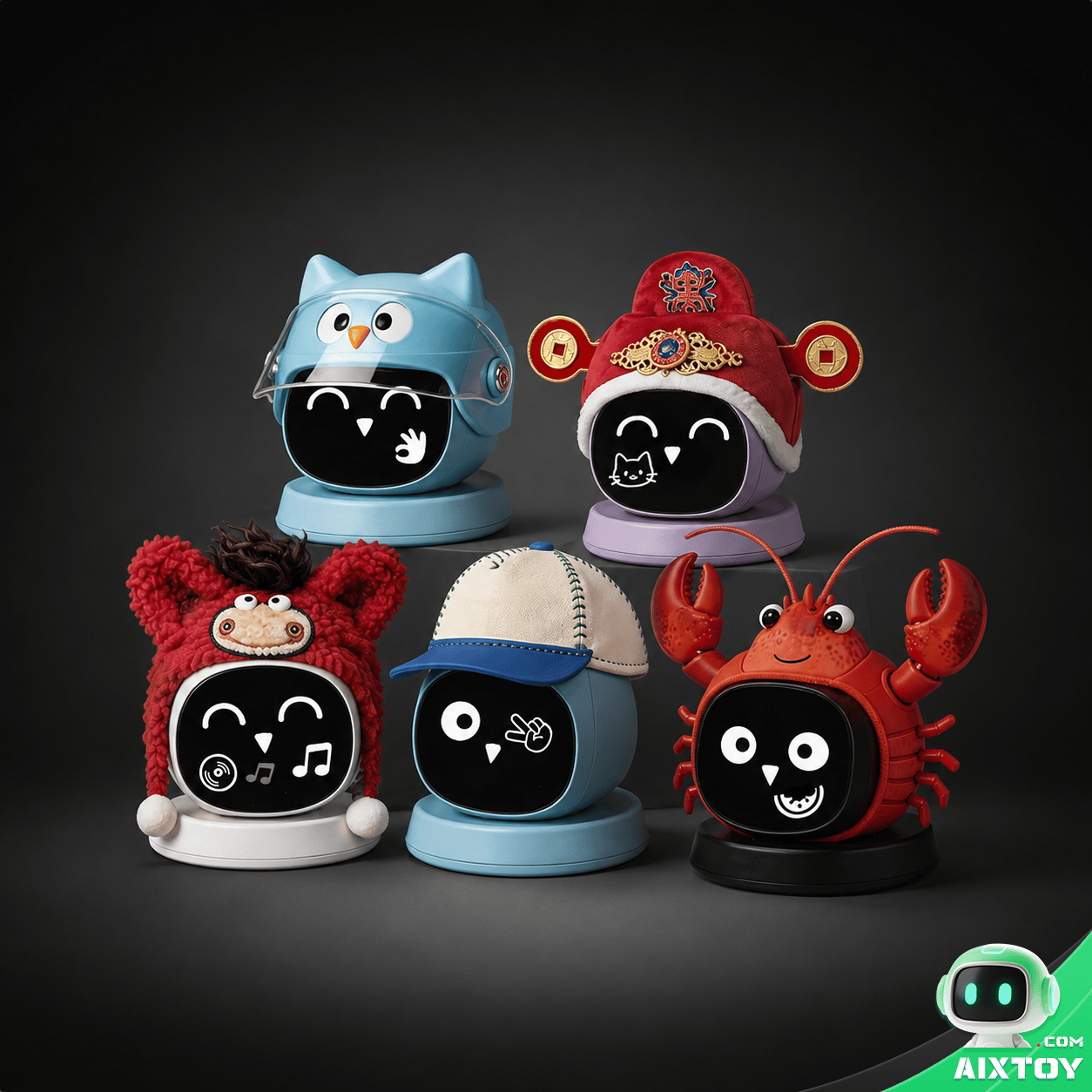
The conversational route, done well. It answers, it performs, and it is built to be addressed. Buy this if what you actually want is a small character that responds to you out loud — not a presence that stays quiet.
The interesting thing about this split is that it is not a price ladder. A $189 desk robot with a voice and a $397 plush that only looks at you are not better and worse versions of each other; they are answers to two different questions. The mistake buyers make is assuming the one with more features is the more advanced product. In this category, the feature list is often the thing that makes a device less like a companion — because every added capability is another reason for the object to demand something from you.
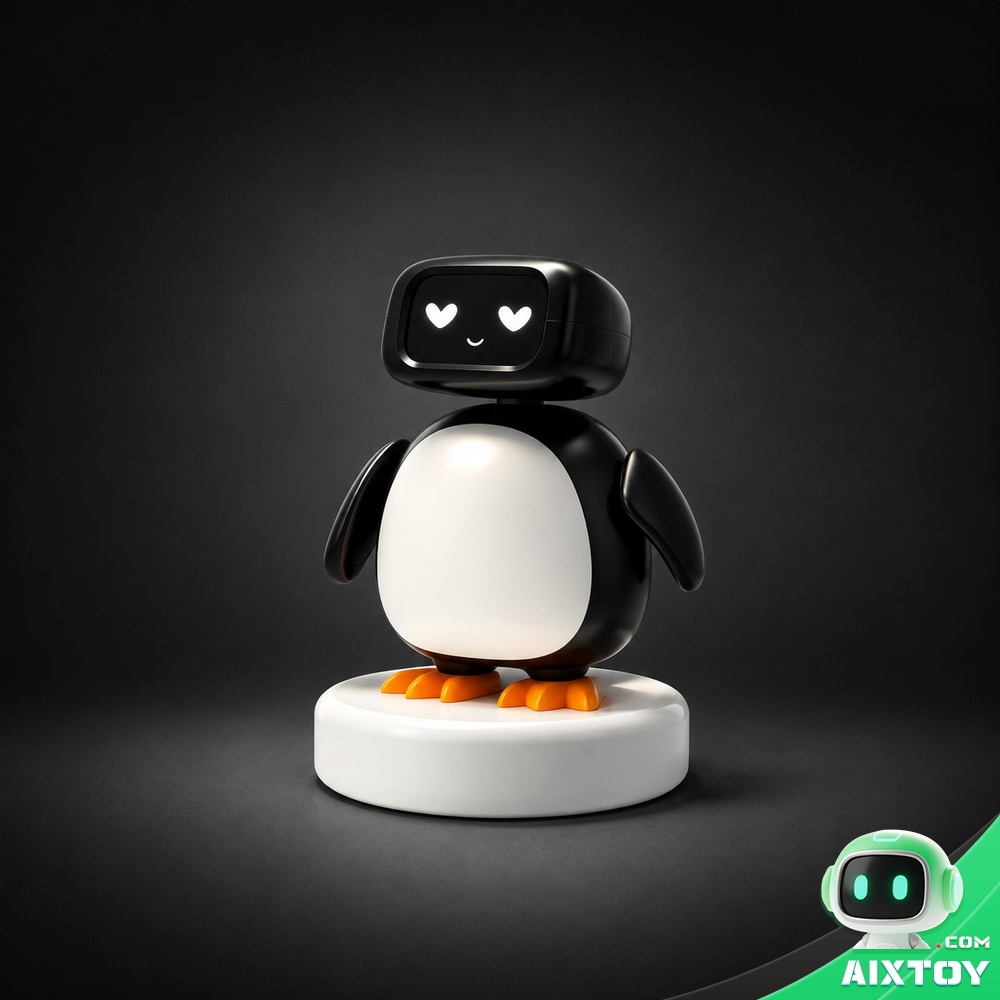
Qiubao AI Companion Robot
$188.99
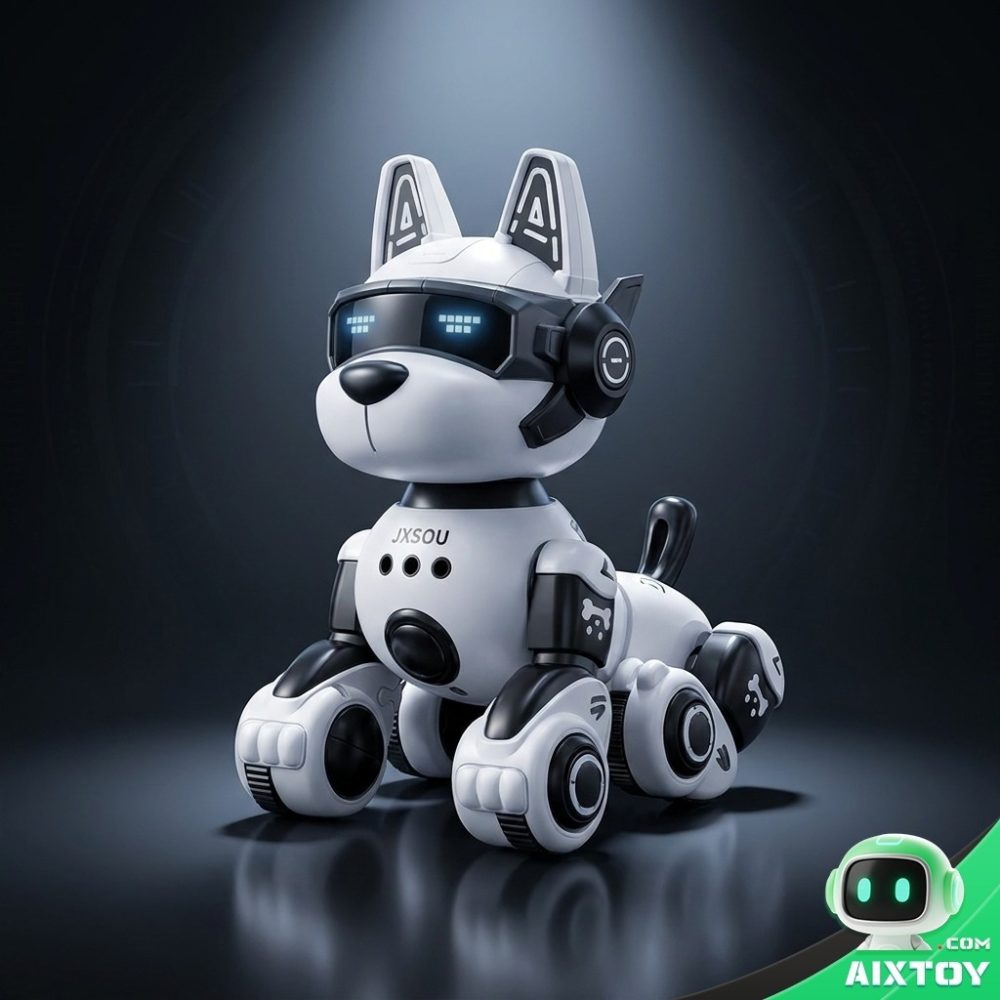
The entry point to talking desk robots, and a reminder that price is not the dividing line in this category. It costs less than INU and does far more of the things INU deliberately refuses.
The short version
INU is a 20-centimetre plush robot that has been deliberately stripped of the two features the rest of the industry is racing to add: a camera and a conversational voice. What is left is a presence with an eye, four degrees of freedom, a radar and a local model — priced at about $252, crowdfunding now, shipping planned for early 2027.
Whether that is worth paying for is not settled. The company’s own position is that it depends on whether people still want it on the desk once the newness is gone, and no amount of specification can answer that in advance.
What can be said is that the five questions the team uses to describe its own product work just as well pointed at everything else on the shelf. What can it sense without being spoken to? Can you read its answer without opening an app? Can you switch it off with one hand? Does it know when to be quiet? And what is still there when the network is gone?
A robot that scores well on those five is not necessarily smarter. It is just more likely to still be on your desk in a year.
Tags:Companion RobotAmbient ComputingAI CompanionINULudens AIEmotional AIDesktop RobotAI Toy IndustryAI HardwareAi Plush Toys