


No products added!

A desk robot that arrives without a brain — on purpose
Most AI gadgets fail the same way. They arrive with an underpowered chip, a mediocre screen and a camera that a five-year-old phone would embarrass, and then they ask you to pay $500 for the privilege of owning hardware that was obsolete before the box was opened.
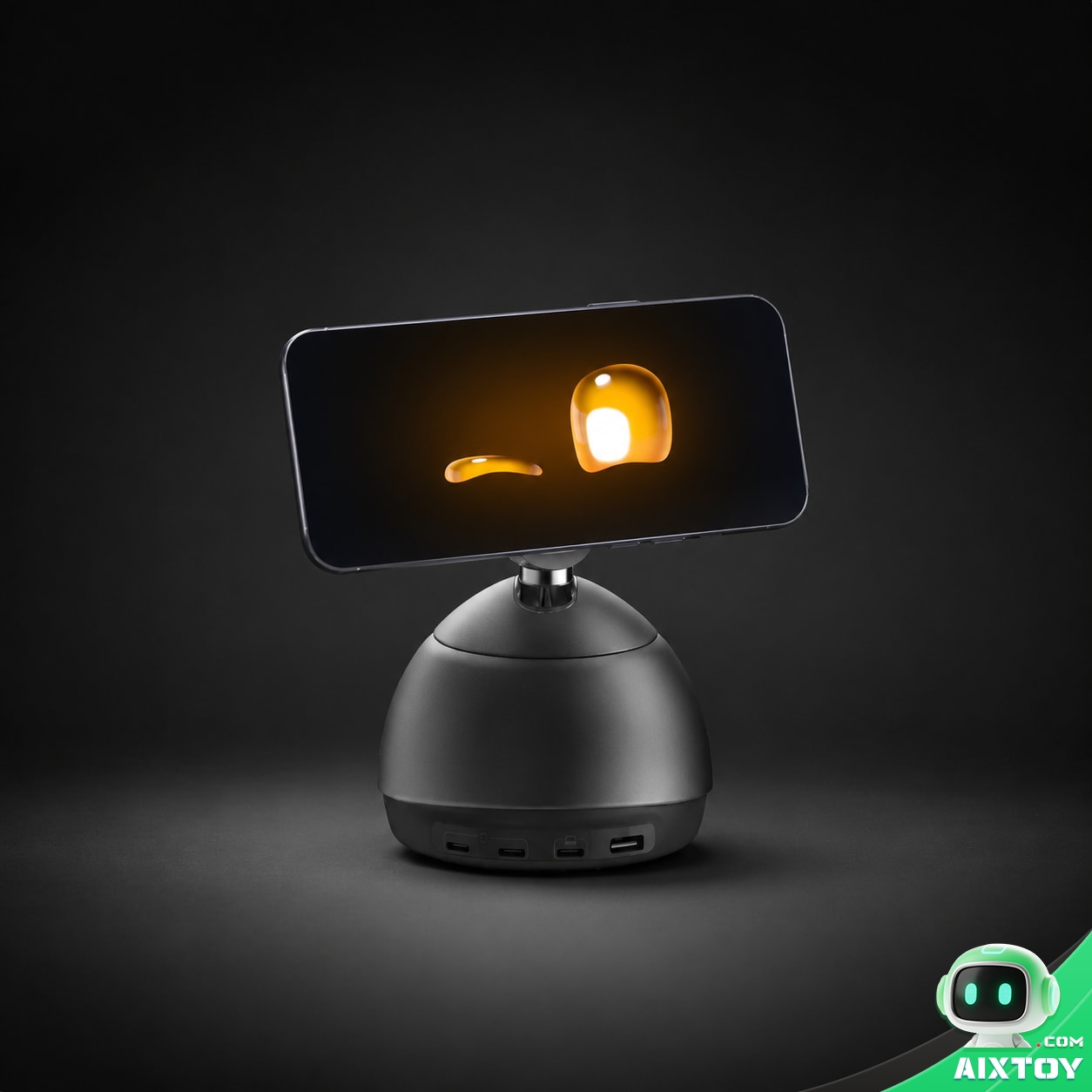
Loona DeskMate does the opposite. It ships with no screen, no camera, no microphone, no battery and no system-on-chip at all. Every expensive, fast-depreciating part of a smart device is already sitting in your pocket. Slot an iPhone 12 or newer onto the MagSafe pad and the phone becomes the face, the eyes, the ears and the compute. What is left in the box is a motorised arm, a weighted aluminium base, and a 165 W GaN charging hub.
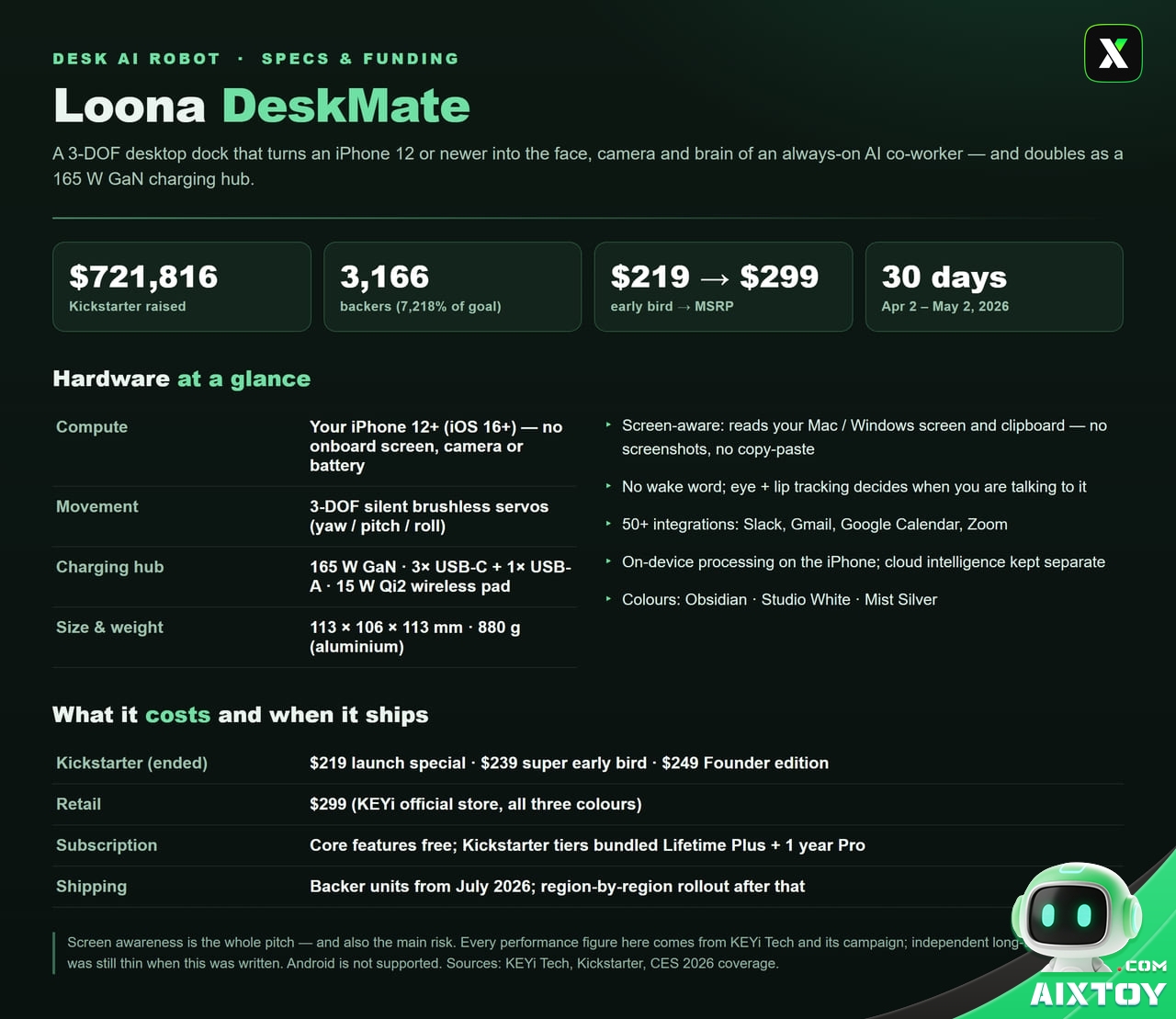
It is a genuinely unusual piece of product thinking, and the market noticed: KEYi Tech’s Kickstarter campaign closed on 2 May 2026 after raising $721,816 from 3,166 backers against a $10,000 goal — about 7,218% of target — at early-bird prices from $219 and a $299 retail tag.
What Loona DeskMate actually does
Strip away the animated eyes and there are four claims that matter.
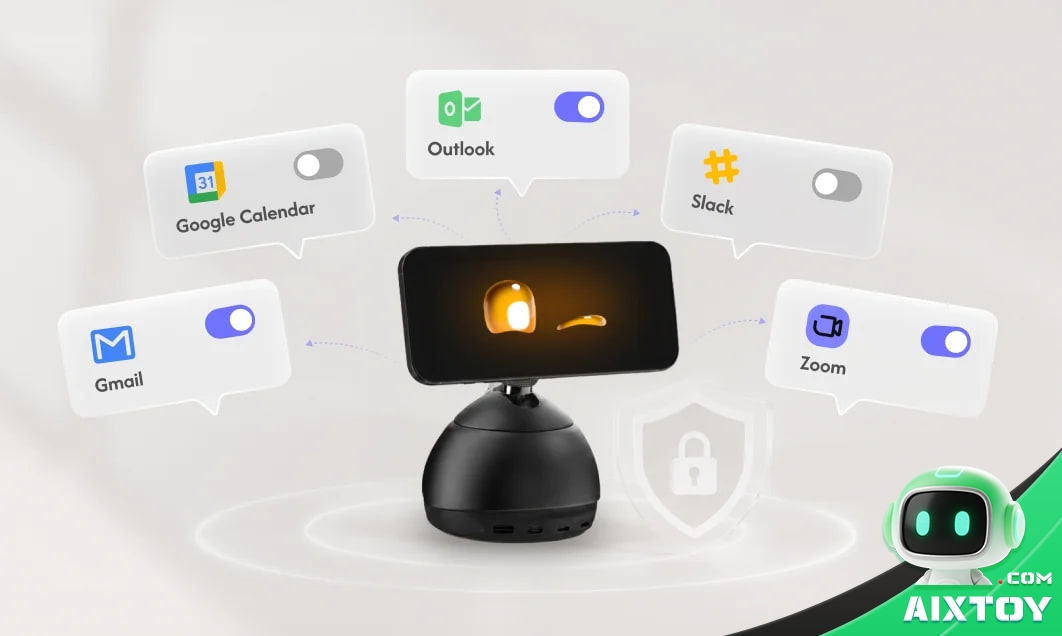
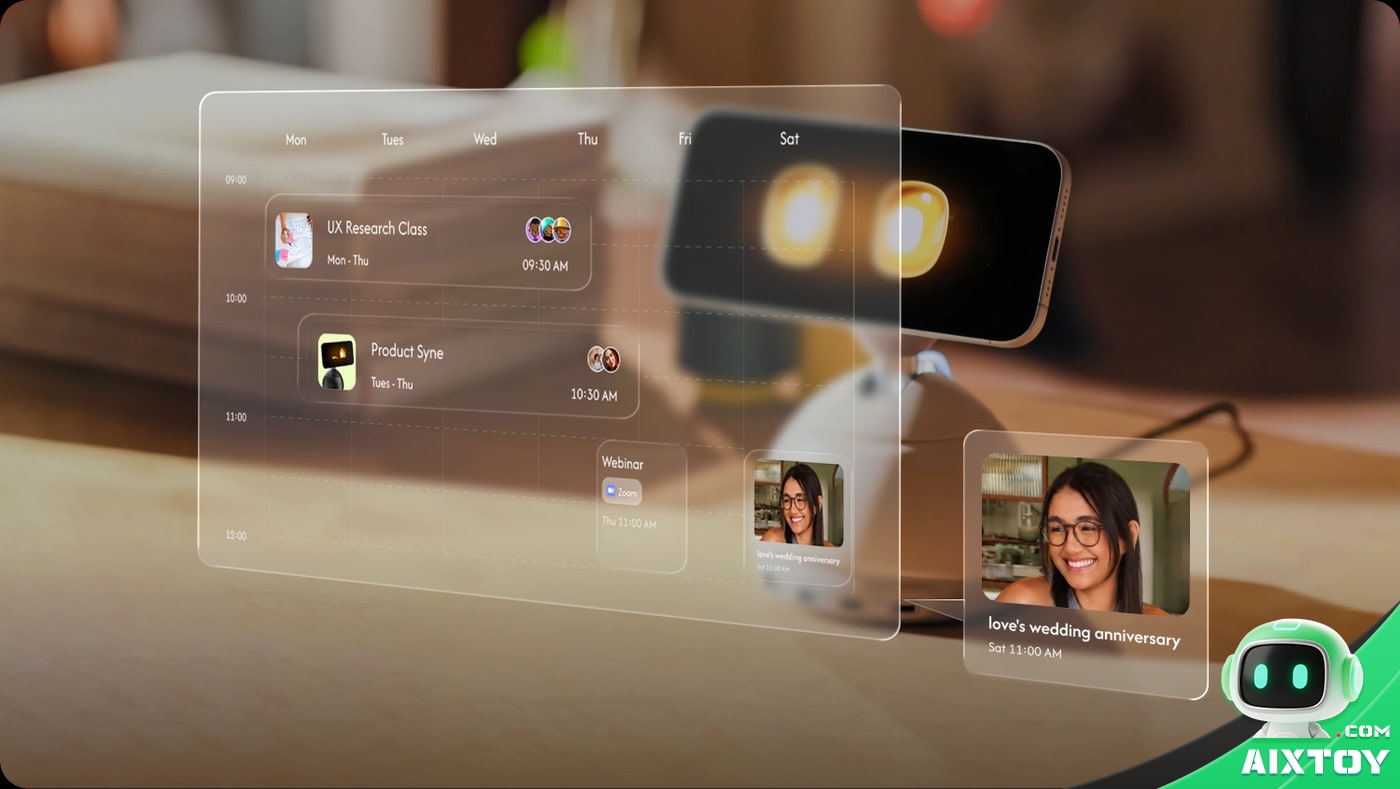
1. It reads your screen. A companion app for macOS and Windows gives the robot screen awareness: it can follow what you are working on, pick up clipboard content and answer against that context. The point is that you never screenshot, paste or re-describe what you are looking at — you glance over and say “summarise this email”.
2. There is no wake word. Instead of waiting to hear its name, the robot uses eye and lip tracking plus audio-visual cues to work out when you are actually addressing it — and, just as importantly, when you are not. KEYi quotes response times in the 300–500 ms range.
3. It moves. Three silent brushless servos give three degrees of freedom — yaw, pitch and roll — so the panel physically turns to keep the phone facing you. KEYi says the expressions and head tilts are generated live by the model running on the phone, not played back from a canned animation loop.
4. It is a charger first. The base is a 165 W GaN power station with three USB-C ports, one USB-A port and a 15 W Qi2 wireless pad. That is enough to run a laptop and charge a phone from a single cable.
The clever part is not the AI — it is the power strip
Here is the observation that makes DeskMate more than a novelty: desktop robots die of neglect, not of malfunction. They get unplugged, pushed to the edge of the desk and forgotten, because nothing in your day requires them to be there.
DeskMate borrows a solution from an entirely different category. It does not ask for a new spot on your desk; it asks for the spot your charger already occupies. If the robot is the thing keeping your laptop alive, it never leaves the desk, and every time you sit down you look straight at it. Whatever the AI is worth, the retention mechanism is real — and it is the kind of unglamorous insight that usually decides whether a hardware product survives its second year.
Under the shell
The hardware is deliberately minimal, and the specification sheet is short:
• Compute: your iPhone 12 or newer (iOS 16+) — no onboard screen, camera, microphone array or battery
• Motion: 3-DOF silent brushless servos (yaw / pitch / roll)
• Power: 165 W GaN hub, 3× USB-C + 1× USB-A, 15 W Qi2 wireless pad
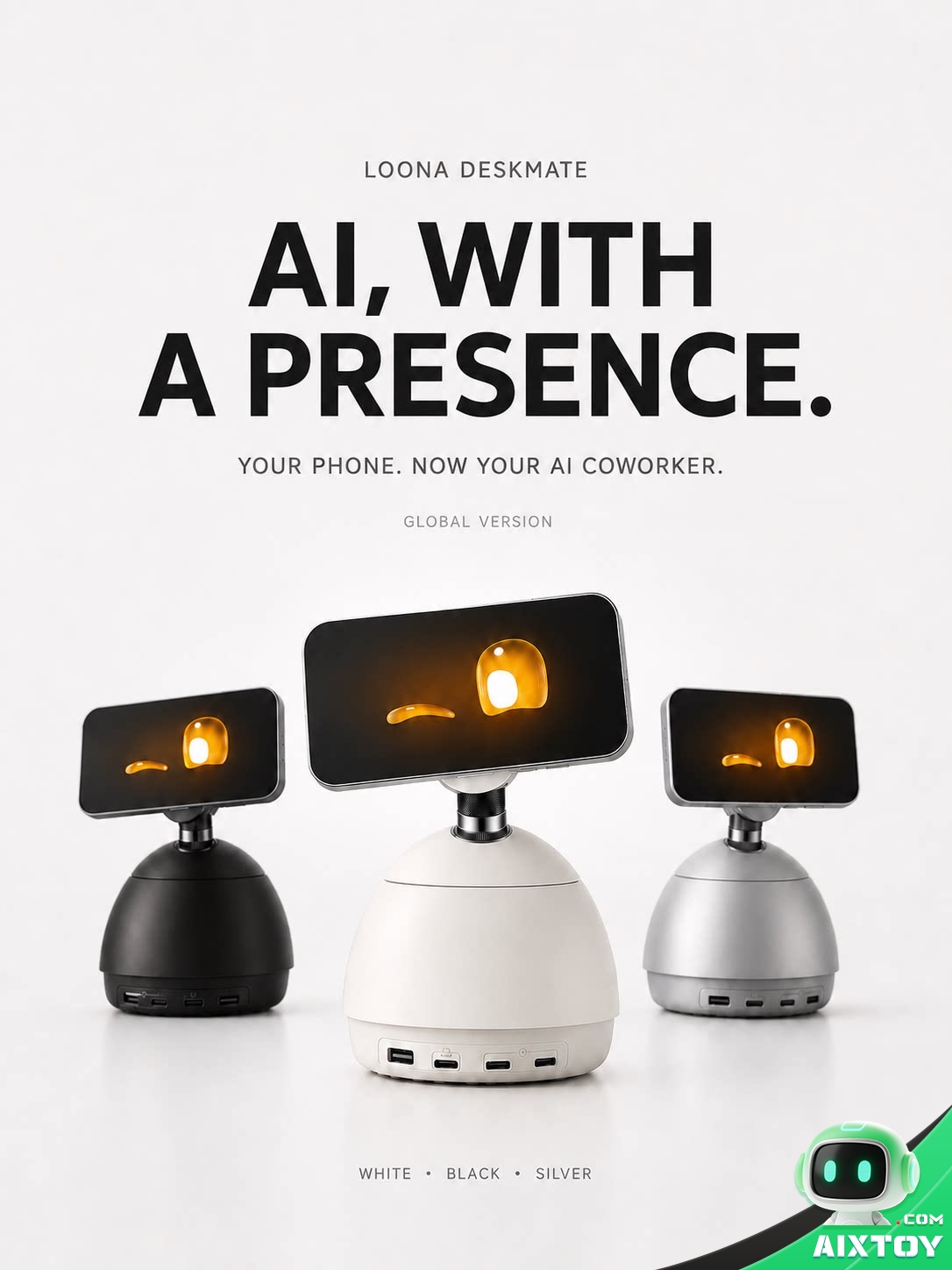
• Body: aluminium, 113 × 106 × 113 mm, 880 g
• Finishes: Obsidian, Studio White, Mist Silver
The privacy story is a direct consequence of that architecture. Face tracking, screen reading and voice handling run on the phone, and KEYi separates that on-device processing from cloud intelligence. It is a defensible design — the data never has to leave hardware you already trust with your photos and passwords. It also happens to be the only architecture available to a company that did not want to build a privacy policy around a camera it manufactured itself.
The business model hiding behind the robot
Hardware is the easy part of the pitch to explain. The harder question is how KEYi intends to make money after the box is sold — and the answer, as it usually is in AI hardware, is a subscription.
DeskMate’s core features are free to use, and every Kickstarter tier shipped with lifetime Plus access plus a year of Pro. But KEYi has signposted paid Plus and Pro tiers as the long-term monetisation path, alongside a credit system that meters the genuinely expensive operations so that heavy users cannot quietly destroy the gross margin.
Read the strategy plainly and it looks like this: sell the dock at a price that makes the hardware decision easy, then convert the people who use it every day into subscribers. The hardware is the distribution channel; the agent is the product. That is the same flywheel that has worked for robot vacuums and doorbells — and the same one that has generated a decade of customer resentment when the free tier starts shrinking.
KEYi has done this before — twice
DeskMate did not come from a company guessing. KEYi Tech has been building consumer robots since 2014, and its two previous products both shipped in volume: the ClicBot modular robot kit has sold more than 40,000 units, and the Loona Petbot companion robot has shipped well over 100,000 units worldwide after a 2022 Kickstarter that cleared $2 million in 15 days and finished above $3 million — still one of the best-funded consumer robots in the platform’s history.
That track record matters for a very practical reason. The hardest part of a crowdfunded hardware product is not the campaign; it is the production line. KEYi has already run an emotional-robotics supply chain at scale, and DeskMate reuses that mechanical and servo expertise in a simpler, smaller, cheaper body. When a first-time founder raises $700,000 for a robot, the sensible assumption is that it will arrive late and half-finished. Here, the prior evidence points the other way.
The market this pitch is aimed at
DeskMate is not being sold into a quiet niche. Companion robots have moved from novelty to volume business, and the desktop is where the growth is being pushed. One Chinese industry analysis cited in the case-study coverage of this launch put the global companion-robot market at roughly $11 billion in 2023, growing to about $45 billion by 2029 — a compound annual rate of 25.6% (converted from the yuan figures at 6.7330, the 9 October 2026 central parity rate).
Treat that number with some caution: “companion robot” in those forecasts is a deliberately wide basket that includes educational and service machines, not just the plush and desktop devices you see on Kickstarter. What it does describe accurately is the direction of travel. The category that was selling $99 plush toys in 2023 is now shipping $299 productivity hardware, and the average selling price is climbing as these devices move from the bedside to the desk.
What buyers should actually watch
Android is locked out. The entire architecture depends on a recent iPhone. If you are on Android, this product does not exist for you — and buying a second-hand iPhone purely to run a desk robot is a genuinely odd shopping decision that early backers have already been debating.
Screen awareness is the hard part, and it is the whole product. Reading a screen is easy. Understanding it — knowing which window matters, which email is the one you meant, when to stay quiet — is the hardest problem in applied AI. Every claim about DeskMate’s usefulness rests on that one capability, and it is also the capability most likely to feel impressive in a demo and inconsistent in week three.
Nobody has lived with one yet. Units began shipping to backers from July 2026. There is still very little independent, long-term reporting on heat, battery drain on the phone, or whether the screen-reading actually holds up across a real working day.
It is a camera pointed at your desk, permanently. The on-device processing story is credible, but the psychological question is not technical. Some people will not want an eye tracking their monitor from 40 cm away, no matter where the data is processed.
The price is not the whole price. A $299 dock plus a recurring subscription is a different commitment from a $299 dock. Work out what the tier you actually need will cost over two or three years before you decide.
The AIXTOY take
DeskMate is the most interesting AI hardware idea of 2026 because it attacks the category’s economics rather than its spec sheet. Removing the screen and the silicon is not a cost-cutting gimmick; it is an admission that phone makers have already won the parts of the problem that hardware startups keep losing money trying to solve.
The risk profile is equally clear. Its differentiation lives almost entirely in software running on a device it does not control, sold on a subscription that has not been priced yet. If Apple ships a comparable ambient agent — and motion plus MagSafe is not a hard thing for Apple to build — DeskMate is a dock. That does not make it a bad product. It makes it a bet on the software being good enough, fast enough, before the platform owner decides it wants this feature too.
For an iPhone-owning knowledge worker who already keeps a MagSafe charger on the desk, though, the arithmetic is unusually forgiving. You are not adding a gadget; you are replacing one. Everything the robot does on top of charging is upside. That is the strongest argument in the category this year, and nobody else is making it.
Quick answers
Does it work with Android? No. iPhone 12 or newer, iOS 16+.
Does it need a subscription? Core features are free. Plus and Pro tiers exist and Kickstarter backers received lifetime Plus plus a year of Pro; treat the paid tier as the direction of travel rather than a certainty.
Is it a robot pet? No. It does not walk, and it is not aimed at children. It is a stationary productivity dock with an agent attached.
When can I buy one? Backer units started shipping in July 2026 and retail availability is rolling out region by region.
Loona DeskMate AI Desk Robot
Coming Soon
iPhone-powered desk robot with screen awareness, 3-DOF motion and a 165 W GaN charging hub. Backer units are shipping now — retail stock through our store is being arranged. Contact us to be notified.
Tags:Loona DeskMate KEYi Tech Desk Robot AI Hardware Crowdfunding Kickstarter iPhone Robot Productivity AI Assistant Robotics AI Companion Ces 2026