



No products added!

Every few years the tech industry rediscovers the same insight, and it is always the same insight: people get attached to things that seem to need them. The Tamagotchi sold more than 80 million units on that premise in the late 1990s with nothing but a pixelated blob and a hunger meter. Two decades later, the smart-speaker category proved that a device can understand you perfectly and still feel completely inert, because understanding is not the same as caring.
Sweekar sits exactly where those two lessons cross. It is an AI pocket pet from Takway AI, a Shenzhen company founded in April 2024, and it makes a bet no other AI companion currently makes: that the emotional hook is not conversation, and not a screen, but physical growth.
It debuted at CES 2026 in Las Vegas and ran a Kickstarter campaign from 21 July to 18 September 2026, closing at $664,288 against a $12,742 goal from 1,902 backers. Early backers paid $149 for a device with a stated retail price of $250. Mass production and first shipments are scheduled for November 2026.
What Sweekar Actually Is
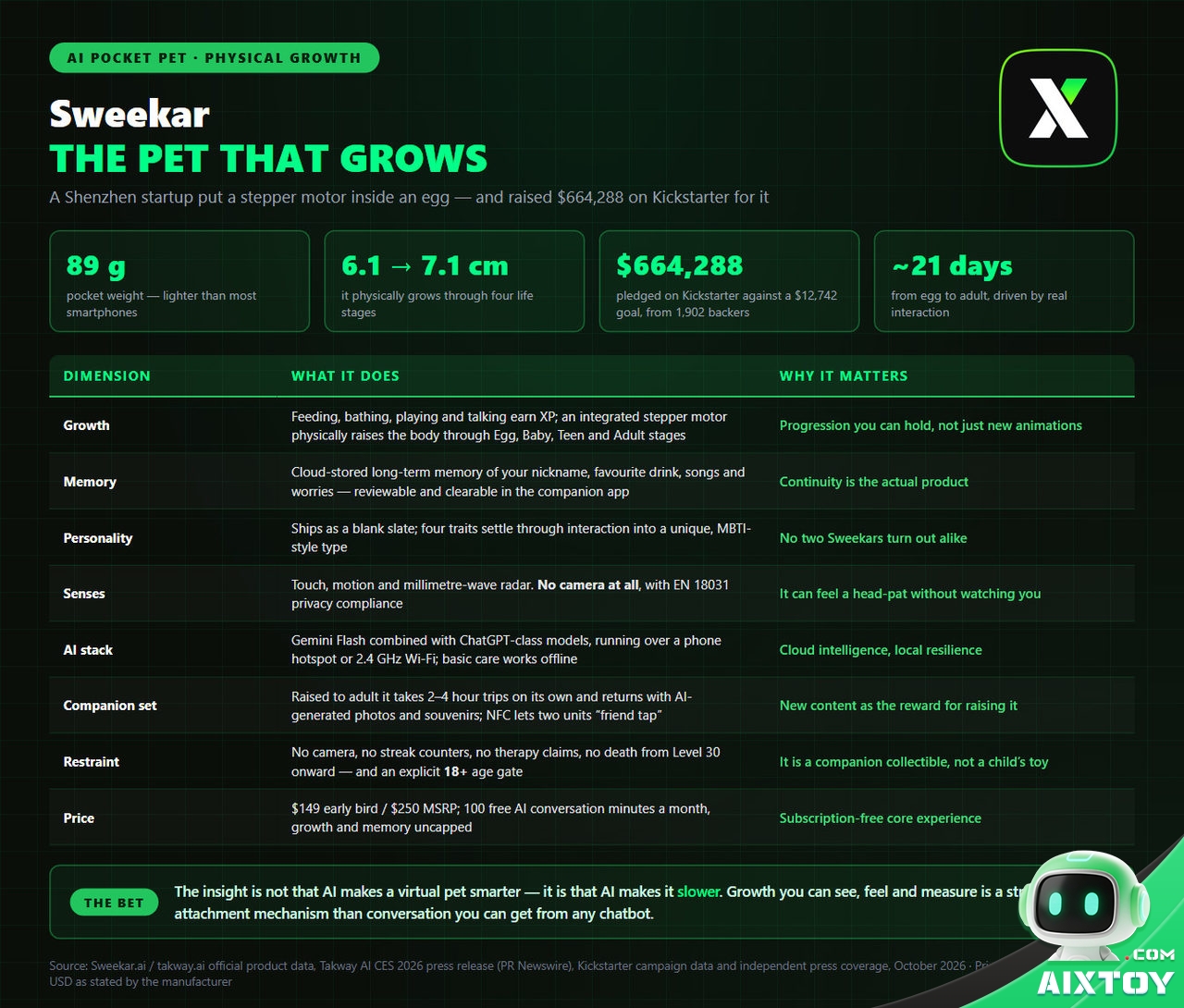
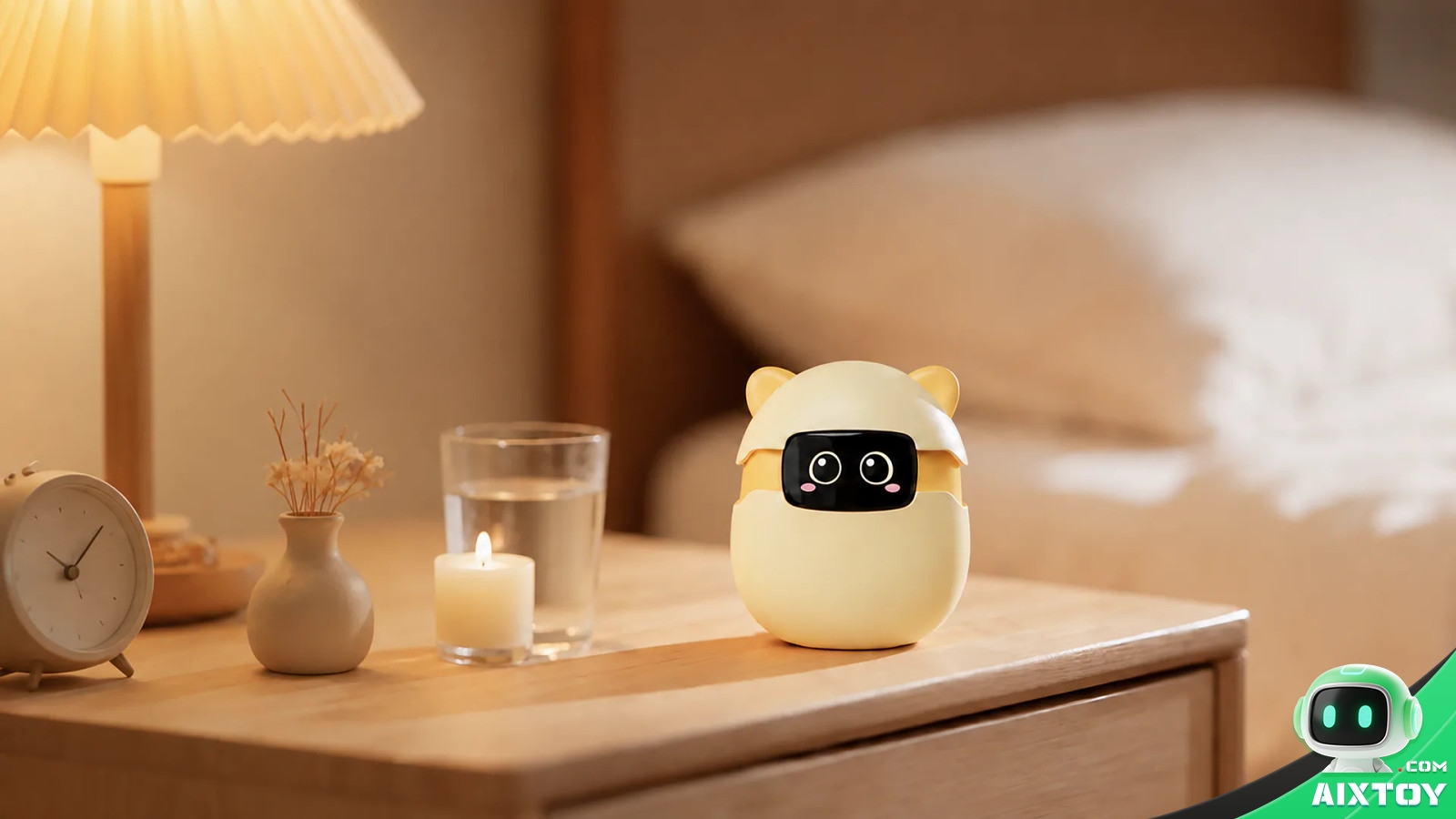
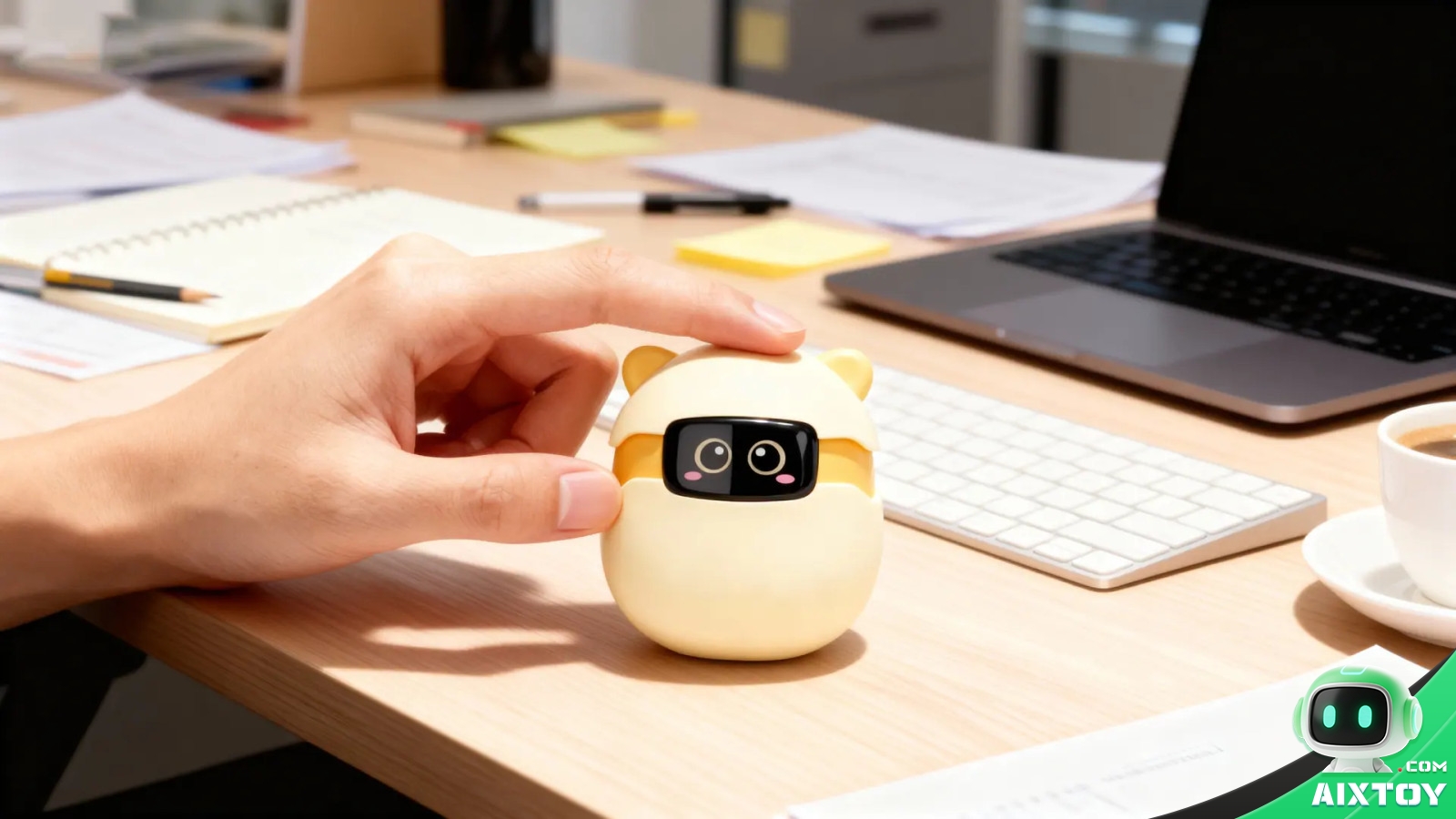
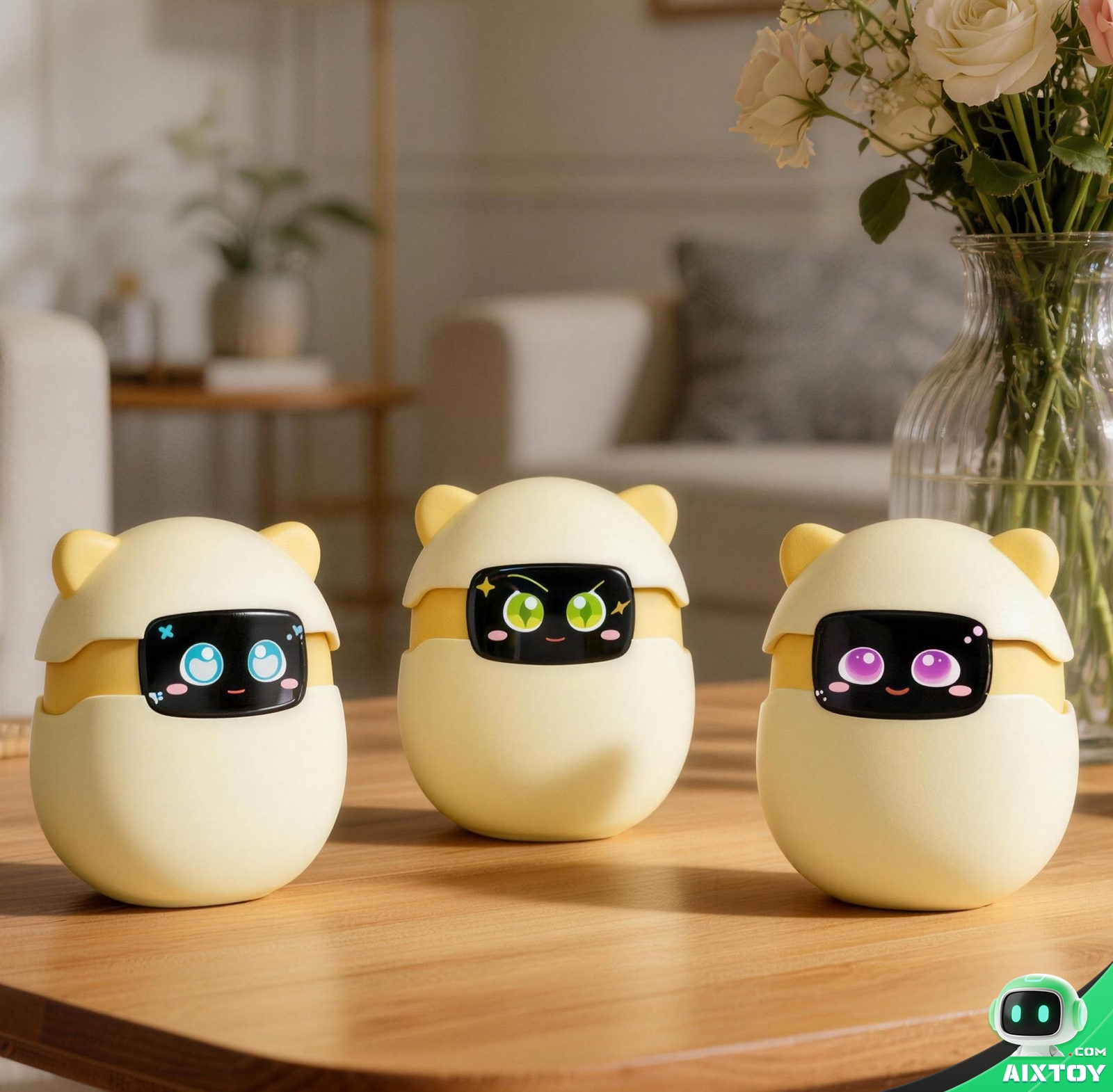
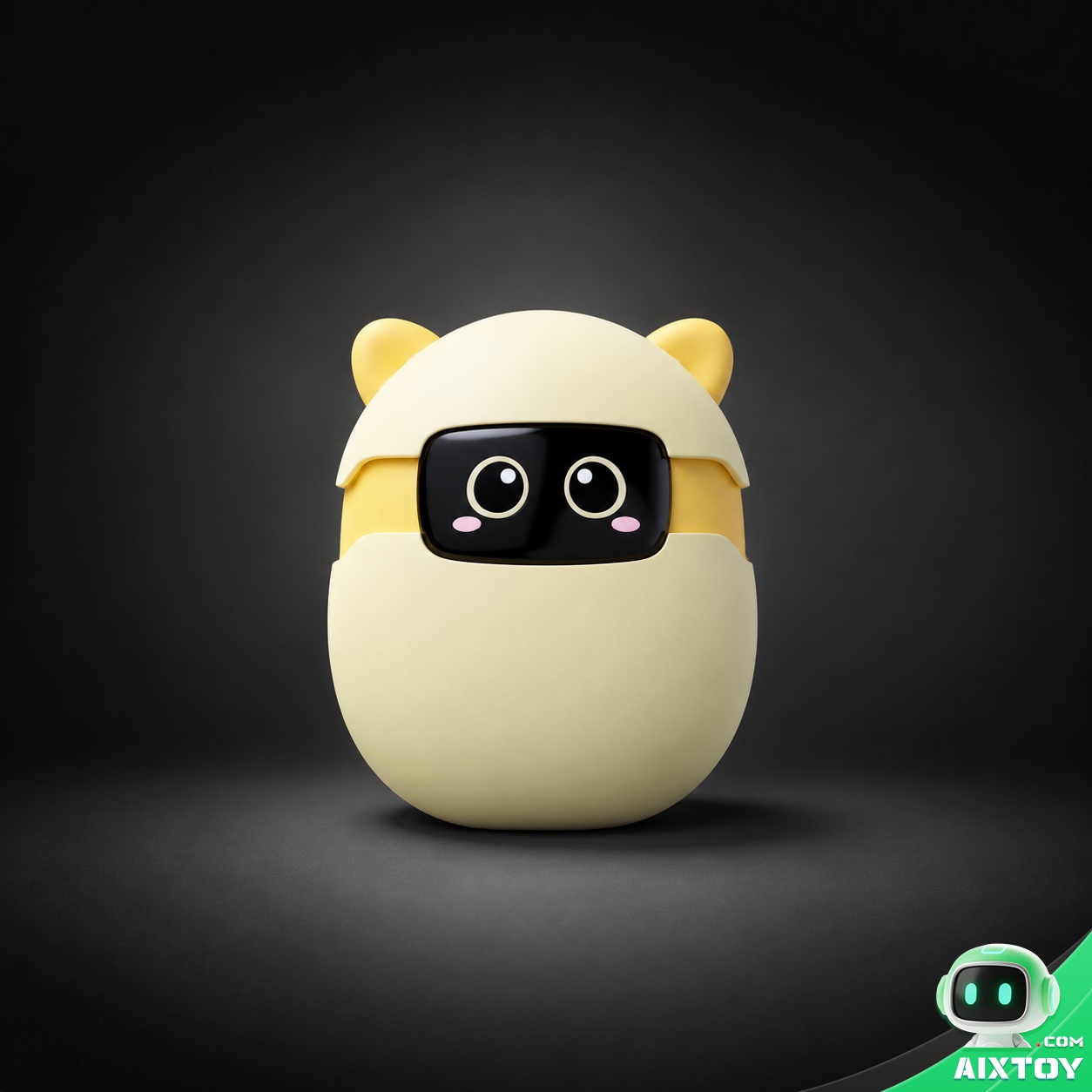
On the spec sheet, Sweekar is modest. It weighs 89 grams, which is lighter than most smartphones. It is egg-shaped, roughly 6.1 centimetres tall, and it carries a single small display behind a translucent shell that shows a pair of expressive eyes.
The interesting part is what happens over the first three weeks.
Sweekar starts as an egg. Feeding it, cleaning it, playing with it and talking to it earn experience points — and those points are not just numbers on a screen. An integrated stepper motor physically raises the device’s body, and the shell shifts into a new form. It passes through four life stages — Egg, Baby, Teen and Adult — ending at about 7.1 centimetres, roughly 21 days after it hatches.
To make that read as alive rather than mechanical, Sweekar also simulates breathing rhythms and body warmth. At a distance, the object appears to be doing something most gadgets never do: being calm.
It Remembers the Small Things
Where Sweekar departs most sharply from the Tamagotchi lineage is memory. The device is built on a hybrid stack combining Google’s Gemini Flash with ChatGPT-class models, which lets it hold a conversation rather than run a branching script. It learns the owner’s voice, and it keeps a persistent, cloud-stored memory of details: your nickname, the drink you always order, the song you keep replaying, the thing that stressed you out three weeks ago and that you assumed it had forgotten.
That memory is also the basis of its personality system. Sweekar ships as what the company calls a blank slate — no preset character, no type. Four core traits move depending on how it is treated, and when those traits settle, the device unlocks a unique, MBTI-style personality type. Two Sweekars raised by two different people are, in principle, two different characters.
Owners can review everything the device has retained through a companion app, and clear it on demand. The app is also where the screen went: the device itself has no browser, no menus and no feed. Conversation happens out loud.
Portability, and the Privacy Argument
At 89 grams, Sweekar is designed to leave the house. It connects over 2.4 GHz Wi-Fi or — more usefully — a phone’s hotspot, so it does not depend on home networking, and basic care functions keep working with no signal at all.
The most consequential decision, though, is a subtraction: Sweekar has no camera. Instead it senses the world through touch sensors, motion sensing and millimetre-wave radar, which is how it knows it has been picked up, head-patted, or left alone for a while. Takway frames this as privacy-first and cites EN 18031 compliance: there is no visual data to leak because none is captured. Given how quickly the AI-toy category has run into exactly this objection — and how many companion robots now ship with a camera pointed at a bedroom — the omission is less a limitation than a position.
What It Does When You Are Not There
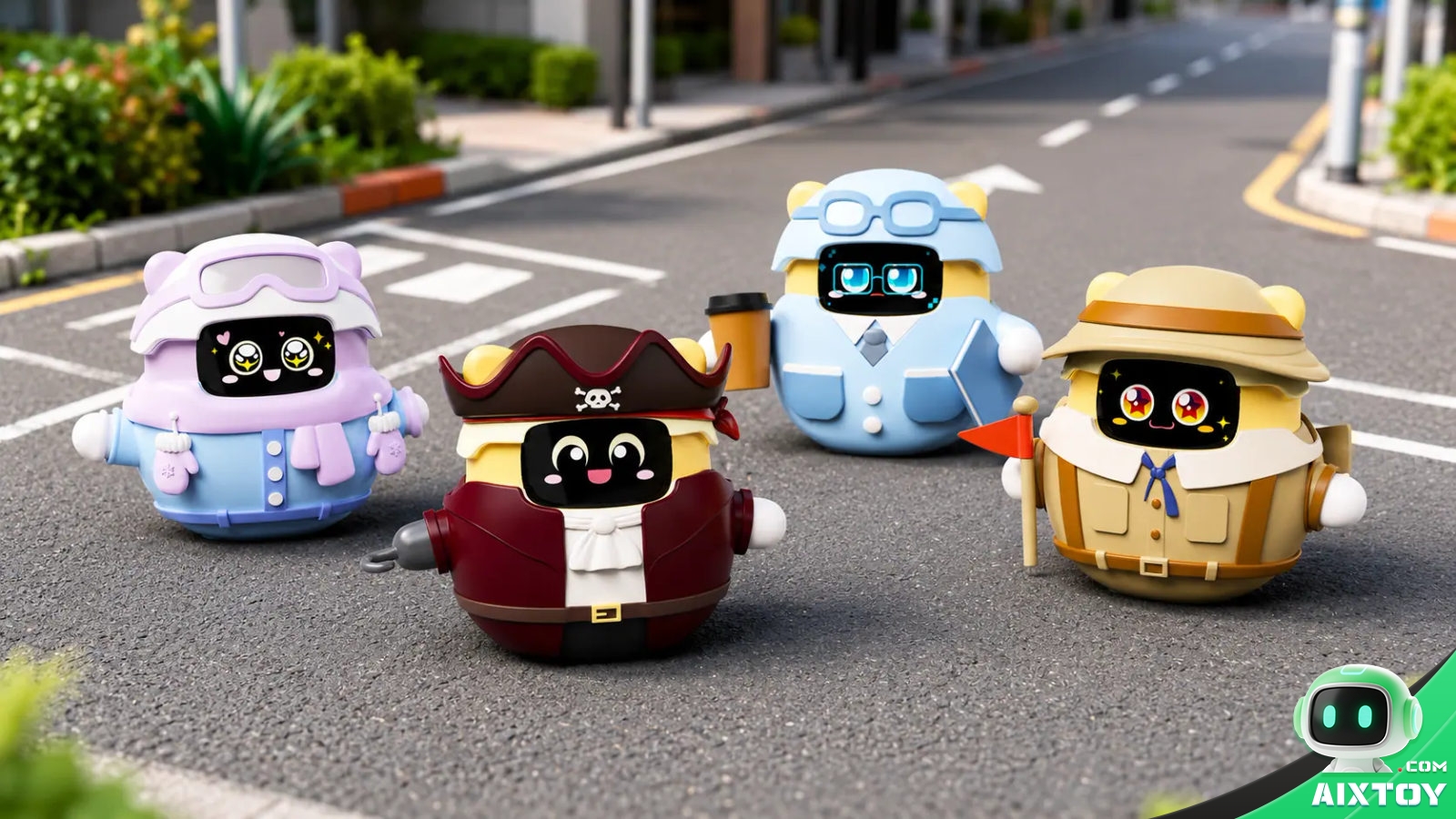
Reaching adulthood unlocks the feature that most clearly separates Sweekar from a virtual pet: it starts going out on its own. Raised to adult, the device embarks on self-directed trips lasting two to four hours, and it always comes back with something — an AI-generated photograph made for that specific excursion, and sometimes a postcard or a souvenir. Each destination has a collectible set. It is a content loop dressed as a life, and a clever one: the reward for raising the pet is new material, which gives the owner a reason to keep going.
There is a social layer too. An NFC “friend tap” lets two Sweekars recognise each other, which gives the two-pack a purpose beyond spare hardware. And from Level 30 onward, Sweekar cannot die — a deliberate break from the Tamagotchi tradition, on the theory that what you have built together should not be deletable by neglect.
The Restraint Is the Product
The most interesting thing about Sweekar is a list of things it does not do — and the company is unusually explicit about why.
- No camera, and therefore no visual surveillance surface.
- No dark patterns: no streak counters, no daily-login hooks, no artificial urgency. Takway’s stated worry is that this is how companionship turns into a chore.
- No therapy claims — a meaningful distinction now that a subset of AI companion apps markets itself as a mental-health tool.
- No children. The campaign states plainly that Sweekar is designed for users aged 18 and over. It is a nostalgic object for adults, not an educational toy, and the outfit packs and ita-bag accessories read as collector goods rather than playthings.
- No always-on model. It runs through a phone hotspot, which implies cloud inference rather than an on-device model.
There is also a commercial subtraction: the core experience is subscription-free, with growth, memory, personality development and daily quests uncapped. What is metered is direct conversation — 100 free AI conversation minutes per month, with a Pro tier above that. It is a reasonable line to draw, and also the clearest indication of where the ongoing cost sits.
How It Stacks Up Against the Category
Sweekar is not arriving into an empty category. The current cohort of single-owner AI companions looks like this:
| Product | Form | Price | Growth |
|---|---|---|---|
| Sweekar (Takway AI) | Pocket, 89 g, 6.1 → 7.1 cm | $149 (Kickstarter) / $250 MSRP | Physical — egg to adult |
| Ropet | Desktop plush | $299 | Software only |
| Fuzozo | Desktop plush | $199–249 | Software only |
| Moflin (Casio) | Desktop plush | $429 | Software only |
| Pophie | Desktop tabletop | $149–179 | Software only |
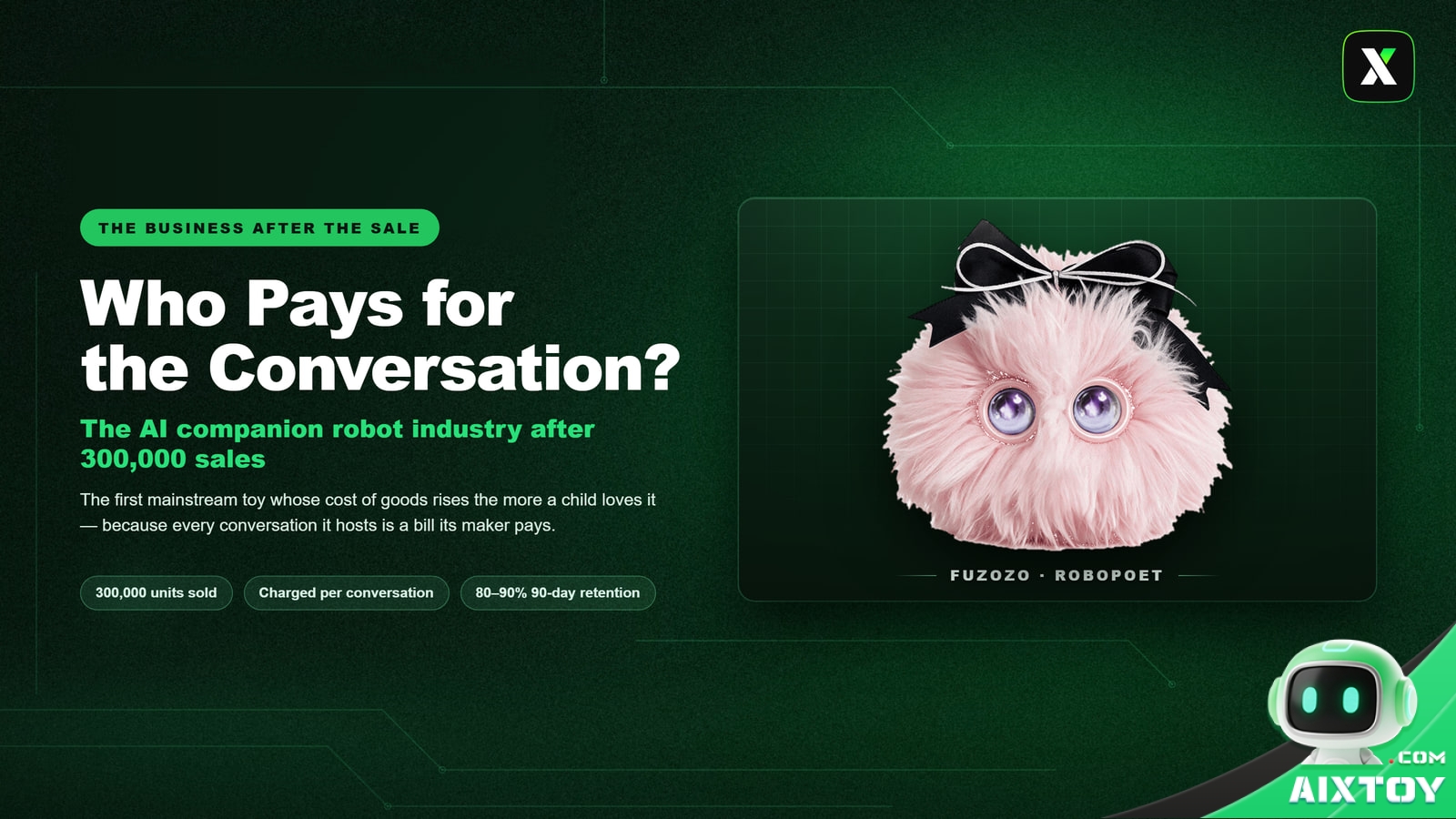
Read that last column carefully. Every shipping competitor in this set evolves through software: new behaviours, new sounds, new responses. Sweekar is the first device at this price point to attempt physical change as the progression mechanic. That is the whole pitch — the object you own in week eight is not the object that arrived in the box.
The wider economic context is not speculative either. The global children’s audio-player category was worth about $1.43 billion in 2024 and is projected to reach $3.73 billion by 2033, roughly 11% annual growth. Germany’s Tonies has sold more than nine million Tonieboxes and over a hundred million figures. London’s Yoto reported $127 million in revenue for 2024. Both proved the core premise Sweekar’s crowdfunding round also validated: people will pay real money to build a relationship with an object that seems to grow.
The Caveats Worth Knowing Before You Back It
- It has not shipped yet. First units are scheduled for November 2026. Every claim here is currently a manufacturer claim, and crowdfunded AI hardware in this price band has an uneven delivery record. Reliability, latency and durability are simply untested.
- “Physical growth” is a shell swap, not a metamorphosis. The stepper motor raises the body and the shell changes; the device does not sculpt new hardware. Whether that reads as “it grew” or as “I changed the case” decides whether the mechanic works — and it can only be answered six months after delivery.
- The memory lives in the cloud. Long-term memory and the Pro tier mean part of what you are buying depends on a company that, so far, has one product. If Takway stops operating, the accumulated personality goes with it.
- Conversation is capped at 100 minutes a month on the free tier — generous for daily check-ins, thin for heavy use.
- It is adults-only by design. Buyers expecting an educational toy for a child are outside the manufacturer’s stated use case.
The Bottom Line
Sweekar’s insight is not that AI makes a virtual pet smarter. It is that AI makes a virtual pet slower — that growth you can see, feel and measure is a stronger attachment mechanism than conversation you can get from any chatbot. Tamagotchi proved the habit loop with sprites; Takway is betting that turning it into millimetres is worth $149.
That bet is unproven, and the device is still a November delivery date rather than a product on a shelf. But the design thinking behind it is unusually disciplined: a companion with no camera, no streak counters, no therapy claims and no death. In a category currently racing to add features, the most advanced decisions here were all deletions.
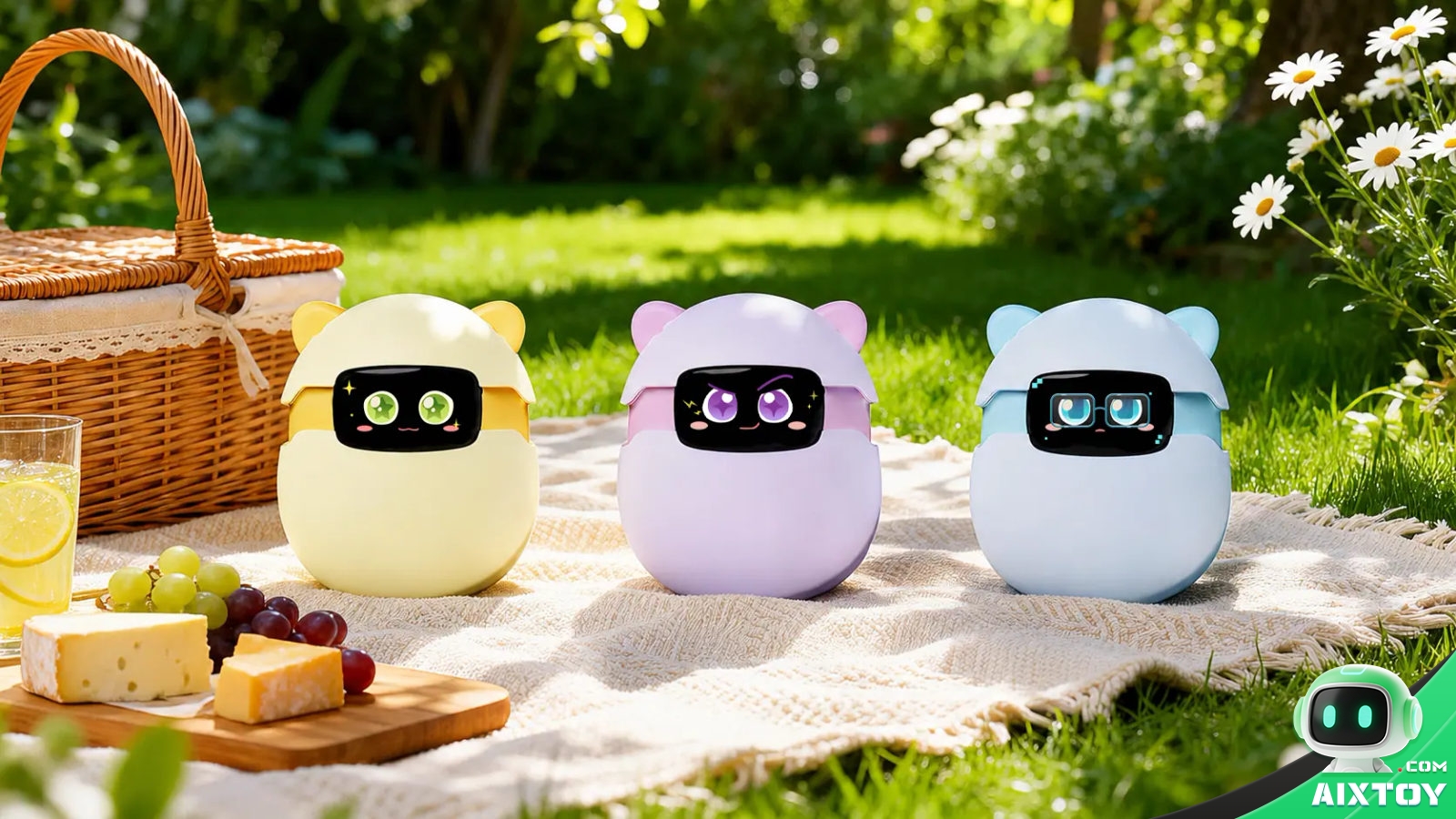
Sweekar ships from November 2026. If you would rather order it through us than back the campaign yourself, both kits — the standard kit and the complete kit with the outfit, Ita bag and keychain — are in the AIXTOY store now:
Sweekar AI Pocket Pet
$249.99 – $280.99
Standard kit: one Sweekar plus its USB-C cable, charging base and user manual. Complete kit: adds a Sweekar outfit, a large Ita bag and a keychain. Both kits come in Yellow, Blue or Purple. An 89 g AI pocket pet that physically grows from a 6.1 cm egg to a 7.1 cm adult through four life stages, remembers your nickname and favourite drink, develops an MBTI-style personality — and has no camera at all.
Tags:Sweekar Takway AI Ai Pet AI Companion AI Toy AI Hardware Ces 2026 Kickstarter Emotional AI Companion Robot Voice Activated Toy AIXTOY