


No products added!

Ask a room of product teams to design an AI toy for children and most will converge on the same answer: add a screen. Add animations, add a chat interface, add content, add menus. The unspoken assumption is that “smart” and “with a display” are the same thing.
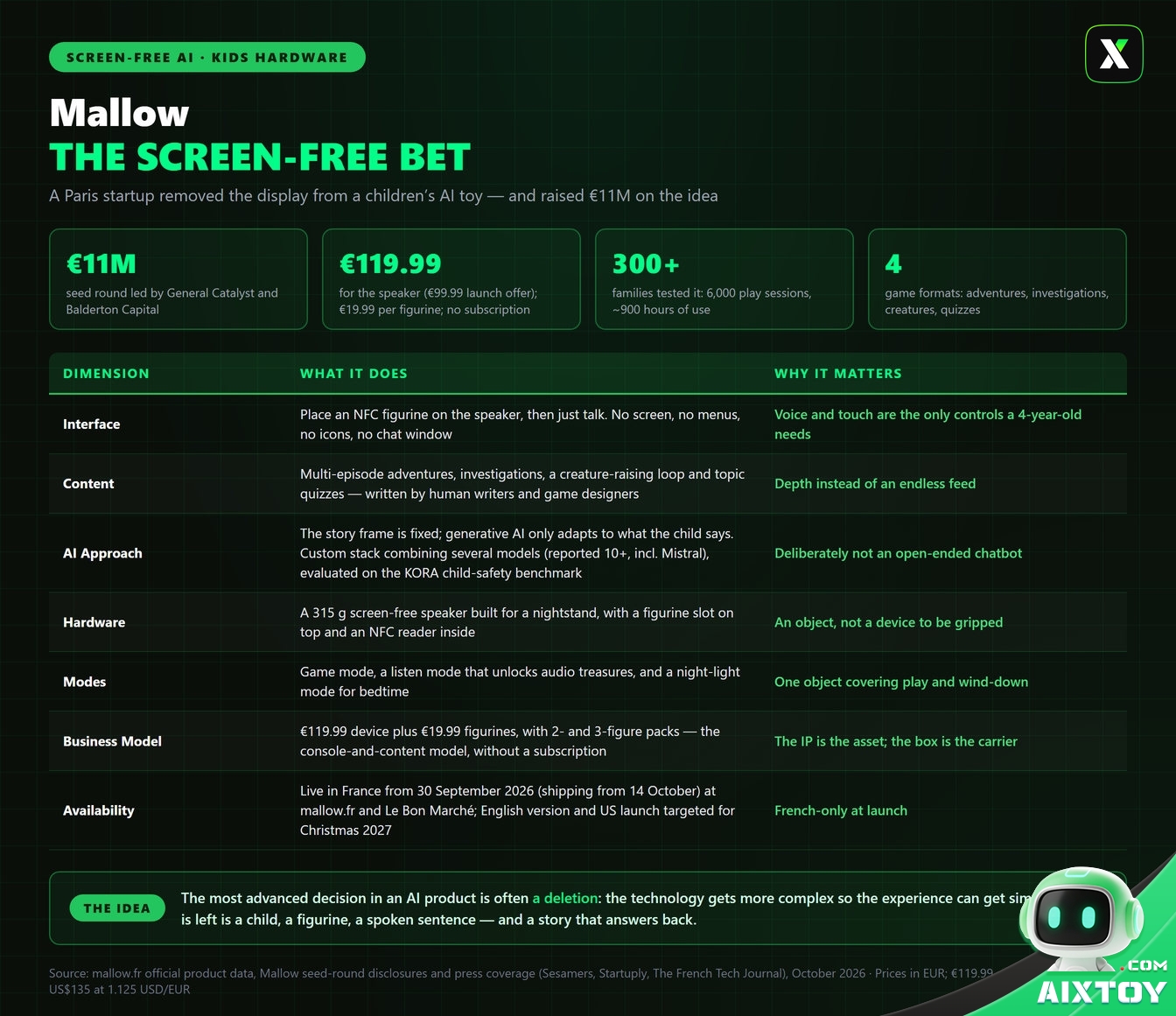
Mallow, a Paris startup that came out of stealth on 30 September 2026, is a direct challenge to that reflex. Its product has no screen, no menus, no icons and nothing to swipe. A child places a physical figurine on top of a small speaker, says something out loud, and the story answers back. That’s the entire interface.
The company raised an €11 million seed round on the bet — co-led by General Catalyst and Balderton Capital, with Alpha Intelligence Capital, Edu Capital, Motier Ventures, Kima Ventures, daphni and Sistafund participating. It is a striking cheque for a consumer-hardware company in Europe, and stranger still because most of it was raised in 2024, two years before anyone outside the company saw the product.
What Mallow Actually Is
Mallow is a screen-free audio game speaker for children aged 4 to 10. It sells for €119.99 — about US$135 at today’s rate — with a launch price of €99.99 until 14 October, and no subscription. Extra figurines are €19.99 each. It is available on mallow.fr now, arrives at Le Bon Marché in Paris on 24 October, and orders ship from 14 October.
The mechanism is almost aggressively simple:
- The child picks a figurine and places it in the slot on top of the device.
- An NFC chip identifies the character and loads its world.
- The child talks — asks, chooses, guesses, argues.
- The AI responds in real time, moving the story forward.
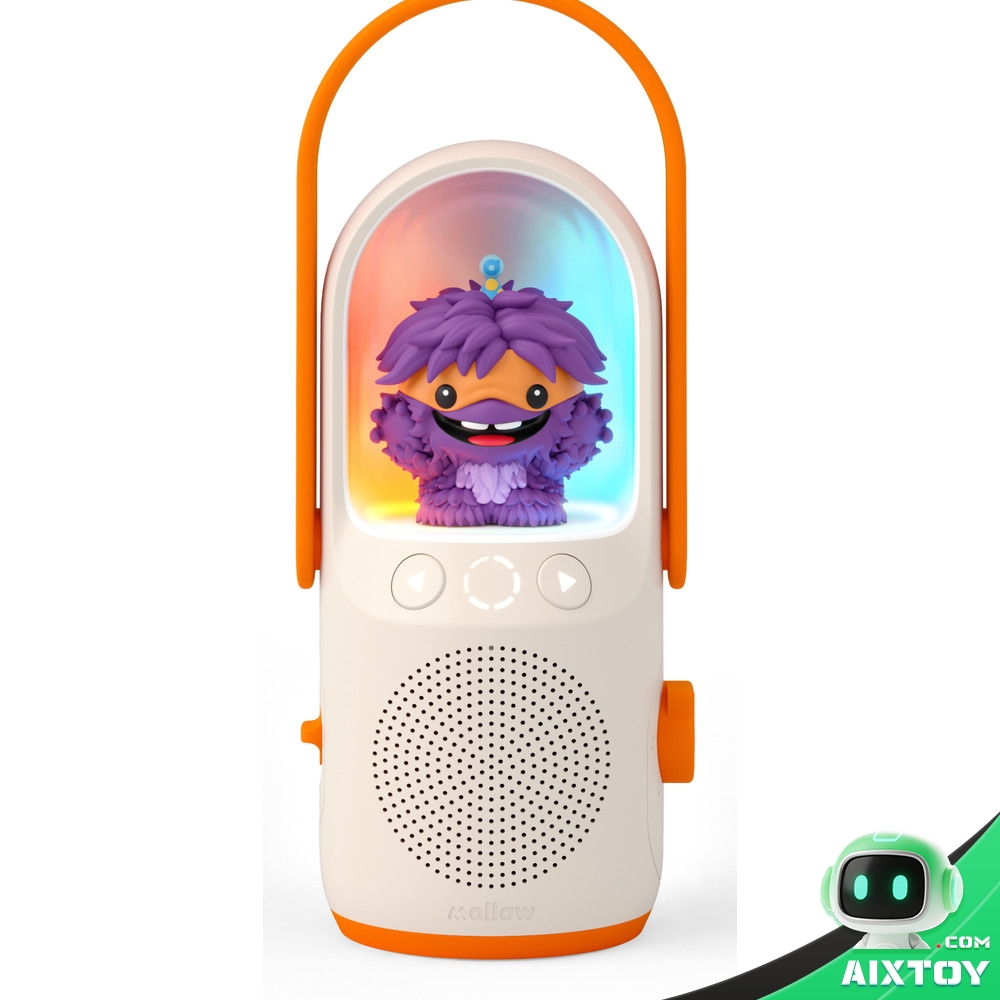
There are four game formats. Adventures are multi-episode narratives where the child is the protagonist. Investigations are structured mysteries. Creatures is a Tamagotchi-like loop in which the child teaches a character words. Quizzes test knowledge across topics. On top of that sit three modes: a game mode, a listen mode that turns progress into audio treasures the child can replay, and a night-light mode that softens the device into a warm glow at bedtime.
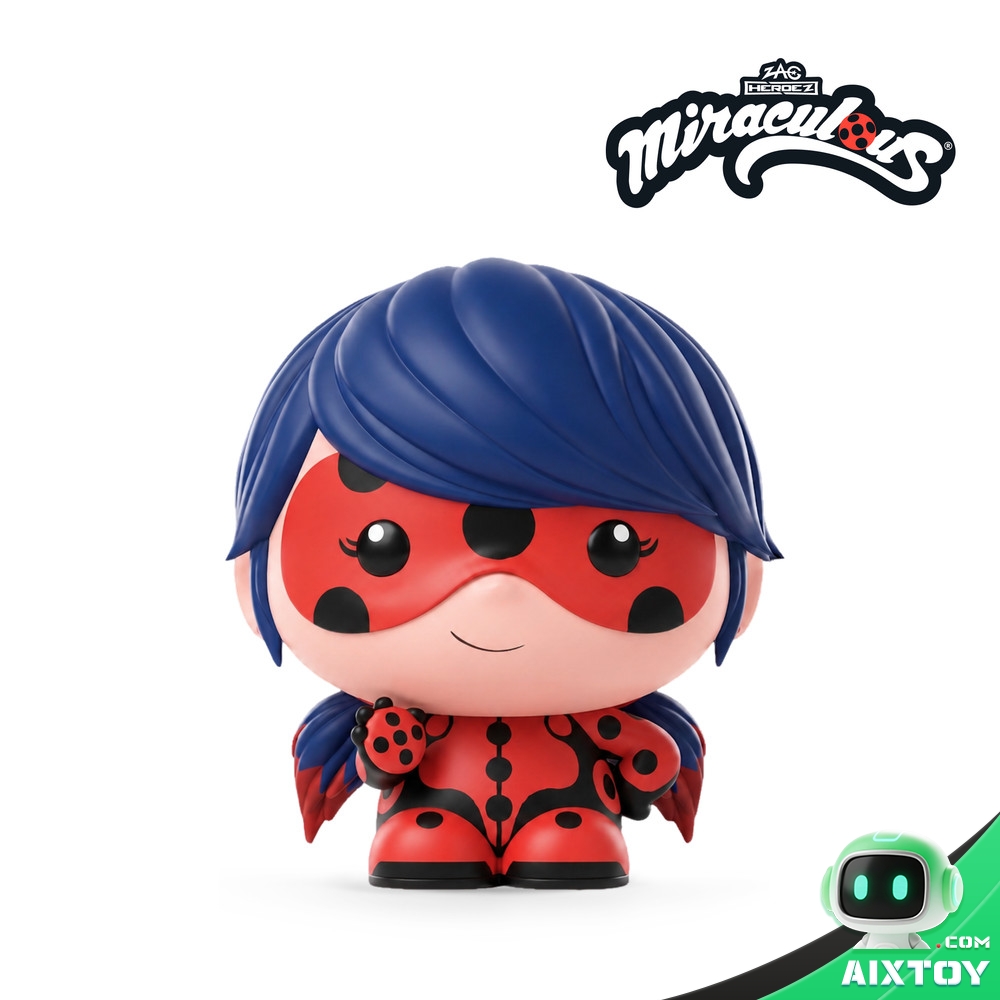
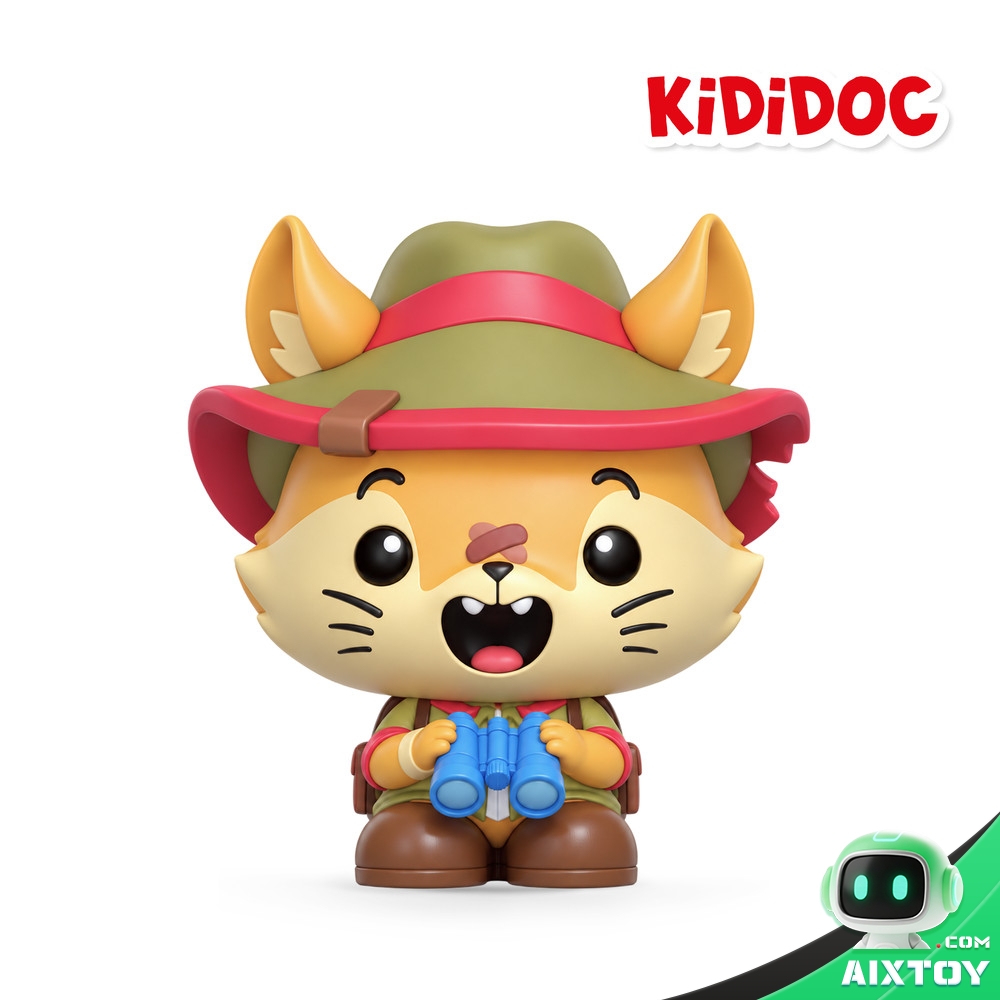
Launch content leans on licensed IP: an interactive adventure with Miraculous (Ladybug), a knights quiz from Éditions Nathan’s Kididoc series, plus original characters including Oli, Charlie and Bébé dragon. Rounds of multiplication practice, detective stories and a collection set are listed as coming soon.
Physically, the device is deliberately unremarkable — a 315-gram, soft-edged speaker designed to sit on a nightstand rather than be gripped by a child. It is not a tablet. It is not a robot. It is closer to a bedside radio that talks back.
The Screen Reflex
The consumer-electronics industry spent the last decade adding displays to things that never needed them: refrigerators, running machines, speakers, mirrors. In children’s products the reflex is at its most extreme, because “educational” and “screen” have become effectively synonymous. The result is that a great many smart devices end up as phones in different sizes.
Mallow starts from a different question: do four-to-ten-year-olds actually need a graphical user interface? The argument is that they don’t. The interactions young children are naturally good at are touching, picking up, placing, listening and speaking — not clicking, swiping and hunting for icons.
So the company inverted the design brief. What the child sees is a soft, simple object and a cast of small characters. What the child never sees is the stack underneath: the generative models, the NFC reader, the cloud content system, the safety layer, the speech understanding. Mallow calls this invisible AI, and it is a useful phrase. The most sophisticated technology in the product is the part designed to disappear.
Why the Figurine Matters
If voice alone can start a story, why insist on a physical character?
Because a tap on a glass icon is an instruction, while placing a figurine on a device is a ritual. It has weight, texture and a beginning and an end. For a child, the object becomes the key to a digital world — and the ritual is what makes the world feel real.
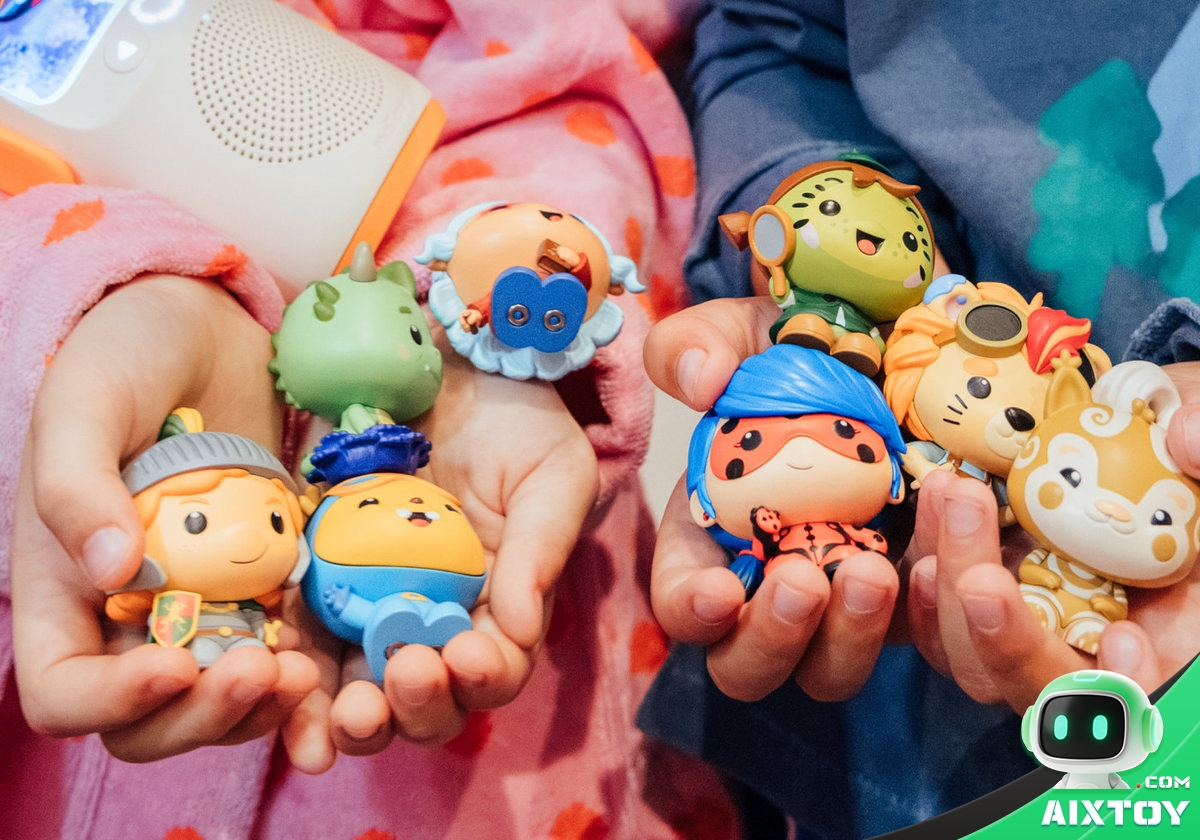
It is also, deliberately, a business model. Mallow borrows the console logic the games industry perfected decades ago: sell the platform once, then keep selling the things that make it worth owning. At €19.99 a figurine, and with packs of two or three priced at €35.98 and €53.97, the company has built a repeat-purchase loop on top of a single hardware sale — without a subscription. The company’s own positioning is that the IP and the content, not the plastic box, are the durable asset.
The Hard Part Is Restraint, Not Technology
Mallow’s most consequential design decision is what its AI is not allowed to do.
An adult’s speech is orderly: complete sentences, clear intent. A four-year-old’s is the opposite — fragmentary, associative, emotional, prone to sudden topic changes. That makes open-ended large-model conversation a poor fit for this age group, where output quality, values and safety are genuinely hard to control.
Mallow’s answer is to fence the model in. Story frameworks are written by human writers and game designers; generative AI operates inside that frame, adapting to what the child says and does rather than inventing the world from scratch. The company describes this as letting the AI do the one thing it can do reliably — respond — rather than the thing it does unpredictably — create freely.
Underneath sits a stack of safety measures: a custom AI system that combines multiple generative models (reported to involve at least ten, including technology from Mistral AI), multi-layer moderation, and evaluation against the KORA benchmark for how AI behaves with children. A scientific advisory board of child-development researchers — Grégoire Borst, Alex de Carvalho, Justine Cassell and Adele Diamond among them — advises on design and usage. There is also a dedicated parent app for following a child’s progress, which is where the screen went: out of the child’s hands and, in a limited form, into the adult’s.
The company’s framing is pointed: it is not selling an imaginary friend. There is no companion that asks about your day and remembers your secrets. It is selling audio games with characters, a scenario and rules — deliberately bounded.
The Validation Behind the Launch
Mallow is not a weekend prototype. By the company’s account, more than 300 children and families tested the device over roughly two years, generating over 6,000 play sessions and around 900 hours of use. The device at launch reflects that iteration.
The round is also, in structure, a familiar European playbook: a founding team whose track record functions as collateral. CEO Cédric O was France’s Secretary of State for Digital Affairs from 2019 to 2022 and is an advisory co-founder and early shareholder of Mistral AI. Chief Product Officer Flore Cousin came from BCG and the French fintech Alma. The non-executive bench — Fred Potter (Netatmo, Withings), Sébastien Boyer (FarmWise) and Nicolas Princen (Glose) — reads like a roll call of French consumer hardware. O has been candid that the structure was copied from what worked at Mistral.
The market context is not speculative. The global children’s audio-player category was worth about $1.43 billion in 2024 and is projected to reach $3.73 billion by 2033, roughly 11% annual growth. Germany’s Tonies has sold more than nine million Tonieboxes and over a hundred million figures, crossing the ten-million mark at the end of 2025. London’s Yoto reported $127 million in revenue for 2024. Both proved the commercial premise at the heart of Mallow’s pitch: parents will pay real money to buy their children less screen time. Mallow’s bet is narrower and more interesting — that the next generation of that category is conversational, not pre-recorded.
The Caveats Worth Knowing
- It is French-only, and France-only, for now. The device launched in French, in France, through mallow.fr and premium Parisian retail. An English-language version with a US launch is targeted for Christmas 2027.
- The margins are tight. Hardware at €119.99 with no subscription leaves little room for error, and the category’s incumbents are not standing still — Yoto has deep content libraries and strong brand loyalty, and could add generative features on top of an installed base.
- Independent evidence is still thin. The developmental claims rest on the company’s own testing and its advisory board; large-scale, peer-reviewed validation is not yet part of the public record.
- Content velocity will decide it. The console model only works if the figurine shelf keeps growing. If licensed IP deals multiply, the model is working; if the catalogue stalls, the device becomes a nice object with three stories.
What Other Hardware Teams Should Take From It
Strip away the French design language and Mallow is a case study in subtraction. Four moves are worth copying:
- Hide the AI in the experience, not the spec sheet. Nobody buys a toy because of a model version number.
- Be willing to remove the screen and rebuild the interaction around it. The hardest part of screenless design is not the hardware; it is admitting how much of your interface existed only because it was easy.
- Let a physical object carry the digital entry point. It creates ritual for the child and a repeat-purchase loop for the business.
- Treat IP and content as the long-term asset; the box is just the carrier. One-off hardware sales are a crowded red ocean. Hardware plus content plus IP is the model with a future.
There is also a lesson aimed squarely at industrial designers. The old craft competed on curves, proportions, CMF and UI layout. Products built around AI compete on something else: how the interaction is defined, what the product refuses to do, and how the commercial model is folded into the object. Can the screen go? Can the buttons go? Can the operation disappear?
The Bottom Line
Mallow may or may not become the defining children’s device of the next decade. Its price acceptance, content cadence and IP pipeline all still have to be proven in the market. But it makes one argument very cleanly: the most advanced design decision in an AI product is often a deletion.
Take away the screen, take away the menus, lower the barrier, hide the technology — and what is left is a child picking up a figurine, setting it down, saying something, and a story beginning. The technology gets more complex so that the experience can get simpler.
Mallow itself is French-only for now. If you want a screen-free, voice-first AI companion you can buy today rather than in 2027, the RAGUS voice-interactive AI figurine in the AIXTOY store is a talking collectible kids speak to instead of tapping — and it ships worldwide now.
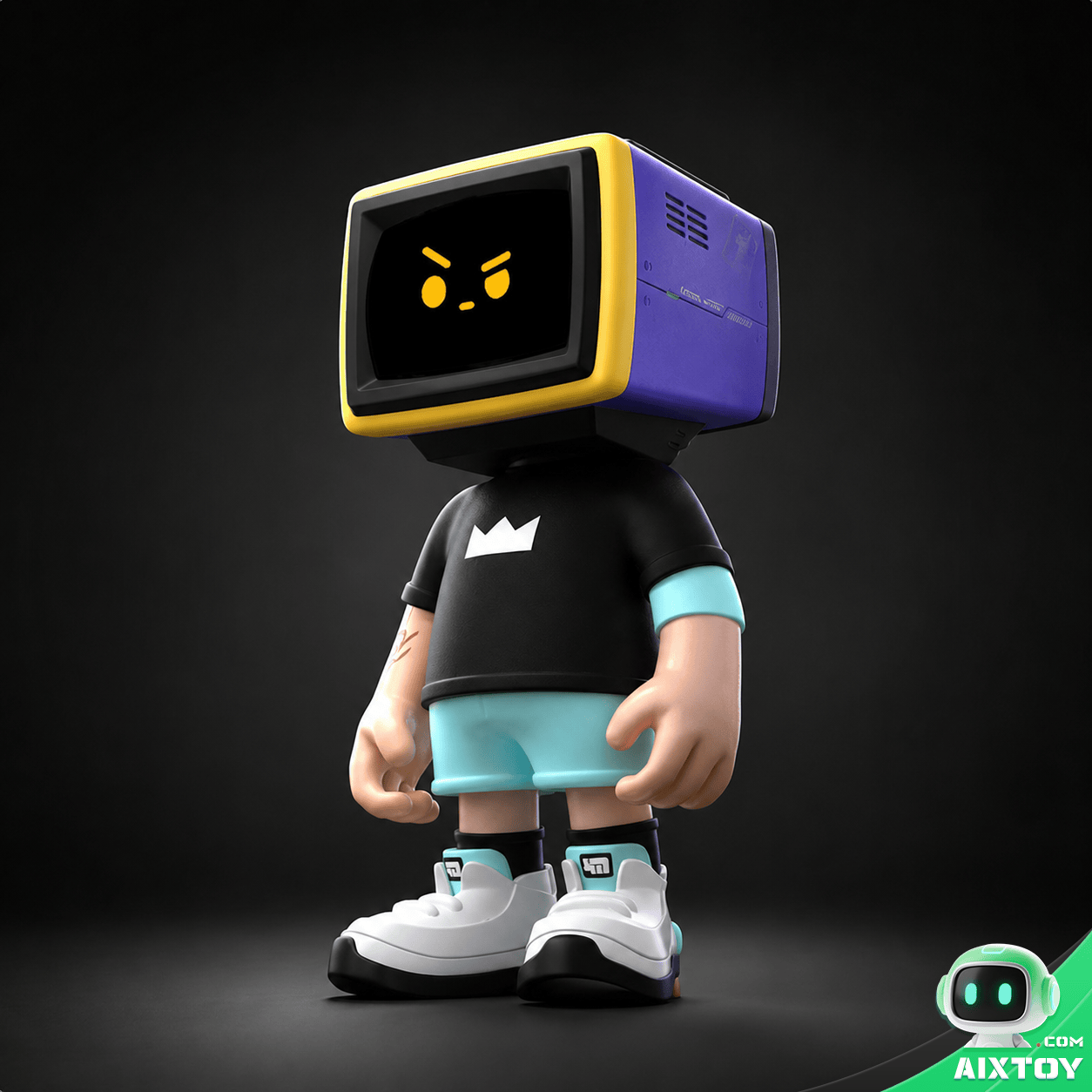
RAGUS Voice-Interactive AI Figurine
$189.00
A talking robot collectible from Qimiao Labi with no screen and no menus — just speak and it answers, reacting with lifelike animations and voice recognition that parses natural language. Swappable play cards change its look and unlock new interaction modes. Voice-first, screen-free, ships worldwide from AIXTOY.
Tags:Mallow Screen-Free AI Toy AI Hardware AI Companion edtech Voice Activated Toy Tonies Yoto AIXTOY