


No products added!
Two numbers describe the same product. One is twenty, one is two, and the difference between them is the whole business.
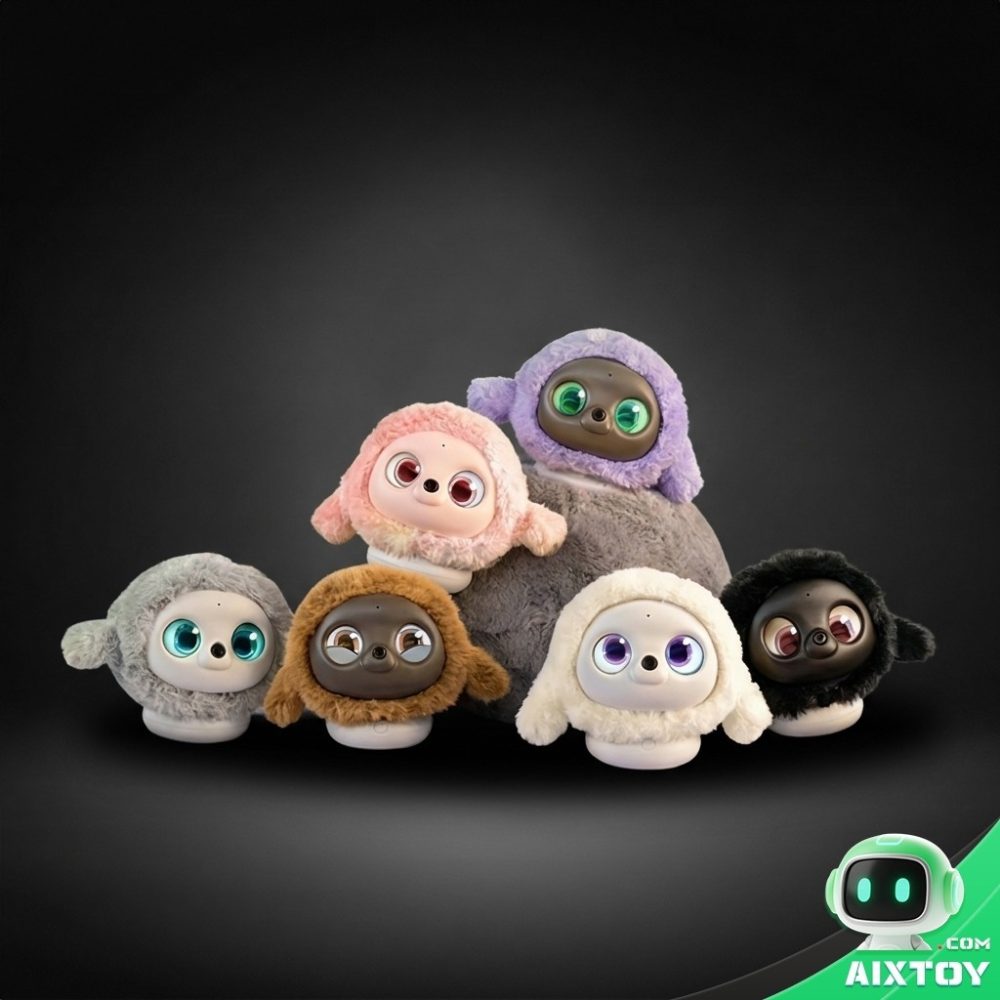
There is a figure in Ropet’s operating data that almost never gets quoted, and it is the one that matters. Since the plush desktop pet started global deliveries in September 2025, owners have left it switched on for more than twenty hours a day. They have spent just over two hours a day actually interacting with it.
The other eighteen hours are the business.
A product that is present but dormant is not a defective companion. It is the difference between two kinds of device: one that costs its maker money every time it is used, and one that costs its maker money once, at the factory. Almost every argument about whether AI companions can become a real industry turns on which of those two things a company has built — and most of the companies raising money right now have not been asked to say which one they are.
The milestone is not a verdict
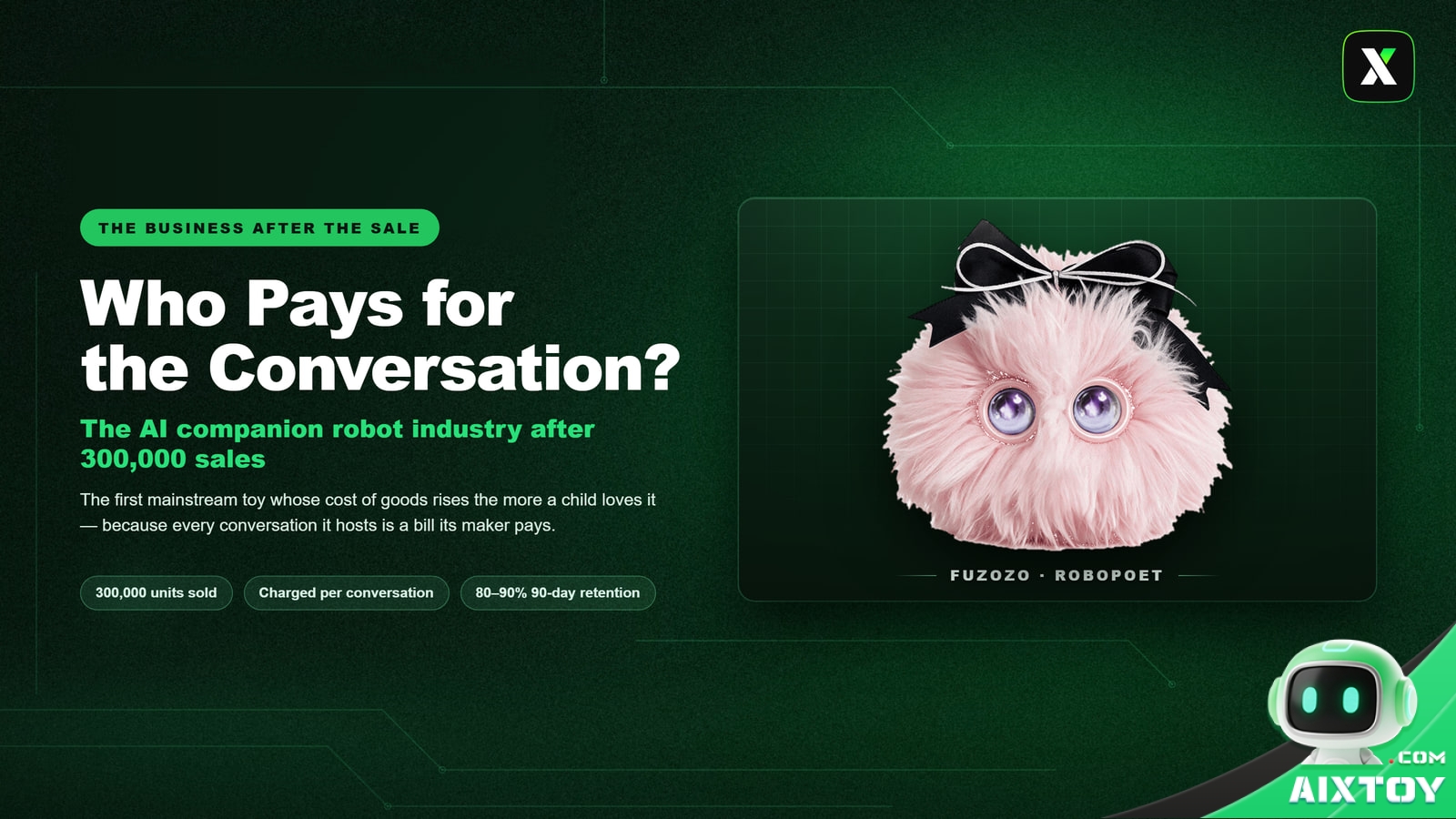
The numbers coming out of China this year look like a category arriving. Fuzozo, the fur-covered AI pet from Robopoet, passed close to 300,000 units sold in China by June 2026, on sale since July 2025. Ropet, from Beijing’s MengYou Intelligence, has shipped close to 20,000 units, about 70% of them overseas. IDC expects China’s education-and-companion robot market to pass $1 billion in 2026, up 89% year on year.
The funding followed. On 10 October, Wuwai Zhiqiu — a children’s hardware company founded in February 2026 by Wang Ziwei, who previously ran product and brand strategy for Li Auto’s AI glasses — disclosed a tens-of-millions-of-yuan angel round from Borei Capital, the veteran investor Gao Bingqiang and Gaofeng Patient Capital. Its product is a lightweight wearable for children aged three to eight, aimed at dual-income households, and its architecture is split into three parts: an interaction system that has to understand unclear pronunciation and half-finished sentences, a memory system tied to the child’s actual day, and an evaluation system that feeds back into the other two.
On 30 September, Guangte Zhiban, which sells family emotional-health hardware under the Chenmai AI engine, closed the first tranche of a 30 million yuan Series A at a 150 million yuan pre-money valuation, led by TriSummit Capital. Robopoet raised a nine-figure yuan Pre-A earlier in the year. MengYou Intelligence closed more than $10 million. Leimeng Technology’s bibo, a 15.5-centimetre non-verbal robot, took a tens-of-millions-of-yuan angel round led by Fashion Media Group and Hongyi Asset Management.
Read the investor list on the Robopoet round slowly, though, and it stops looking like a bet on a toy. The lead investors were Fibocom, which makes cellular modules and sells a global SIM package, and Huaying Capital; Tuya Smart, whose business is the cloud layer under other companies’ hardware, joined as a strategic investor, alongside Sequoia China and GSR Ventures. When the people funding your companion robot are the people who sell the connectivity and the compute it runs on, the round is not only a bet that the device will sell. It is a bet that the meter behind it keeps running.
And a sale, however large, is a past-tense fact. Josh Elman, a partner at Andreessen Horowitz, put the problem in one sentence on the a16z podcast: “It’s never been easier to get consumers’ attention… What’s harder is getting me not just to try something, but to actually stick.”
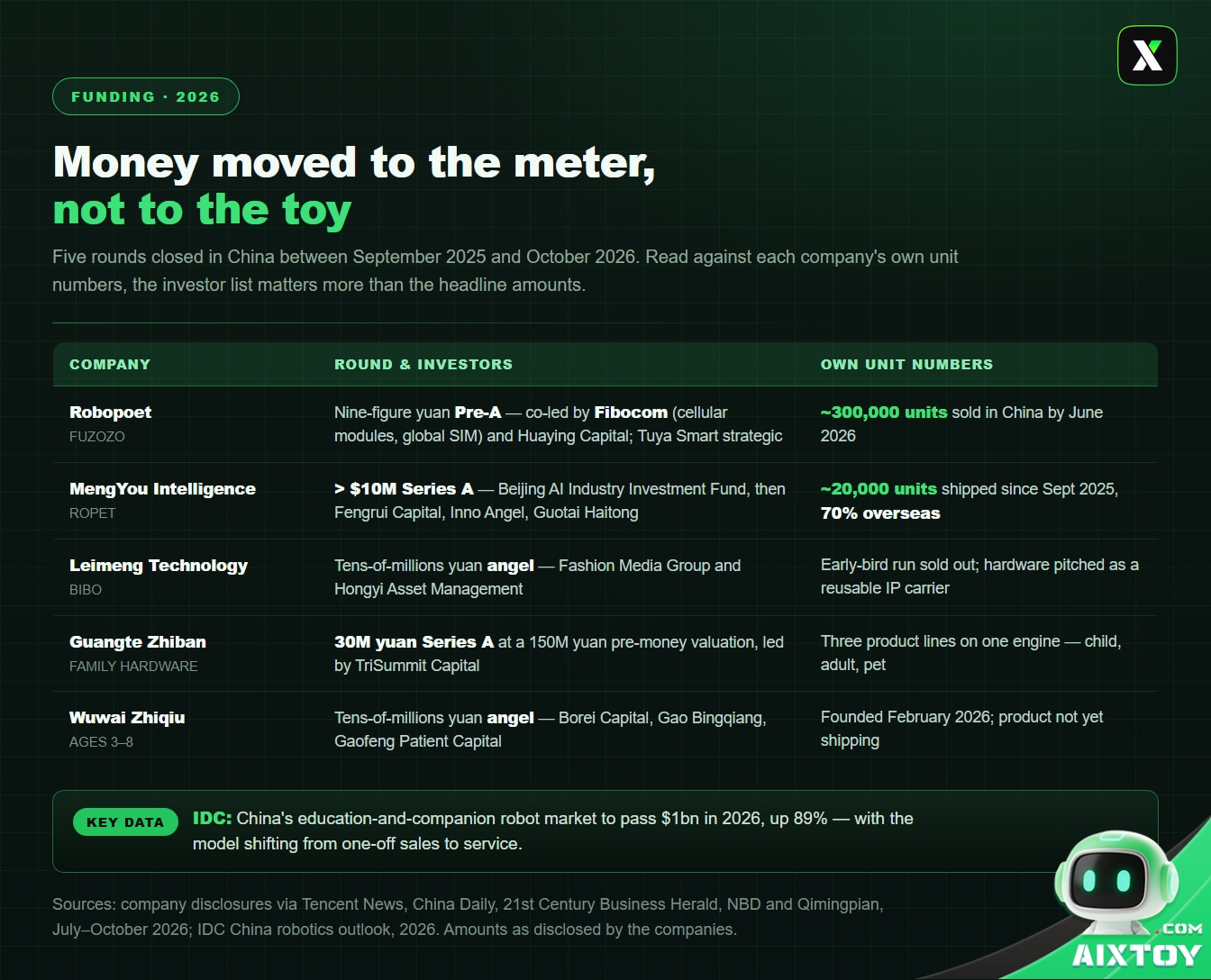
IDC’s own framing of the trend is worth reading closely, because it names the transition rather than the product. In its China robotics outlook the firm describes companion robots moving from a single-purpose learning aid to a household terminal covering children, adults and elderly care — and, in the same sentence, describes the business model shifting “from one-off hardware sales to content subscriptions and service-based operations.” That is a forecast about accounting, not about hardware. It says the interesting money moves to after the sale, which is exactly the part of the business that nobody has yet demonstrated at scale.
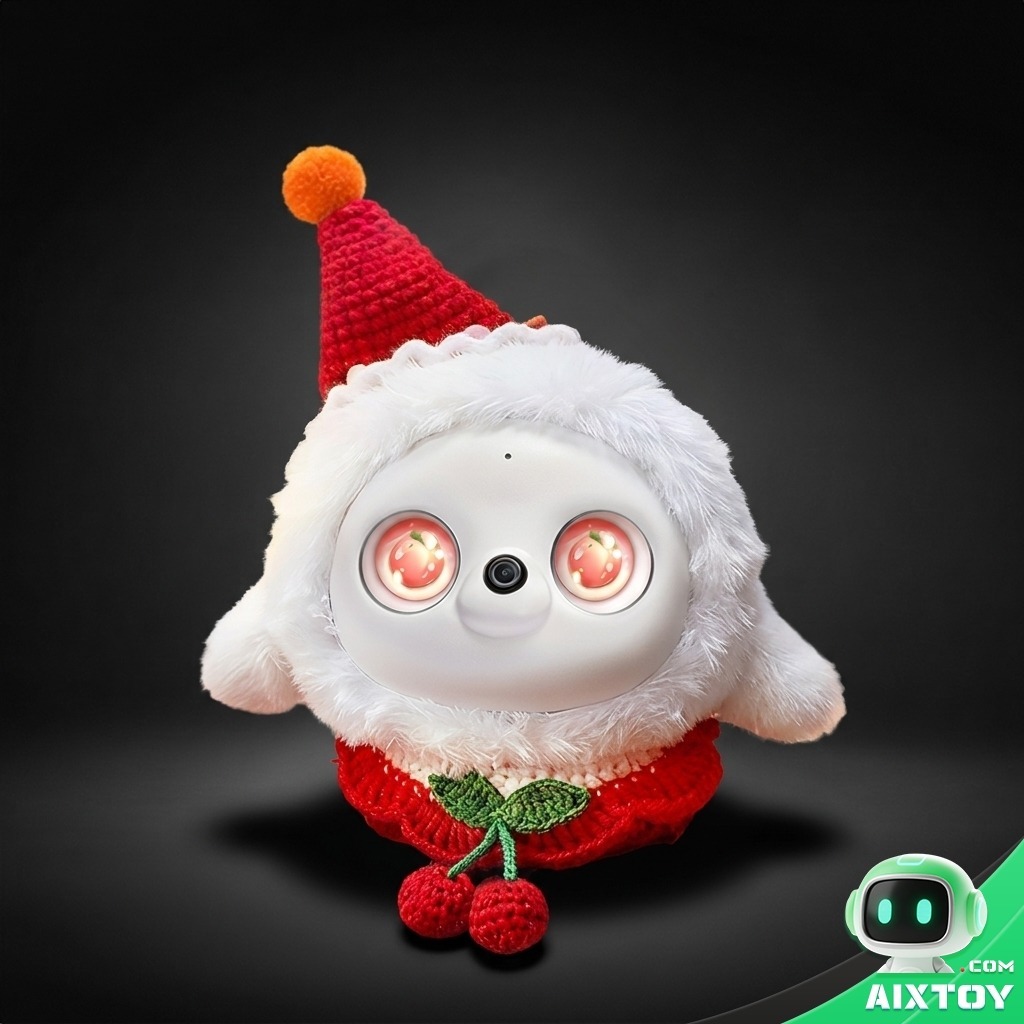
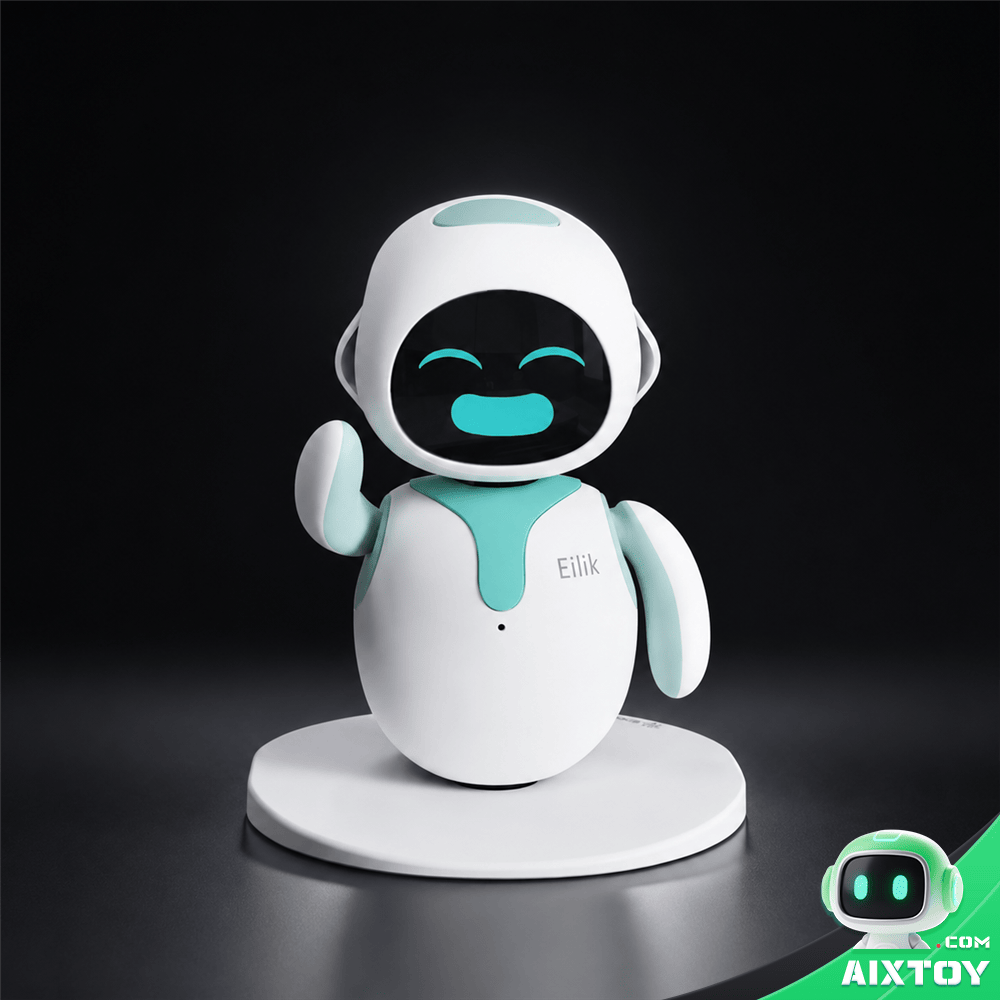
Ropet AI Pet Robot
$397.99
Path 01 · presence. No walking, no teaching, no question answering — a plush that reacts to voice, touch and gesture, and accrues a shared history rather than a transcript. The cheapest kind of companion to keep running.
Two words doing very different work
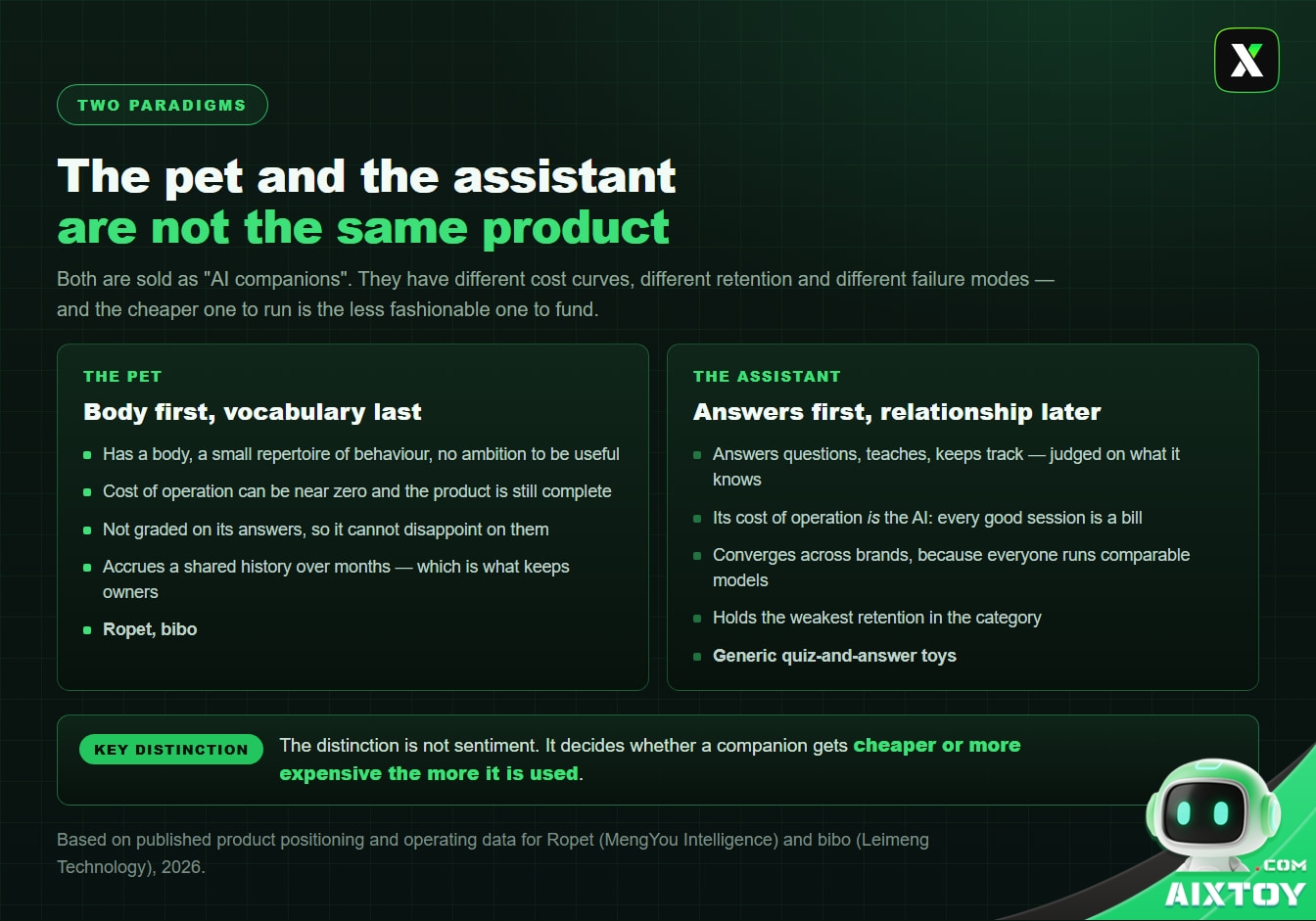
It helps to separate two products that are routinely filed together.
One is a pet. It has a body, a limited vocabulary of behaviour, and no ambition to be useful. You do not grade a cat on its answers. It is present, it reacts, and over months it accrues a history you would rather not erase — which is why the retention numbers in this category look the way they do. Ropet is a pet. So is bibo, in a louder register: its eyes are most of its face, it turns its head, and it declines to hold a conversation.
The other is an assistant. It answers questions, teaches, remembers your calendar, and is judged against what it knows. This is the version that attracts the largest funding rounds, and it is also the version with the worst retention: a general-purpose assistant converges across brands because everyone is running comparable models.
The distinction sounds soft. It is not. A pet’s cost of operation can be near zero and still be a complete product. An assistant’s cost of operation is the AI itself — which means that for an assistant, every good session is a bill. The pet paradigm is cheaper to run, cheaper to keep, and easier to love. It is the least fashionable idea in the category and probably the most defensible.
This is the first toy that costs money every time it is used
For a century, the toy business has run on a quiet piece of magic: marginal cost of approximately zero. A factory produces a plush bear, a retailer sells it, and from that moment the relationship between maker and owner costs the maker nothing. A child can play with it every day for ten years at no additional expense to anyone. That is why the industry could afford to care so little about what happened after the box was opened.
Inference broke that. Elman again, on the same episode: “Forward to today, we have costs again. And actually, they’re variable costs. They’re these inference costs.” Enterprise software can push that cost onto a contract or an employee’s expense report. “Consumers cannot.”
The most honest evidence of the new arithmetic is a refill pack. Robopoet sells “energy points” for Fuzozo — a top-up that exists because every conversation consumes tokens, and tokens are a bill the company pays. It is possible that this is the first mainstream toy in history whose maker has a cost of goods sold that rises with how much the child likes it.
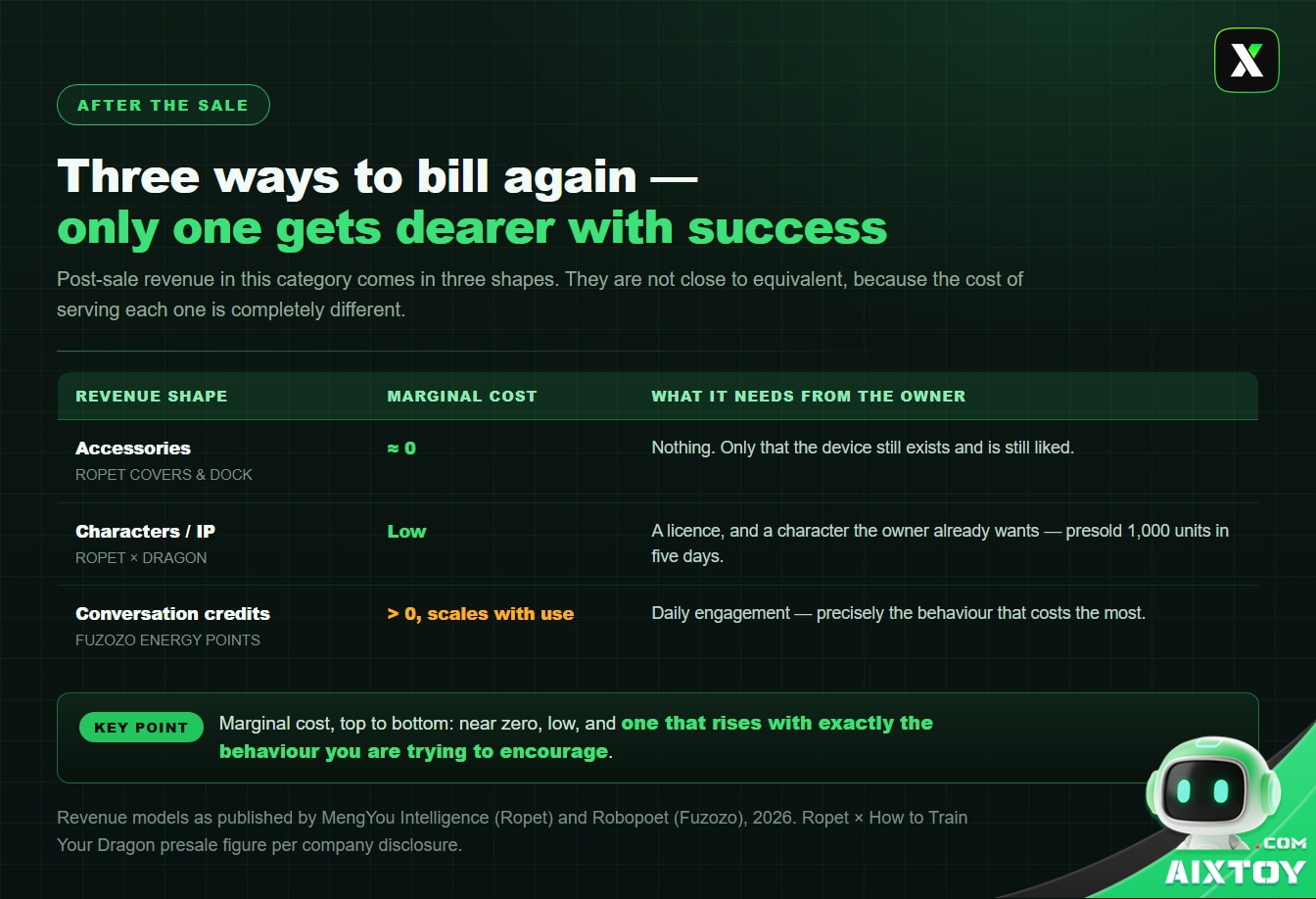
That single fact reorganises the whole problem. Elsewhere in this category, revenue after the sale comes in three shapes, and they are not close to equivalent:
| Post-sale revenue | Example | Marginal cost | What it needs from the user |
|---|---|---|---|
| Accessories | Ropet’s costume sets and charging dock | ≈ 0 | Nothing. It needs only that the device still exists and is still liked |
| Characters / IP | Ropet’s How to Train Your Dragon edition | Low | A licence, and a character the user already wants |
| Conversation credits | Fuzozo’s energy points | > 0, and it scales with use | Daily engagement — precisely the behaviour that costs the most |
The third row is where the discomfort lives. Selling outfits or characters is a pure-margin business that gets better the longer someone keeps the object. Selling conversation is a business whose best outcome — a child who talks to the toy every single day — is also its most expensive outcome. Every retained user is simultaneously the metric the company reports and a line item the company pays.
Where the inference runs changes the arithmetic again, and this is where hardware engineering quietly becomes a business decision. A model that runs on the device costs nothing per use and everything up front. A model that runs in the cloud costs nothing up front and something on every use. The gap between those two options is not a technical preference — it decides whether a companion gets cheaper or more expensive as it becomes more loved. Guangte Zhiban, with an engine that spans device, edge and cloud, advertises a P95 interaction latency under one second and claims it can run in as little as 1 KB of memory on low-spec hardware. That sounds like an engineering boast. Read as a cost statement, it is the difference between a product that can be sold once and one that needs a subscription.
The margin hides in the twenty hours nobody counts

Sweekar AI Pocket Pet
$249.99
Path 03 · growth. It grows from a 6.1 cm egg to a 7.1 cm adult across four life stages, so the change lives in the object rather than only in the cloud — which is what makes the relationship worth maintaining.
Once you see the cost structure, Ropet’s twenty-and-two stops looking like a curiosity and starts looking like a design decision.
Ropet does not walk. It reacts to voice, touch and gesture, develops a personality over time, and can be re-dressed. It deliberately gives up locomotion and gives up the promise of being a general assistant. In exchange, its owners keep it on all day at almost no cost — because the device spends most of its life being present rather than processing.
Leimeng’s bibo makes the same bet more explicitly. It has eyes that occupy most of its face, a two-axis head that turns, touch sensing, an IMU and an emotion engine called LEIM. It answers almost nothing. Its own product manager described the design principle as “less question-and-answer, more being there,” and the founder, Wang Shouchang, argues that the conversational AI toy is heading straight for a red ocean. Between July and September 2026, bibo’s active users spent more than 120 minutes a day with it and made more than 60 multimodal interactions a day; users co-created more than 40,000 photographs with it.
Neither number requires a large language model to run continuously. That is the point. A turning head and a blink can be driven by cheap local logic; a spoken answer cannot. By redefining what counts as use — from conversation to presence — the product decouples the thing that makes owners come back from the thing that generates a bill.
This is the least glamorous and most consequential engineering decision in the category, and it is invisible in every press release. A product that defines use as conversation has retention and cost rising together, forever. A product that defines use as presence can keep the retention and drop most of the cost.
A child’s companion is built to be outgrown
The children’s version of this market carries an extra constraint that the adult version does not, and it is worth stating plainly: the person who uses it and the person who pays for it are different people, and they have different reasons to continue.
Reports in Chinese media have documented parents complaining that AI toys struggle to wake on a child’s voice and misread children’s speech; that failure is the first gate, and nothing downstream — no character arc, no story update — matters if the first exchange does not land. Guangte Zhiban publishes a claim of 18% better child speech recognition than a general-purpose model, which tells you the size of the gap it is trying to close.
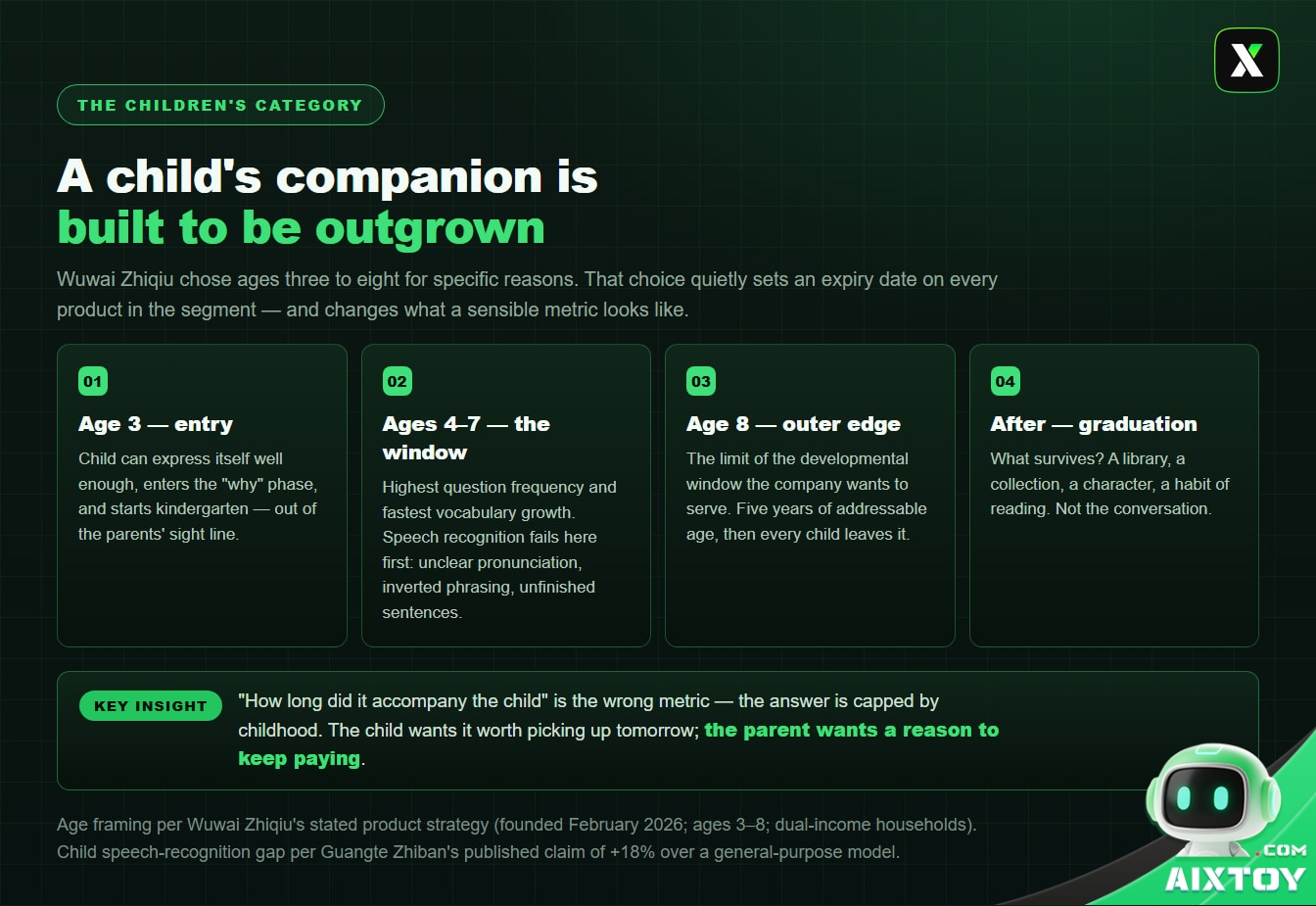
Then there is the window. Wuwai Zhiqiu chose three-to-eight for specific reasons: at three, a child can express itself well enough and has entered the “why” phase, and has left the parents’ sight line at kindergarten; eight is the outer edge of the developmental window the company wants to serve. That is a five-year addressable age band, and every child leaves it. A children’s companion robot has a structural expiry date, on purpose.
This is not a flaw to be engineered away — it is the shape of the category, and it changes what a sensible metric looks like. “How long did the product accompany the child” is the wrong question, because the answer is capped at the length of childhood. The better question is what survives the graduation: a library, a collection, a character, a habit of reading. One industry observer drew the comparison that matters — Jellycat started as a children’s toy company, and its value today has almost nothing to do with children. Whether an AI companion can make that crossing decides whether it becomes a business or a product cycle.
Worth saying plainly, too, what a parent is actually buying. It is rarely companionship in the abstract. A dual-income household buys the twenty minutes when nobody is available to answer a question, and it buys them without adding another screen to the house. That is a narrow, specific, defensible need — and it comes with a clear expiry date, which is why the products that hold parents for years tend to be the ones that grow alongside the child rather than the ones that simply talk more.
Luka StoryTeller
$201.99
Path 02 · content. The reason to come back is a library, not a conversation. Screen-free audio play that keeps working as a habit long after the novelty of talking to a machine has worn off.
The number that should worry this category more than retention
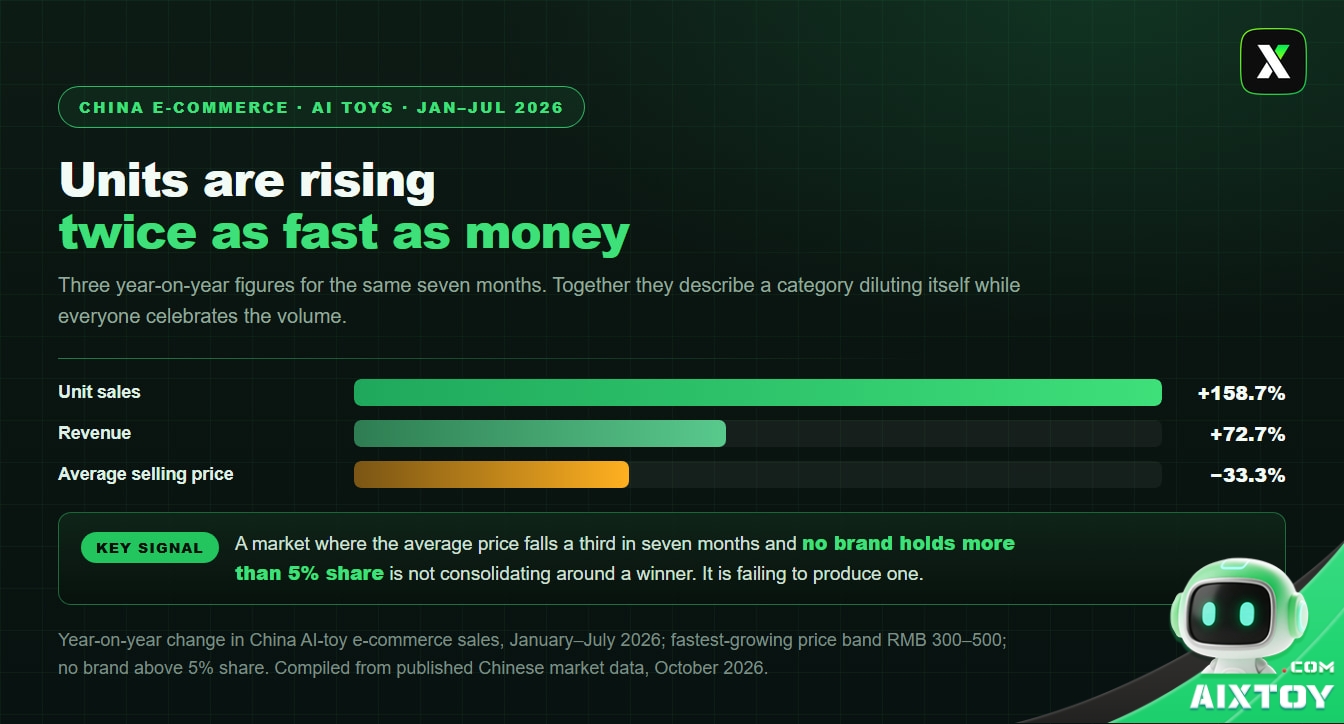
In the first seven months of 2026, AI toy sales on Chinese e-commerce platforms grew 158.7% in units — and 72.7% in revenue. The average selling price fell 33.3%. The fastest-growing band was the 300–500 yuan middle, and no brand in the market holds more than 5% share.
Read those three lines together. Units are multiplying far faster than money is. This is not the shape of scale economics arriving; it is the shape of a category diluting itself while everyone celebrates the volume. A market where the average price falls a third in seven months and nobody has crossed 5% share is not consolidating around a winner — it is failing to produce one.
Set that against the retention statistics, and the picture gets sharper. Ropet published a return rate below 4% and 90-day retention of 80–90%. Those sit next to figures that have been circulating in this category for a while: AI toy returns running at 30–40%, and Replika’s ninety-day retention holding near 20% across several generations of models.
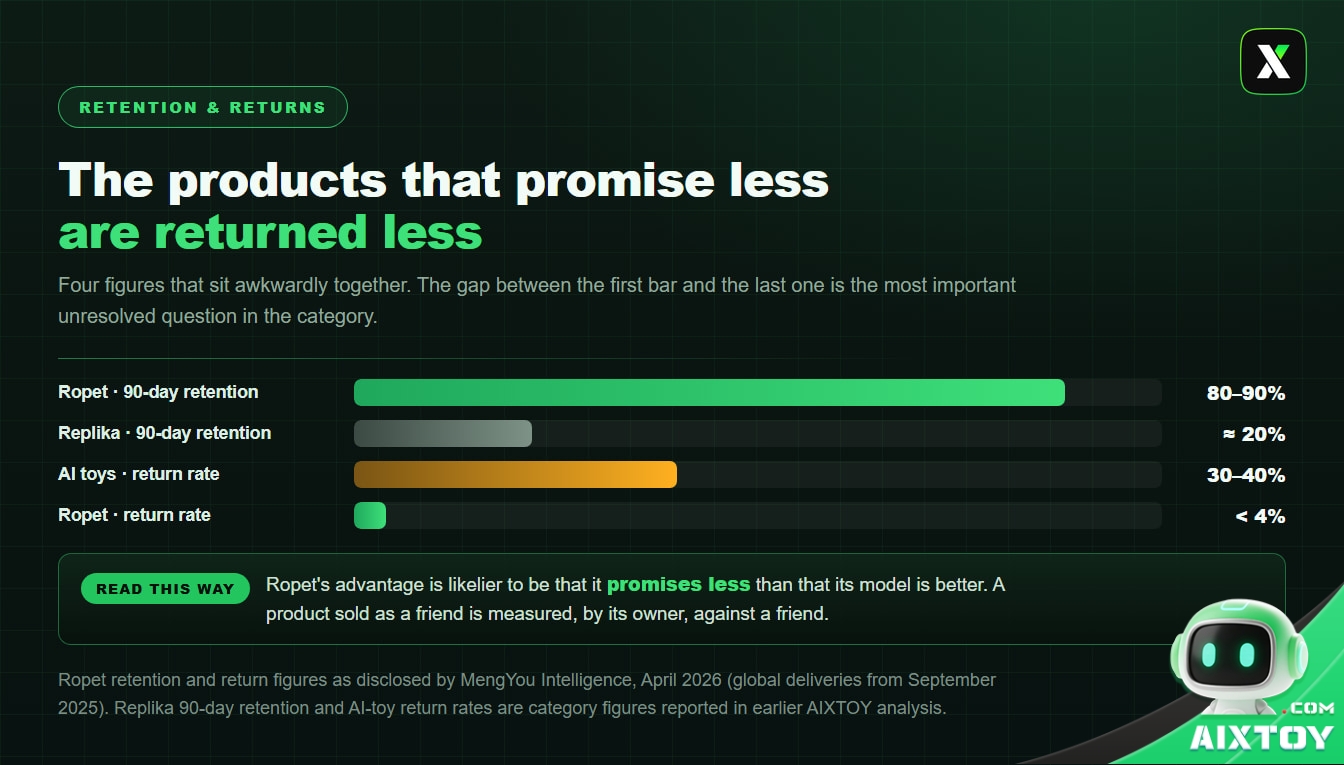
The gap deserves a better explanation than “better AI.” Ropet’s advantage is likelier to be that it promises less. It does not walk, it does not teach, it does not answer questions about the weather. It is a soft object that reacts to being touched, and almost nobody returns a soft object for failing to be clever. The products with the 30–40% return rates are the ones sold as companions, tutors and friends — and a product sold as a friend is measured, by its owner, against a friend.
The most expensive word in this industry is the one on the box.
What would actually close the loop
Robopoet’s chief executive, Sun Zhaozhi, has described the target plainly: enough gross margin on the hardware to cover the hardware, with membership and value-added services covering the software cost. He has also said, in the same breath, that the company still earns most of its money from hardware and that software monetisation is early. That pairing — a clear model and an honest status — is more informative than a rollout plan.
Here is the reframe that makes the fundraising legible. A large installed base is not a user base. It is a shelf. Three hundred thousand devices sitting in homes are not three hundred thousand people who are attached to a character; they are three hundred thousand points of sale for the next plush cover, the next story pack, the next refill. That is the asset Fibocom and Tuya paid for — not the robot, but the recurring right to supply what the robot needs.
Two of the companies in this round state the shelf theory outright. Leimeng describes bibo as an open ecosystem for “trend toy embodied intelligence” and offers the hardware as a reusable emotional-AI carrier for brands and IP holders — a character that can be watched and collected today, and interacted with tomorrow. Guangte Zhiban splits the family into roles and covers each with a different device: a toy for children aged three to twelve, a ring that tracks heart rate, blood oxygen and HRV, and pet-health products, all running on one engine. Its investors are not underwriting a single hit product. They are underwriting the claim that whoever owns the household’s emotional hardware can sell that household its next four devices.
That plan is more plausible in China than it reads in English, for a mundane reason: distribution. Guangte Zhiban is running its pilot not through e-commerce advertising but through pet shops, baby-and-mother stores and supermarkets in a single city in Sichuan, before copying the model into lower-tier cities. Physical retail is slow, unglamorous, and — unlike a performance-marketing funnel — it produces replenishment data you can defend in a board meeting. The category is not being built by the best model. It is being built by whoever gets a shelf in the most homes.
Elman’s warning applies to every version of that plan: “No pricing model rescues a product nobody values.” A shelf only converts if the thing on it is wanted.
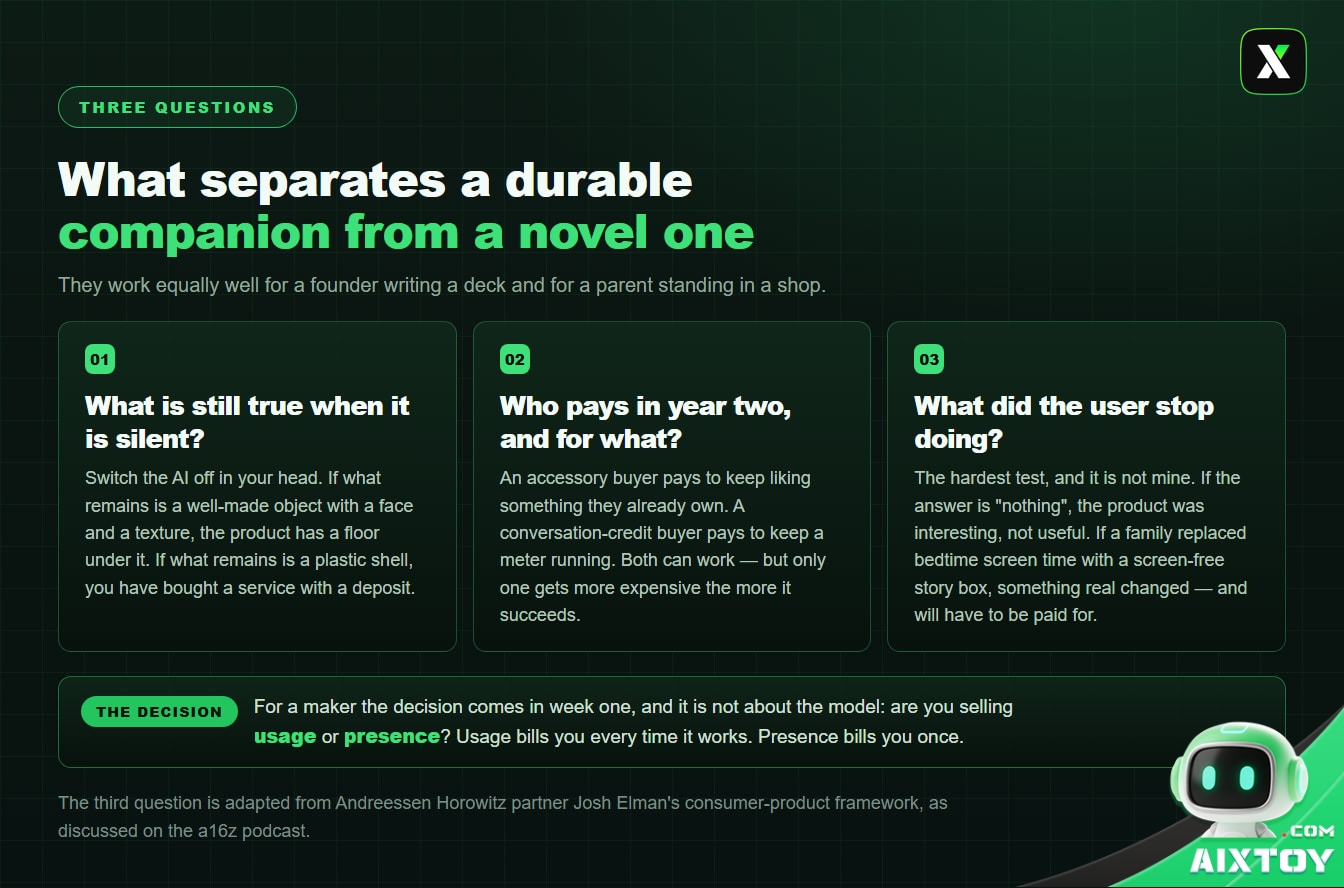
Which leaves three questions that separate a durable companion product from a novel one. They work equally well for a founder writing a deck and for a parent standing in a shop.
What is still true when it is silent? Switch the AI off in your head. If what remains is a well-made object with a face and a texture, the product has a floor under it. If what remains is a plastic shell, you have bought a service with a deposit.
Who pays in year two, and for what? An accessory buyer is paying to keep liking something they already own. A conversation-credit buyer is paying to keep a meter running. Both can work — but only one of them gets more expensive the more it succeeds.
What did the user stop doing? This is Elman’s own test, and it is the hardest one. If the answer is “nothing,” the product was interesting, not useful. If a family replaced bedtime screen time with a screen-free story box, something real changed — and something real will have to be paid for.
The AIXTOY take
Our catalogue is a fair sample of the question, because we stock both kinds of product.
The devices we would defend are the ones that are still worth owning when the server is quiet. Ropet is the clearest case: a plush that reacts, promises little, and has now held its owners for close to a year at a return rate the rest of the category would envy. Sweekar makes the same argument physically — it grows from a 6.1-centimetre egg to a 7.1-centimetre adult across four life stages, so the change lives in the object, not only in the cloud. Story boxes like Luka sit at the content end: the thing you return for is a library, not a conversation. And there is a quiet signal in the fact that we stock a replacement charging dock for Ropet at all — spare parts are only worth manufacturing for products expected to outlive their warranty.
For a buyer, the test is short. Buy the thing that is still a thing when it is not talking.
For anyone building in this category, the decision comes in week one and it is not about the model. It is whether you are selling usage or presence. Usage bills you every time it works. Presence bills you once. The first is a metered utility with a plush cover on it; the second is a toy that happens to notice you. Both can be good products. Only one of them gets cheaper as it gets better loved.
Quick answers
Is 300,000 units a lot? It is a real number and a weak proof. Both Ropet and Fuzozo have demonstrated that people will pay for a companion that behaves well. Neither has yet shown that they will still be paying in year three, and in this category that is the only question that ends the argument.
Why is Ropet’s return rate so much lower than the category’s? Because it asks for less. A device that never claimed to walk, teach or answer is not judged on whether it can. Low promises are cheap to keep, and the return rate is where that shows up first.
Does an AI companion need a subscription? No — but if it does not have one, the company is either funding the inference itself or keeping inference cheap enough not to matter. Both are valid; only the second is durable. Look for products that behave well without a network connection, and you have found the second.
Will these replace human company? No. The useful framing from the industry is that being physically present solves how the device arrives in your life; it is emotional presence that decides how the two of you get along. That is a much smaller claim than companionship — and it is the only version of the claim that survives a child growing up.
What is the single number to watch? Not units. Watch whether the average selling price in this category stops falling. A market where volume doubles while revenue grows half as fast is a market paying for its own growth. The moment price stabilises, the category has found something people want rather than something they can afford to try.
Tags:AI Companion RobotsAI Toy IndustryCompanion Robot BusinessRetentionRopetFuzozobiboAI HardwareToken CostsAI Toy MarketProduct StrategyAIXTOY